Last month, I asked a small business owner a simple question: "How do your customers find you?"
He said, "Google." Then he paused, checked his phone, and corrected himself. His last three customers had come from a WhatsApp forward, a Google Maps listing, and ChatGPT. None of them had typed his website address. None had scrolled through a list of blue links the way we were trained to expect.
That pause is the story of marketing in 2026. The front door is still there, but people are coming in through the windows.
What That Little Chrome Prompt Actually Taught Us
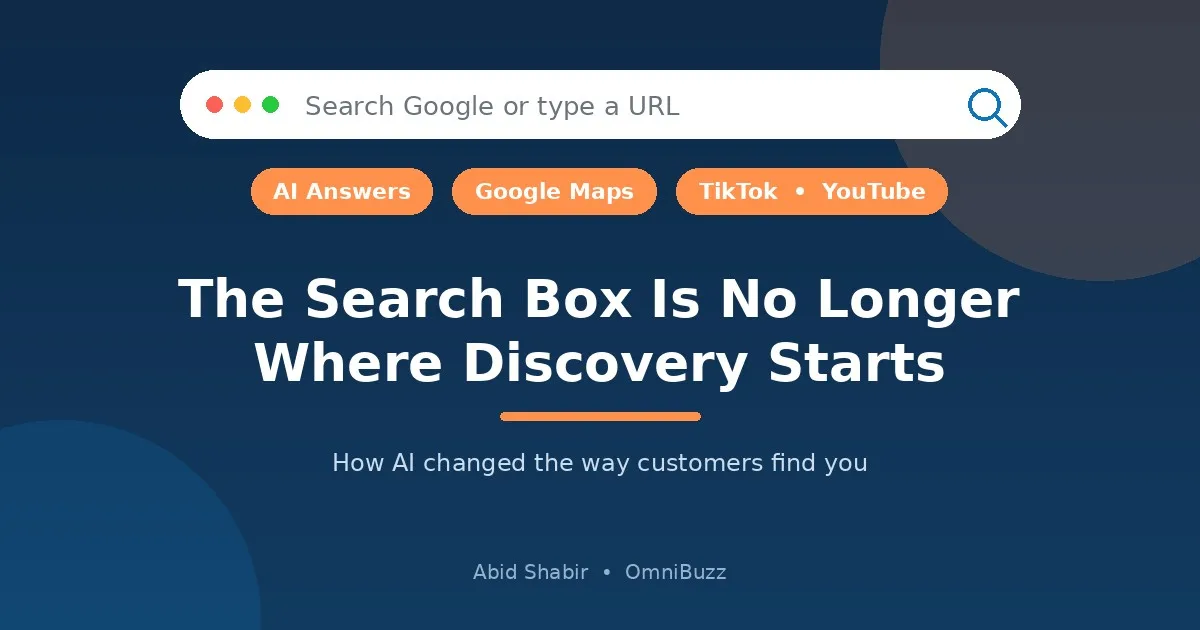
For almost two decades, Chrome taught the internet one habit. Open a tab, and you get a single instruction: Search Google or Type a URL.
It sounds trivial, but that one box merged two very different behaviours into one place.
The first was navigational. You already knew where you wanted to go — your bank, a news site, a tool you use every day — so you typed it directly.
The second was exploratory. You had a problem, not a destination. You typed words and hoped Google would figure out the destination for you.
Good SEO was built for the second behaviour. Find the query, match the intent, earn the click. That model still matters, but it no longer describes the whole journey. Treating it as if it does is where most small teams are quietly losing traffic without understanding why.
Three Places People Actually Start Now
1. They ask an AI a complete question
People do not talk to AI tools the way they talked to Google in 2015. They do not type "best bus route toronto." They ask, "I land in Toronto at 9 pm with two bags, what is the cheapest safe way to downtown?"
That is not a keyword. It is a brief.
Google itself has leaned into this shift with AI Overviews and AI Mode, summarising answers instead of only listing pages. You can read Google's own explanation of how generative AI is changing Search on its Search blog. Whether you like the change or not, the implication is the same: being the best answer is not enough if your content cannot be extracted, summarised, and trusted by a system doing the reading first.
2. They search inside a platform, not on the web
A second change is less discussed because it does not happen on Google at all. People search TikTok for a restaurant review, YouTube for a fix, Maps for "near me," and Instagram for proof that a bakery's cakes look as good in real life as they do in photos.
Each platform is its own search engine, with its own rules for what counts as helpful. A business that is perfectly optimised for Google but invisible everywhere else looks, to a younger customer, like it does not exist.
3. They tap instead of typing
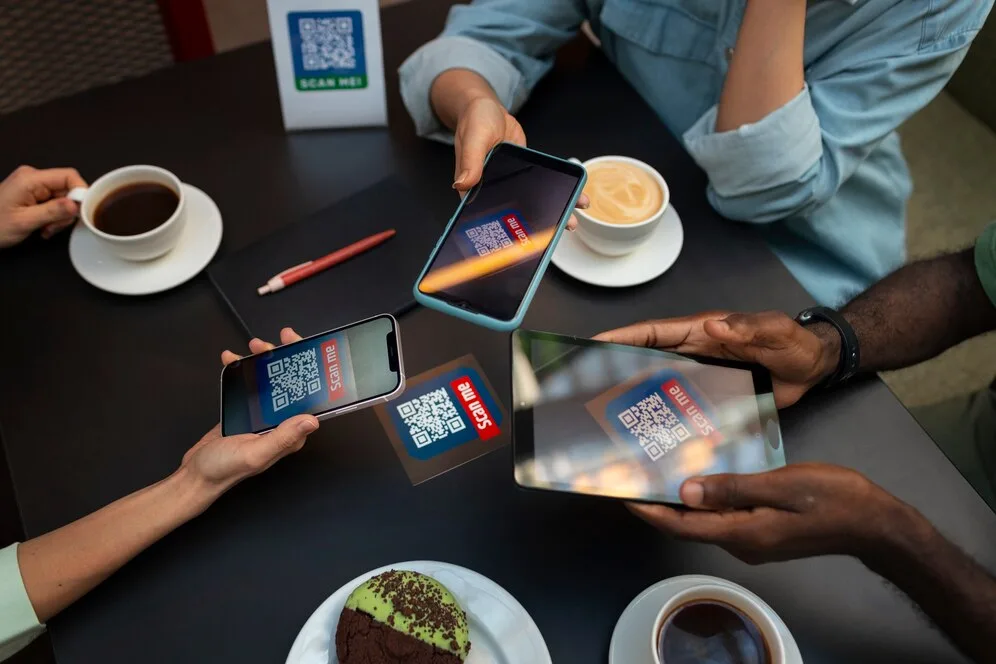
Autofill, saved passwords, history suggestions, voice search, and QR codes have removed typing from the journey. Discovery is often a tap on a suggestion that appeared before the person finished their thought.
That puts more weight on a factor marketers undervalue: being remembered. If someone has to be reminded you exist by an algorithm every time, you do not have an audience. You have rented reach.
What This Breaks in Traditional Marketing
The obvious counter-argument is that SEO experts declare SEO dead every year, and every year Google still sends enormous traffic. That is true. I still do keyword research. I still fix headings, internal links, and page speed, because a broken site will not rank anywhere, including in AI answers that cite real pages.
What has broken is not SEO. What has broken is the single-channel assumption behind it.
Three things follow from that.
First, zero-click is no longer an edge case. If an AI summary or a Maps pack answers the question, the click may never happen, even if you influenced the decision. Measuring success only by sessions will make good work look like failure.
Second, mentions matter almost as much as links. An AI system building an answer pulls from reviews, forums, videos, listings, and articles that talk about you consistently. If those sources disagree on your name, location, or what you actually offer, you become hard to recommend with confidence.
Third, thin content has nowhere to hide. A page written only to contain a keyword gives an AI nothing distinctive to quote and a human nothing distinctive to remember. It fails both audiences at once.
What I Changed in My Own Work
I work in SEO, so I felt this shift in my reporting before I had language for it. Pages were ranking, impressions were holding, but clicks and enquiries were moving in ways rankings alone could not explain. Here is what I changed.
I start with the question behind the query
Instead of opening a keyword tool first, I write down the actual sentence a customer would say out loud. Then I check whether the page answers that sentence in the first few paragraphs, plainly, without forcing the reader to hunt.
If it does not, no amount of optimisation further down the page fixes it.
I use AI for research, not for replacement writing
This is where AI Powered Marketing has to mean something more useful than generating 50 blog posts in an afternoon.
Used well, AI is good at the boring, valuable work: clustering search terms by intent, spotting gaps between what competitors cover and what customers actually ask, summarising reviews to find repeated complaints, and turning one solid piece of research into formats for different platforms.
Used badly, it produces exactly the kind of interchangeable content OmniBuzz and every serious publication are now screening out. The tool is not the strategy. The judgement about what is worth saying still has to come from a person who has done the work.
I build every important page to be quoted
That means clear headings, short paragraphs, a direct answer near the top, and evidence underneath it — data, an example, or a source. Not because a machine demands a format, but because both a busy reader and an AI summarising your page need the same thing: structure they can trust quickly.
I track more than clicks
Alongside rankings and traffic, I now watch branded searches, Maps actions, direct visits, and how often a business is mentioned in the places its customers actually talk. None of those metrics is perfect alone. Together, they show whether discovery is getting stronger, even when the click moves somewhere else.
A Simple Test Before You Publish Anything
Before you publish your next article, product page, or video, ask three questions.
One, if someone never visited your site and only saw an AI summary of this page, would they understand what makes you different?
Two, if a friend had to recommend you from memory, is there one clear sentence in here they could repeat?
Three, does this page contain something you learned first-hand — a mistake, a result, a decision — that a competitor could not copy by rewriting your headings?
If the answer to all three is no, the page is not ready. Not for Google, not for AI, and not for a human.
The Takeaway
People have not stopped searching. They have stopped searching in only one place, in only one way.
The businesses that adapt will not be the ones that chase every new tool. They will be the ones that make themselves easy to find, easy to understand, and easy to quote — wherever the question is asked.
Start with one page this week. Read it as if you were the AI trying to summarise it and the customer trying to decide in 30 seconds. Fix what confuses both. That single exercise will teach you more about modern discovery than another month of staring at keyword volumes.