The Growing Need for Precise Underground Work
Modern infrastructure depends heavily on underground systems. Water pipelines, electrical conduits, internet cables, drainage routes, irrigation networks, and solar connections are all commonly placed below the surface for protection, safety, and a cleaner site layout.
However, installing these systems requires more than simply digging into the ground. Contractors must create trenches that follow a planned route, provide adequate depth, avoid unnecessary soil disruption, and allow cables or pipes to be placed correctly. The quality of trenching can influence the speed, appearance, safety, and long-term maintenance of the entire installation.
For smaller sites and precision-focused work, compact trenching machines are becoming an increasingly practical choice.
Why Manual Digging Is Not Always Efficient
Manual excavation remains common for small projects, but it can become inefficient when the trench needs to run across a large area. Digging by hand requires time, labour, and close supervision to maintain a consistent depth and width. It may also lead to uneven channels that require additional work before pipes or cables can be installed.
At the other end of the scale, heavy excavators are not always suitable. Large machines require more space to move, may disturb a wider area of ground, and can be difficult to operate near buildings, boundary walls, gardens, crop rows, or existing infrastructure.
Compact trenchers fill the gap between these two approaches. They are intended for work that requires mobility and controlled trenching without bringing oversized equipment onto the site.
How Walk-Behind Trenchers Support Project Teams
Walk-behind trenchers are designed to make narrow channels for underground installations. The operator guides the machine along the planned route, helping create a more defined and uniform trench than manual digging alone.
This type of equipment is useful for:
- Installing drip irrigation and sprinkler pipelines
- Preparing routes for water-supply lines
- Laying electrical cables and conduits
- Creating channels for telecom and fibre-optic networks
- Installing drainage connections
- Preparing earthing routes for electrical systems
- Supporting solar-project cable installation
- Completing landscaping and property-development work
By creating a trench that is closer to the required dimensions, teams can reduce excess excavation and make the installation stage more organised.
Agriculture and Water Management Applications
Agriculture is one of the important sectors where compact trenching equipment can provide practical value. Irrigation systems often require a network of pipes extending across fields, orchards, plantations, or protected cultivation areas. These pipes may need to be buried to protect them from weather exposure, field activity, and accidental damage.
A compact trencher can help farmers and irrigation contractors prepare channels for drip lines, sprinkler pipelines, and water-distribution systems. This can reduce the dependence on large manual labour teams, particularly where the route is long and consistent trench dimensions are needed.
Drainage management is another relevant application. In areas affected by excess water, trenches can support the installation of drainage pipes or channels that guide water away from selected zones. Better drainage planning can help protect crops, pathways, and structures from water accumulation.
Utility, Telecom, and Solar Installations
The demand for underground cable installation continues to grow as residential, commercial, industrial, telecom, and renewable-energy projects expand. Cable routes must be carefully prepared so that wiring remains protected and accessible for future maintenance.
For telecom work, compact trenching equipment can assist in preparing narrow routes for fibre-optic cables and communication ducts. In solar projects, trenching may be required for underground connections between solar panels, junction boxes, inverters, and control equipment.
Because these projects often involve working around existing structures or in restricted layouts, a walk-behind machine can be easier to handle than a large excavator. It gives project teams a way to complete focused trenching work while maintaining better site control.
Choosing the Right Compact Trencher
Selecting a trenching machine should begin with the requirements of the project. Users should assess the soil type, trench length, required depth, trench width, available access space, and the type of utility being installed. A machine that works well in open agricultural soil may need different operating conditions from one used in compact construction areas.
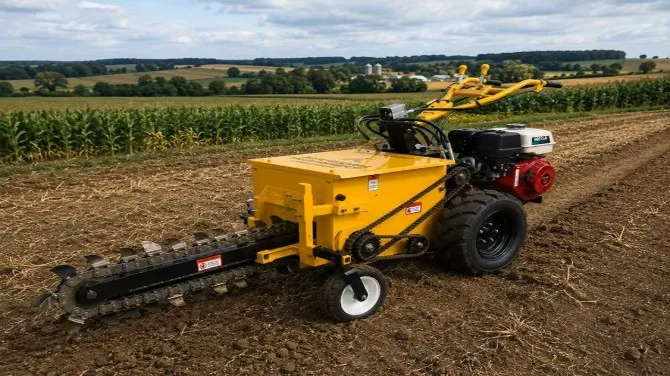
The Dhruva 100 is a self-propelled walk-behind mini trencher built for compact trenching applications. It can be used for irrigation lines, pipeline routes, cable installation, drainage work, landscaping, and utility projects. The machine provides adjustable trench widths of 120–200 mm and can trench up to 500 mm deep, offering flexibility for different installation requirements.