
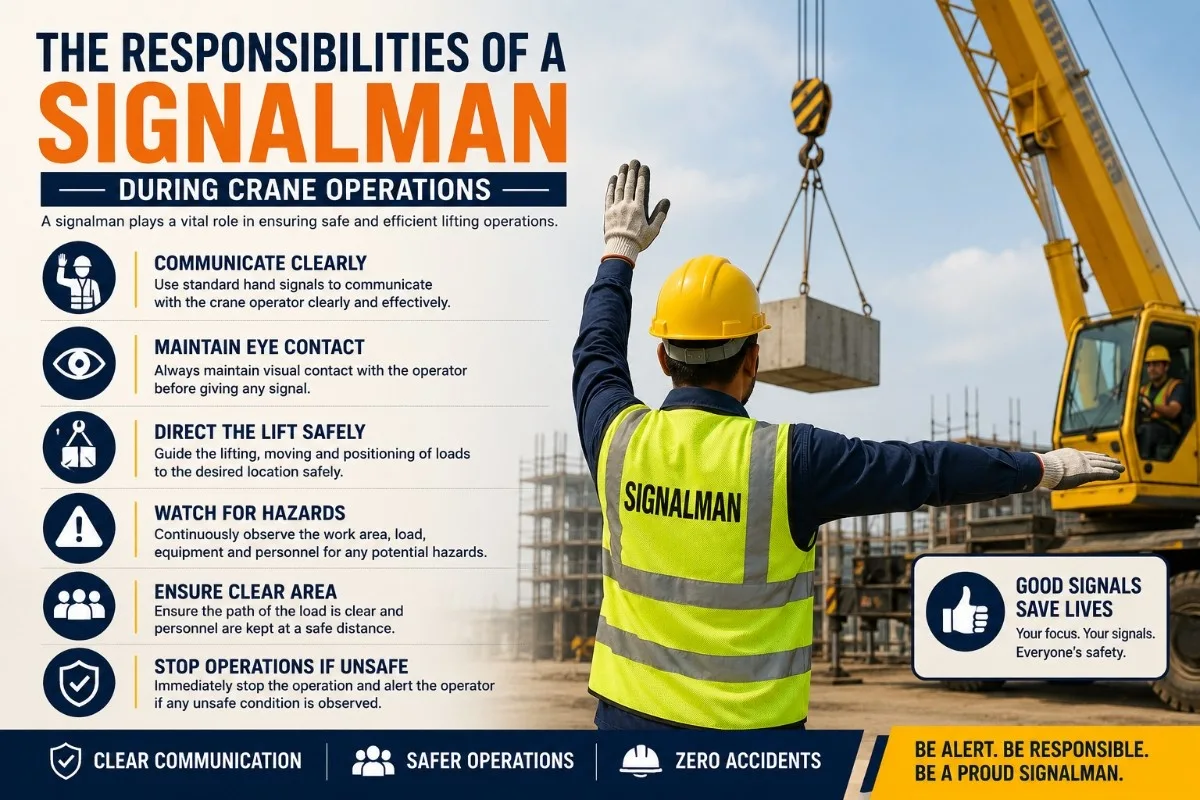
Crane operations are among the most vital activities that take place on construction sites, shipyards, manufacturing plants, and other industrial facilities. Although most lifting operations are controlled by the crane operator, the success of any lifting activity relies on effective coordination and communication.
It is the signalman who is responsible for directing the crane operator using hand signals or other approved means. In addition, the signalman oversees the lifting operation to guarantee safety and facilitate smooth lifting activities.
Who is a Signalman?
A signalman is a qualified professional who directs crane operations when the view of the operator is limited or additional guidance is needed. A signalman acts as the ‘eyes’ of the crane operator on the ground and guides them throughout the lifting process.
The signalman collaborates with the crane operator, rigger, lifting supervisor, and other relevant personnel to ensure that all lifting activities take place safely and efficiently.
Responsibilities of a Signalman
A signalman has several duties to perform, including:
Guide Crane Operations
The primary responsibility of a signalman is to guide crane operations using hand signals or other approved means. The signalman should use clear signals to guide the crane operator. All signals should be easily understood and have specific meanings.
Good communication reduces the likelihood of accidents during lifting operations. The signalman should communicate effectively with the crane operator and other personnel on site. In case of poor communication, the signalman should halt lifting activities until there is a clear communication link.
Monitor the Lifting Zone
Before and during lifting operations, the signalman should observe the lifting zone to identify and mitigate risks. The signalman should monitor the lifting area for:
• Workers entering the lifting zone
• Overhead power lines
• Nearby equipment
• Obstacles
• Zones that should be kept clear of workers
• Other hazards
The signalman should ensure that all lifting activities are carried out safely and without risks to workers and other people around the lifting site.
Ensure Smooth Load Movement
During lifting operations, the signalman should monitor the load movement to guarantee that the load is clear of overhead obstacles, maintains adequate distance from workers and other equipment, and swings within the designated area.
The signalman should also guide the operator throughout the lifting process and ensure that the load is moved safely from one point to another. In addition, the signalman should monitor the load to ensure that it does not collide with workers, equipment, or other overhead structures.
The signalman should also be alert to load behavior and ensure that all lifting activities are carried out safely.
Liaise With the Rigger
A signalman should liaise with the rigger to ensure that the load is rigged appropriately before lifting operations commence. The signalman should confirm that the slings, ropes, and other rigging gear are strong and suitable for the intended use.
In addition, the signalman should ensure that the lifting path is clear of obstacles and workers. The signalman should also confirm that the workers are at a safe distance from the lifting zone. This way, the signalman reduces the likelihood of accidents during lifting operations.
Conduct Pre-lifting Inspections
Even though lifting inspections are conducted by authorized personnel, the signalman should carry out a visual inspection to confirm that conditions are suitable for lifting.
A signalman should inspect lifting equipment, the lifting path, ground conditions, and other relevant factors before lifting operations commence. Some of the factors that the signalman should consider when carrying out pre-lifting inspections include:
• Stable ground
• Safe lifting path
• Safe working conditions
• Appropriate working environment
• Clear lifting path
• Suitable ground conditions
• No overhead hazards
• Suitable lighting in the lifting zone
If the signalman identifies any concerns, they should report them before lifting operations commence.
Use Standard Hand Signals
The signalman should use standard hand signals to guide crane operations. Hand signals such as hoist, lower, stop, swing left, swing right, boom up, boom down, and emergency stop should be used consistently.
Standard hand signals enable the signalman and crane operator to understand each other clearly, especially when communication is limited.
Be Alert and Pay Attention
A signalman should remain alert and pay attention throughout lifting operations. They should monitor load movement, lifting activities, the crane, and the lifting zone throughout the lifting process.
It is the responsibility of the signalman to ensure that lifting activities are carried out safely and efficiently. As such, the signalman should remain focused and pay attention to all activities throughout the lifting operations.
Halt Unsafe Activities and Procedures
The safety of workers should be the primary concern of a signalman. As such, a signalman should halt lifting activities immediately if they identify unsafe activities or conditions, including the following:
• Inadequate ground conditions
• Poor communication
• Poor working conditions
• Unstable load
• Unidentified hazards
• Poor weather conditions
• Equipment failure
• Insecure load
The signalman should halt lifting operations if there is a risk of damage to the crane, equipment, or workers.
Skills Required for a Signalman
A competent signalman should have a combination of soft skills and technical know-how. Some of the skills that a signalman should possess include:
• Excellent communication skills
• Good lifting knowledge
• Crane operating knowledge
• Hazard identification skills
• Observation and scanning skills
• Quick decision-making skills
• Teamwork skills
• Situational awareness
• Safety awareness
ConclusionA signalman is a key member of any lifting team, as they facilitate smooth and safe lifting operations. From the duties and responsibilities discussed above, it is evident that a signalman has various roles to play before, during, and after lifting operations. As such, signalmen should have the appropriate skills and technical know-how to perform their duties efficiently.
Lifting activities are among the most hazardous activities that take place on a construction site. As such, it is critical for signalmen to acquire the relevant skills and experience to ensure that lifting activities are carried out safely. All workers who are involved in lifting activities should consider enrolling in the WSQ Perform Rigger and Signalman Task (PRST) course to gain the requisite knowledge and skills to support safe lifting operations in Singapore.