What Orange County Residents Need to Understand About Body Composition, Metabolism, and the Expert Guidance That Makes the Difference
There is a frustrating gap that exists in the fat loss conversation — and it lives squarely between what people are told will work and what the science actually shows. Magazine covers promise results in thirty days. Social media feeds deliver an endless stream of transformation photos that compress months of disciplined work into a single compelling image. Supplement companies speak in the language of certainty about products that deliver, at best, marginal effects in controlled laboratory settings.
Meanwhile, millions of genuinely motivated people follow the advice, put in the effort, and end up exactly where they started — or worse, caught in a cycle of temporary progress followed by frustrating reversal. The problem is almost never effort. The problem is almost always understanding.
Fat loss is a physiological process governed by principles that are well understood by exercise scientists and nutrition researchers. It is not a mystery. But it is also not as simple as "eat less, move more" — a reductionist framework that ignores hormonal regulation, metabolic adaptation, muscle preservation, individual variability, and the behavioral psychology that determines whether any strategy can be sustained long enough to produce lasting results.
Understanding how fat loss actually works — and finding the right professional to guide you through it — is the starting point that most people skip entirely.
Why Fat Loss and Weight Loss Are Not the Same Thing
One of the most important distinctions in fitness that rarely gets explained clearly enough is the difference between losing weight and losing fat. They sound synonymous, and in casual conversation they are often treated as such. Physiologically, they are meaningfully different — and confusing them leads to strategies that undermine long-term success.
Weight loss is simply a reduction in the number on the scale. That number can decrease because you've lost fat, but it can also decrease because you've lost water, lost muscle tissue, or reduced the content of your digestive tract. Many popular diets produce rapid initial weight loss that is almost entirely water and glycogen depletion — creating a dramatic early result that reverses quickly when normal eating resumes.
Fat loss specifically refers to a reduction in adipose tissue — the stored body fat that, in excess, drives the health and aesthetic concerns that motivate most people to seek change. Genuine fat loss, particularly when combined with muscle preservation or muscle gain, produces changes in body composition that are more dramatic visually, more significant medically, and more durable over time than scale weight reduction alone.
Achieving true fat loss rather than generalized weight loss requires a training approach that preserves or builds lean muscle mass while creating the caloric conditions that force the body to draw on stored fat for energy. This is not complicated in principle, but it requires programming discipline, nutritional precision, and the kind of individualized approach that generic programs routinely fail to deliver.
The Metabolic Reality That Derails Most Programs
Here is something that the diet industry has a financial incentive not to tell you clearly: severe caloric restriction is one of the most reliable ways to make long-term fat loss harder.
When caloric intake drops dramatically, the body responds with a suite of metabolic adaptations designed to protect fat stores. Resting metabolic rate decreases. Thyroid hormone output shifts. Muscle tissue becomes a preferred fuel source, reducing the lean mass that drives long-term calorie burning. Hunger hormones intensify while satiety hormones diminish — making the willpower required to maintain restriction increasingly unsustainable over time.
This is why the person who loses twenty pounds on an aggressive diet often regains twenty-five within a year. It is not a personal failure. It is a predictable physiological response to an approach that works against the body's adaptive mechanisms rather than with them.
An evidence-based fat loss strategy works differently. It creates a modest, sustainable caloric deficit rather than a dramatic one. It prioritizes resistance training to preserve and build muscle tissue, maintaining metabolic rate while the body draws on fat stores. It manages training volume and recovery carefully to avoid the hormonal stress responses that trigger adaptive metabolism. And it builds nutritional habits that can be maintained indefinitely — not endured temporarily.
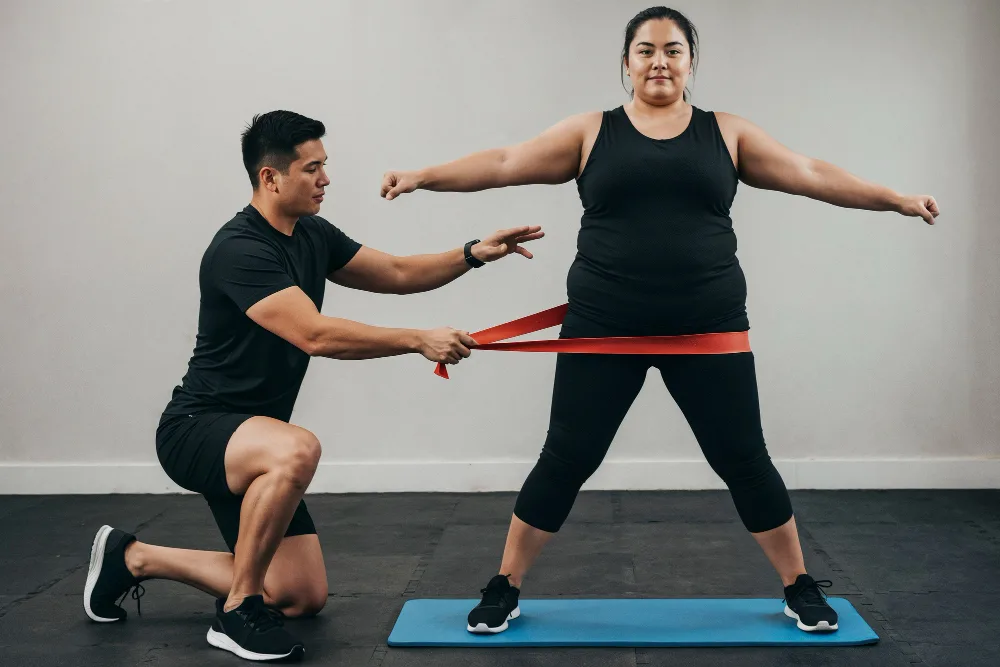
This is precisely why the expertise of a qualified fat loss trainer in Orange County is not a luxury for people who are serious about changing their body composition. It is the practical mechanism through which these principles get applied correctly to a specific individual's physiology, schedule, and lifestyle — producing results that last rather than results that reverse.
What a Qualified Fat Loss Specialist Actually Looks Like
Not every personal trainer is equally equipped to guide fat loss. The field of body composition change requires specific knowledge that goes beyond general fitness programming — understanding of energy balance, hormonal influences on fat storage and mobilization, the relationship between resistance training and metabolic rate, and the nutritional strategies that support fat loss without triggering adaptive responses.
When evaluating trainers for fat loss specifically, look for professionals who can speak fluently about these mechanisms. Ask them to explain their approach to creating a caloric deficit. Ask how they balance cardiovascular training with resistance work for a client whose primary goal is fat loss. Ask how they adjust programming when a client hits a plateau. The quality and depth of their answers will tell you a great deal about whether their knowledge base is genuinely sufficient for the work you're asking them to do.
Credentials from respected organizations — NASM, ACE, NSCA, or equivalent — provide a verified baseline of competence. Additional specialization certifications in nutrition coaching, sports nutrition, or body composition are meaningful signals of focused expertise in this area. Experience with clients who have achieved documented, sustained fat loss results is perhaps the most compelling evidence of all.
Equally important is the trainer's approach to behavior and lifestyle. Fat loss that lasts requires habit change that lasts — and habit change is a behavioral challenge as much as a physical one. A trainer who understands the psychology of habit formation, who structures accountability effectively, and who helps clients build a sustainable relationship with food and exercise rather than an adversarial one is a trainer who produces durable results rather than impressive short-term numbers.
The Role of Resistance Training in Fat Loss
There is a persistent misconception — particularly prevalent in the marketing around popular cardio-based fitness programs — that the path to fat loss runs exclusively through cardiovascular exercise. Long runs, cycling classes, high-intensity interval training: these approaches get positioned as the primary tools for burning fat, with resistance training treated as optional or secondary.
The research tells a more nuanced story. While cardiovascular exercise absolutely contributes to caloric expenditure and cardiovascular health, resistance training plays an equally — and in some contexts more — important role in sustainable fat loss. Here's why.
Muscle tissue is metabolically active. Every pound of lean muscle you carry increases your resting metabolic rate — the calories your body burns at rest, simply to maintain itself. A body composition shift that involves simultaneously reducing fat and increasing lean muscle results in a higher baseline calorie burn that supports fat maintenance over time. This is the physiological foundation of why people who build muscle keep weight off more effectively than people who lose weight without building muscle.
Resistance training also produces an extended post-exercise oxygen consumption effect — sometimes called the "afterburn" — that continues elevating calorie expenditure for hours after the training session ends. Combined with a well-designed cardiovascular component, a resistance-training-centered program produces superior long-term fat loss outcomes for most people compared to cardio-focused approaches alone.
Nutrition, Recovery, and the Complete Picture
Exercise is one pillar of a successful fat loss program. Nutrition is the other — and in the caloric equation, it is typically the more powerful one. The phrase "you can't out-train a bad diet" has become a cliché precisely because it is overwhelmingly supported by evidence.
A qualified trainer who understands fat loss will address nutritional strategy as an integral part of your program — not as an afterthought or a referral to a separate professional. While trainers are not licensed dietitians and should not diagnose or treat medical nutritional conditions, evidence-based guidance on caloric targets, macronutrient distribution, meal timing, and the practical management of nutrition in a busy lifestyle is well within the scope of a knowledgeable fitness professional.
Recovery deserves equal attention. Sleep quality, stress management, and training volume all influence the hormonal environment that governs fat storage and mobilization. A trainer who addresses only the workout while ignoring these factors is working with an incomplete model — and their clients' results reflect that incompleteness.
The Coaching That Changes Everything
For Orange County residents who are ready to approach fat loss with the seriousness it deserves — guided by real science, genuine expertise, and a professional who builds the program around your specific body and life — Best Home Trainer delivers exactly that standard.
Bringing certified fat loss expertise directly to clients throughout Orange County in the convenience of their own homes, Best Home Trainer removes every barrier between you and the professional coaching that produces real, lasting body composition change. No commute. No crowded gym floor. Just focused, expert guidance applied to your goals, your schedule, and your physiology — every single session.
The science is clear. The approach is proven. The only variable left is the decision to start.
Connect with Best Home Trainer today and take the first step toward the body composition results you've been working toward.