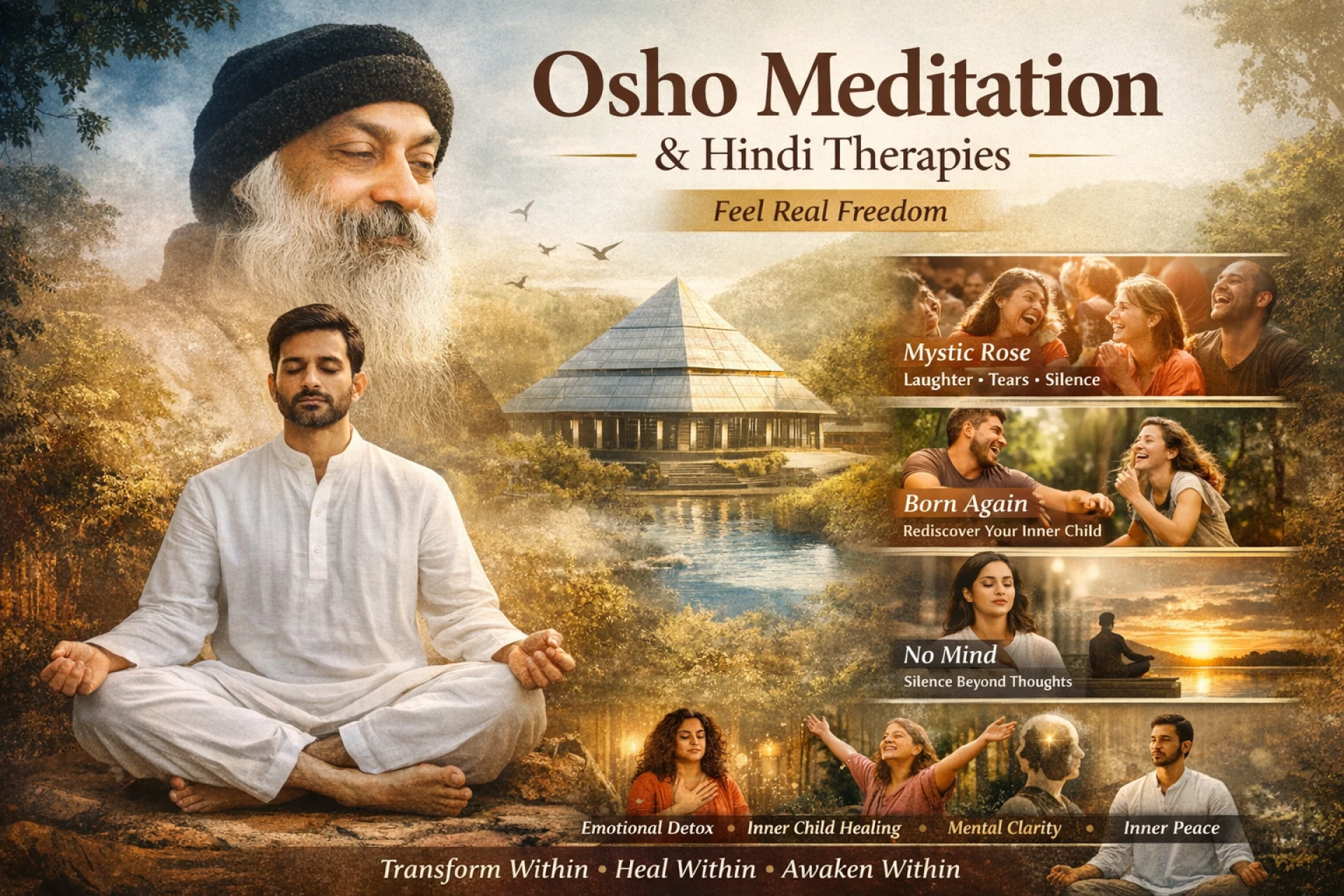
There’s a clear difference between feeling relaxed and actually feeling free. Relaxation is temporary. Freedom is transformative and that deeper shift is exactly where Osho’s meditative therapies begin.
When you explore programs offered through an Osho Meditation Center, you quickly understand — this isn’t about simply sitting cross-legged with closed eyes. Yeh sirf shanti ka surface-level concept nahi hai. It goes beyond calmness. It focuses on emotional detoxification, mental decluttering, and a deep psychological cleansing that most of us didn’t even realize we were longing for.
Let’s understand this honestly, without exaggeration.
Meditation — But Not the Way You’ve Been Told
Many people try meditation and say,
“Mera mind hi shut nahi hota.”
The frustration is valid and the modern mind is overstimulated. We carry unresolved emotions, unfinished conversations, suppressed anger, silent disappointments, and chronic overthinking. Expecting instant silence in such a state is unrealistic.
Osho’s approach acknowledges this reality. Instead of forcing stillness, these therapies begin by addressing the emotional turbulence first — jo hum saalon se andar accumulate karte rehte hain. Only after emotional release does genuine stillness emerge.
That’s why Osho Meditation follows a structured progression.
First release. Then awareness. First cleansing. Then witnessing.
The Three Core Meditative Therapies
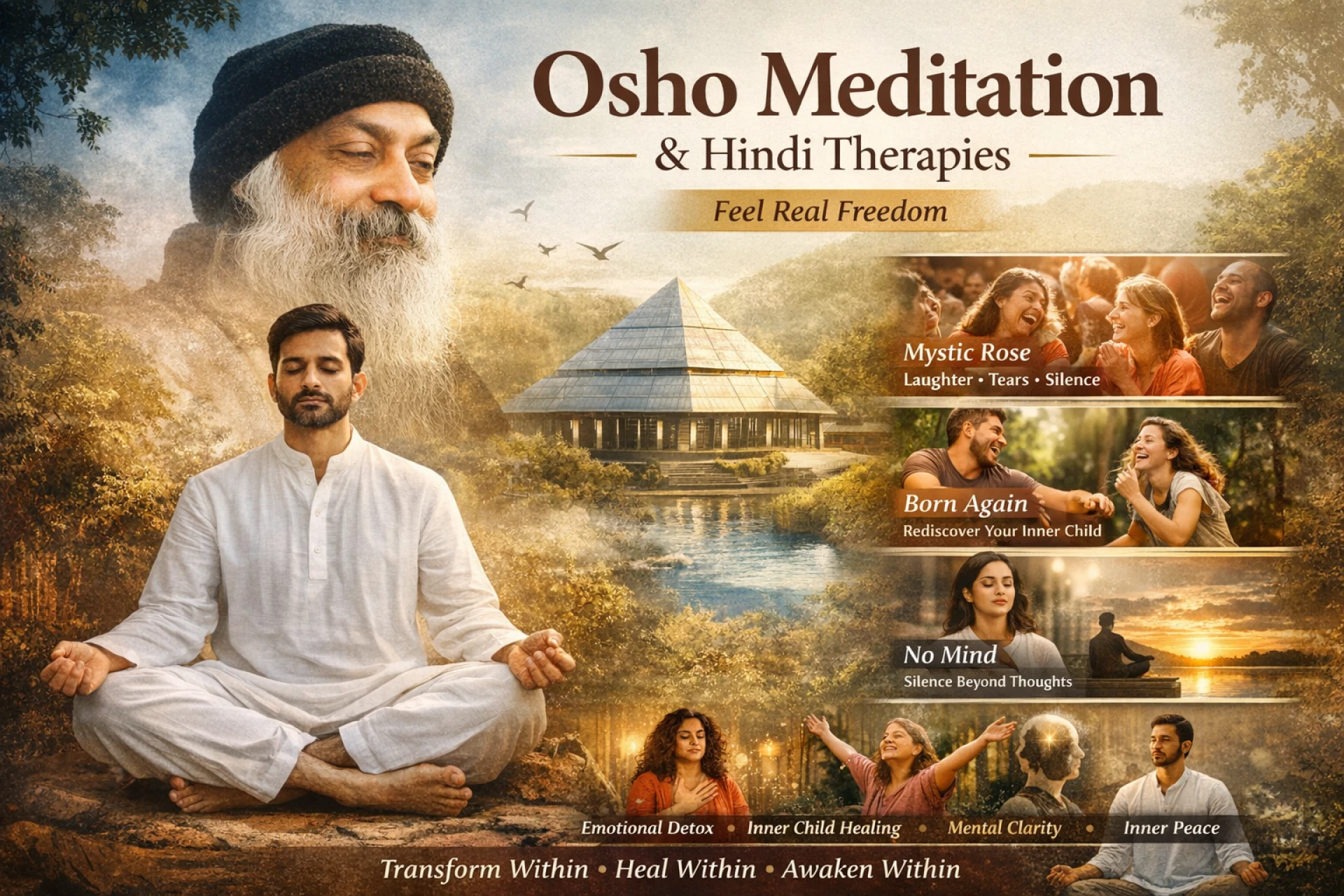
1. Mystic Rose – Laughter, Tears & Silence
This is a three-week immersive process designed with psychological precision.
- Week 1: Intentional, cathartic laughter
- Week 2: Allowing suppressed emotions to surface
- Week 3: Silent witnessing and observation
At first glance, it may sound unconventional. But the logic is powerful. Laughter softens the emotional armor. Emotional expression clears inner congestion. Silence then becomes effortless rather than forced.
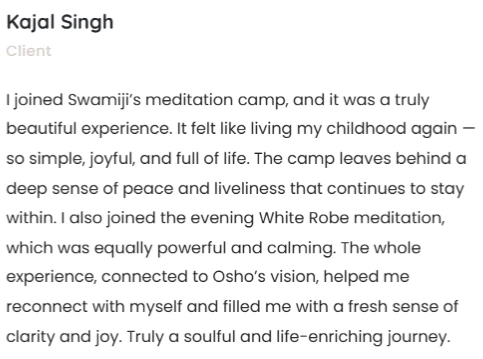
Our participant Kajal Singh shared that after completing the laughter phase, she felt “lighter than she had in years.” Her experience wasn’t about artificial happiness; it was about emotional unloading — a subtle but profound relief.
Duration: 3 Weeks
Format: Daily sessions (usually 2–3 hours per day)
Focus: Emotional cleansing → Inner silence
Week 1: Laughter Phase
This is not casual laughing. It is structured, intentional laughter. At first, it may feel artificial. But gradually, something shifts. The body starts releasing stored tension. Laughter becomes spontaneous. Many participants report:
- Lightness in the chest area
- Reduced physical stiffness
- Unexpected emotional release
- Improved sleep quality
By the end of Week 1, emotional armor begins to soften. The nervous system relaxes naturally.
Week 2: Emotional Expression (Tears Phase)
Once the emotional layer is softened, suppressed feelings surface.
This week allows:
- Unexpressed sadness
- Past disappointments
- Old anger or hurt
- Emotional fatigue
Participants are encouraged to allow emotions without suppression or analysis.
Common week-end observations include:
- Emotional clarity
- Reduced internal heaviness
- Greater self-acceptance
- Increased emotional maturity
Instead of being reactive, individuals start becoming aware of their patterns.
Week 3: Silent Witnessing
After laughter and emotional release, silence feels different. It is no longer forced.
This week focuses on:
- Deep sitting meditation
- Awareness of breath and body
- Observing thoughts without attachment
Participants often report:
- Natural stillness
- Slower thought patterns
- Heightened awareness
- Inner stability
Silence becomes effortless because the internal clutter has reduced.
2. Born Again – Returning to Simplicity
This therapy focuses on deconditioning. From childhood, we absorb expectations — how to behave, how to succeed, how to appear strong.
Born Again gently removes that pressure. No performance. No judgment. Bas presence.
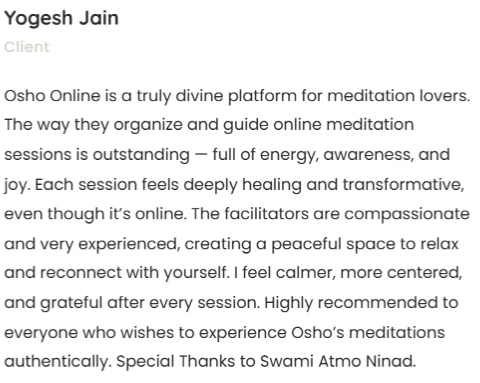
Participants often describe it as reconnecting with spontaneity and natural joy. Yogesh Jain mentioned that even attending sessions online did not dilute the depth of the process. He observed that he became less reactive and more emotionally balanced in daily interactions.
In a culture obsessed with productivity and comparison, rediscovering simplicity is not a small achievement.
Duration: 7 Days
Format: Daily guided sessions
Focus: Deconditioning & Emotional Reset
This therapy is designed to reconnect you with spontaneity and innocence.
Days 1–3: Dropping Social Masks
Activities focus on:
- Free movement
- Expressive playfulness
- Letting go of self-image
Participants often notice:
- Reduced social anxiety
- Less need to impress
- More relaxed body language
Days 4–5: Emotional Cleansing
This phase gently brings up:
- Fear of judgment
- Childhood conditioning
- Performance pressure
Week observations:
- Increased emotional honesty
- Reduced internal comparison
- Better self-trust
Days 6–7: Integration & Awareness
The final days are about integrating simplicity with awareness.
Participants frequently report:
- Renewed enthusiasm
- Clearer communication
- More grounded energy
Instead of being driven by external validation, actions feel internally aligned.
3. No Mind – Dissolving Mental Overload
If overthinking feels like your default mode, this therapy directly addresses it, through structured sounds and guided processes, the constant internal dialogue gradually weakens. The aim is not to suppress thoughts but to transcend their dominance.
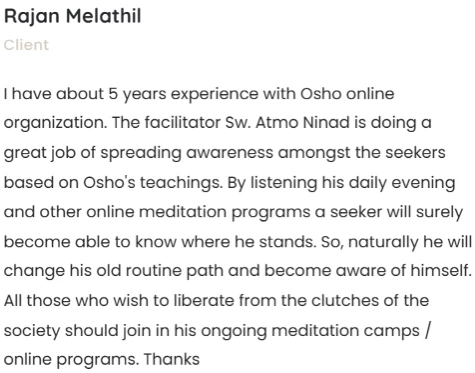
Rajan Melathil, associated with the community for several years, described his experience as “clarity replacing confusion.” That clarity reflects in decisions, relationships, and even professional life.
Duration: 7 Days
Format: Structured vocal and silent sessions
Focus: Breaking repetitive thought cycles
This therapy directly addresses overthinking and mental noise.
Days 1–2: Mental Exhaustion Phase
Through repetitive vocal sounds and guided processes, the mind’s habitual patterns begin weakening.
Common effects:
- Reduced mental speed
- Physical relaxation
- Temporary emotional fatigue (which is natural detox)
Days 3–5: Thought Pattern Dissolution
As repetition continues:
- Internal dialogue slows
- Self-criticism decreases
- Mind becomes less dominant
Participants often report clearer decision-making and better concentration.
Days 6–7: Silent Stability
The final phase moves toward silence and observation.
Outcomes frequently include:
- Deep inner quiet
- Sharper perception
- Emotional balance
- Calm responsiveness instead of impulsive reactions
When mental noise reduces, perception sharpens.
Why This Approach Feels Different
Traditional meditation often advises:
“Sit still. Observe your thoughts.”
But what if your nervous system is already overloaded?
Osho’s methodology recognizes that stress is stored in the body, and unresolved emotions live in the subconscious. Pehle unhe release karo. Phir meditation naturally deepens hoti hai. This preparatory work makes a significant difference. Instead of battling the mind, you prepare the ground for stillness.
Teachings available in Osho Hindi further bridge accessibility for seekers who connect more authentically through their native language. Spiritual growth should not feel distant or intellectual. It should feel intimate and relatable.
Who Can Benefit from This?
- Individuals feeling emotionally stuck
- Chronic overthinkers who cannot switch off
- Seekers who tried meditation but couldn’t go deeper
- Professionals experiencing burnout
- Anyone seeking clarity without rigid religious structures
This path does not demand belief. It invites experience.
Final Reflection
Meditation is not an escape from life. It is a deeper entry into it — without accumulated emotional baggage.
If your experience of meditation has only been momentarily calm, exploring structured Osho Meditation processes may reveal another dimension — one that unfolds gradually, layer by layer. Transformation does not always begin with silence.
Sometimes, it begins with courage — the courage to look within honestly.