The first thing you notice about Armstrong Creek is the light. After years of driving through older suburbs where mature trees canopy the streets, the openness here can feel almost startling. But look closer, and you realise that what appears at first glance to be a blank canvas is, in fact, a carefully composed landscape. The creek that gives the suburb its name has been preserved as a green spine, with wetlands, playgrounds and shared trails threading through each new neighbourhood. This is not sprawl. It is a deliberate, considered act of placemaking.
A Community Built on Connection
Armstrong Creek was conceived differently. Rather than allowing developers to parcel land arbitrarily, the Armstrong Creek Growth Area Plan set out a clear vision: a series of distinct neighbourhoods, each with its own identity, linked by a network of open space and connected to the Geelong CBD and Surf Coast via major roads. More than two decades after the first plans were drawn, that vision is now a lived reality for more than 18,000 residents.
What makes the suburb unusual is the prominence given to shared land. Across the growth area, parks are not afterthoughts squeezed between lots—they are the organising principles around which homes are arranged. The Horseshoe Bend Precinct, for example, incorporates wetland systems, sports fields, a community centre and a school site, ensuring that infrastructure keeps pace with new homes. The Forrest Green precinct was designed to be “sustainable, connected and community-focused”, with stormwater management systems that benefit the entire neighbourhood rather than simply servicing individual blocks.
Townhomes That Offer a Different Choice
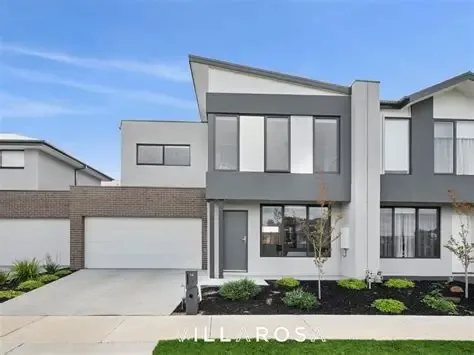
For a long time, new suburban developments offered a single option: a detached house on a block of land. Armstrong Creek is quietly changing that equation. The Harriott community, developed by Jinding in partnership with Nostra Homes, is delivering 164 townhomes on a site between Harkness Boulevard and Barwon Heads Road. The first 45 are already under construction, with each residence designed as a genuinely low‑maintenance alternative to the traditional house and land package.
What distinguishes Harriott is the range of layouts. Across the precinct, buyers can choose from 12 different configurations, from two to four bedrooms. Some have been designed with first-home buyers in mind, offering an accessible entry point into a growing community. Others suit downsizers who want to shed the upkeep of a large garden. A handful are sized for families who need extra bedrooms but prefer a lock‑and‑leave lifestyle. All sit within a two‑minute walk of The Village at Warralily shopping centre and less than 200 metres from a central park.
A Second Wave of Medium Density
The appetite for townhome living is not confined to a single development. A separate project at 690-716 Barwon Heads Road, designed by Tony Preiato & Associates, will add 37 further townhouses to the suburb’s housing mix. The designs have been crafted with an eye to the changing demographics of the area—residents who want the space of a house without the maintenance burden of a quarter‑acre block. For retirees who have spent decades tending gardens, for young professionals who travel frequently for work, and for couples who simply want to spend their weekends at the coast rather than in the backyard, these homes offer a different proposition: less maintenance, more life.
The Creek That Holds It All Together
The Armstrong Creek corridor itself remains the heart of the suburb. The linear park that follows the waterway has been planted with native species, and the shared trails are already worn smooth by the daily passage of joggers, dog walkers and families on bikes. Wetland systems manage stormwater while providing habitat for local birdlife, and strategically placed benches and picnic shelters invite residents to linger.
This is not the kind of parkland you find in older suburbs—hacked out of leftover space decades after the houses were built. It is infrastructure, designed from the beginning. And it works. Residents do not have to drive to find a place to walk. They step out their front door and within minutes they are on a trail, surrounded by native grasses and the sound of water.
A Blueprint Worth Repeating
Armstrong Creek is not finished growing. It is anticipated that the growth area will be fully developed over the next 10 to 25 years, depending on housing demand, but the framework has already proven itself. The combination of diverse housing types, integrated open space, and walkable access to shops and schools offers a model for how greenfield development might be done differently.
What is most striking, walking through the completed sections, is how settled it already feels. The parks are in use. The paths are worn. The townhomes at Harriott, still under construction, already seem to belong to the landscape. Armstrong Creek is not trying to imitate the inner suburbs. It is not trying to be a city. It is trying to be a good neighbourhood—one where the creek runs through the middle, where the shops are within walking distance, and where a townhouse can offer the same sense of home as a house on a quarter acre. That is a modest ambition, perhaps. But in an era of rushed development and broken promises, it is also a radical one.