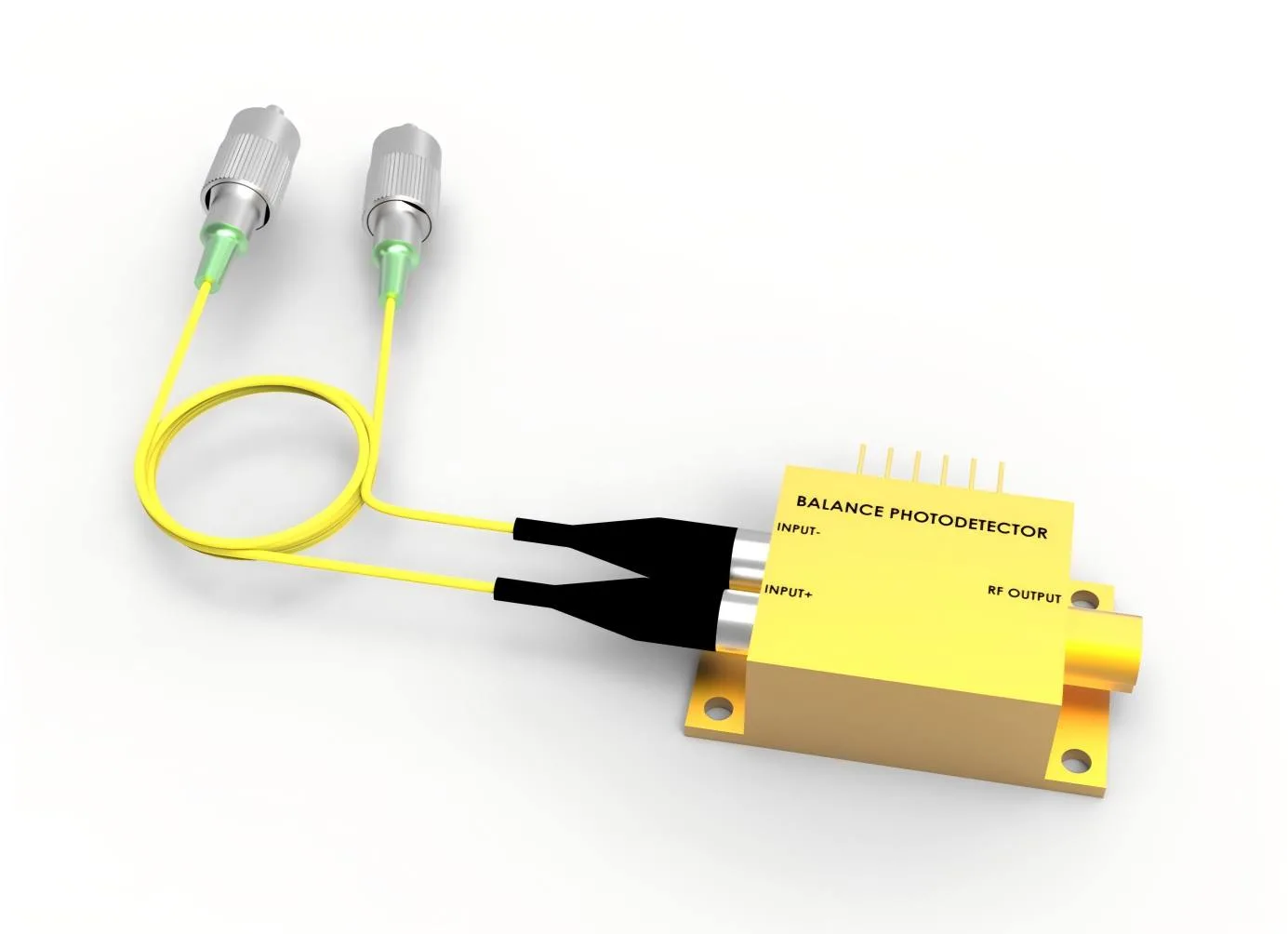
As the demand for higher sensitivity and spectral efficiency grows in applications like LiDAR, coherent optical communications, and microwave photonic signal processing, conventional single-ended detection architectures reach their fundamental limits. The primary challenge is often not the signal itself, but the accompanying noise, most notably the Relative Intensity Noise (RIN) from the laser source. A balanced photodetector offers an elegant and powerful solution to this challenge. By employing a differential architecture with two matched InGaAs photodetector elements, this specialized high speed photodetector can cancel common-mode noise, dramatically improve the signal-to-noise ratio (SNR), and unlock the potential of advanced coherent detection techniques.
The operating principle of a balanced photodetector is a direct application of common-mode rejection. The device has two optical inputs and one electrical output. Internally, two matched InGaAs photodetector chips are connected in series or via a differential transimpedance amplifier so that the output voltage or current is proportional to the difference between the two input optical powers: Iout∝P1−P2Iout∝P1−P2. Now, consider a scenario where both photodetectors receive the same noisy optical signal, perhaps from a laser split 50/50. The common intensity noise on the laser (the RIN) will be present on both P1P1 and P2P2. Because the balanced photodetector outputs the difference, this common noise is subtracted out, ideally to zero. Only the uncorrelated signals or differences remain. This is fundamentally impossible with a single-ended high speed photodetector, which would convert the noisy optical signal directly to a noisy electrical signal. The practical result is a receiver with significantly lower noise floor and higher dynamic range.
The most powerful application of a balanced photodetector is in coherent detection. In a coherent receiver, an incoming signal optical field (EsEs) is combined with a strong, local oscillator laser field (ELOELO) on a 2x2 optical coupler. The two outputs of the coupler are complementary: one is Es+ELOEs+ELO, the other is Es−ELOEs−ELO. When these two ports are connected to the two inputs of a high-speed balanced photodetector, the output current becomes proportional to the product Es⋅ELOEs⋅ELO, which is the coherent mixing term that contains the amplitude and phase information of the original signal. This differential detection scheme provides a massive 3 dB gain in SNR over single-ended detection because it utilizes both outputs of the coupler. Furthermore, it perfectly cancels the DC offset from the high-power local oscillator and suppresses the self-beating noise of the signal and LO, leaving only the desired mixing term. Without a balanced photodetector, coherent detection would be nearly impossible in practice due to the overwhelming DC and noise components.
NEON’s HPPD-Ku high-power InGaAs balanced photodetector exemplifies the engineering required for such demanding applications. This module is specifically designed for the Ku-band (0.8 to 18 GHz bandwidth), making it suitable for high-speed satellite communications and advanced radar systems. The core of the module is its two high-performance InGaAs photodetector chips, which are meticulously matched in terms of responsivity (≥0.85 A/W at 1310nm, ≥0.8 A/W at 1550nm), bandwidth, and phase response. The degree of this matching determines the Common Mode Rejection Ratio (CMRR), a key figure of merit. A high CMRR means the device is extremely effective at canceling noise. The HPPD-Ku also features an exceptionally high saturation optical power of +17 dBm and a burnout power of +20 dBm. This is crucial for balanced detection, as the local oscillator can be a very high-power optical signal. A standard high speed photodetector would saturate or be destroyed by such power, but the HPPD-Ku’s robust InGaAs design handles it with ease, all while maintaining its high-speed, balanced operation.
Beyond communications, balanced photodetectors are essential for applications like Optical Coherence Tomography (OCT) for medical imaging, where they detect the weak interferometric signal scattered from tissue against a bright reference arm reflection. They are also used in precision metrology and sensing. In summary, the balanced photodetector transcends the capabilities of a single-channel high speed photodetector. By leveraging two matched InGaAs photodetector elements in a differential configuration, it actively suppresses noise, cancels DC offsets, and enables the full performance potential of coherent and interferometric systems. For any engineer looking to build a receiver at the absolute limit of sensitivity and dynamic range, the balanced photodetector is not merely an option; it is an indispensable core technology.
The Power of the Balanced Photodetector in Coherent Systems