
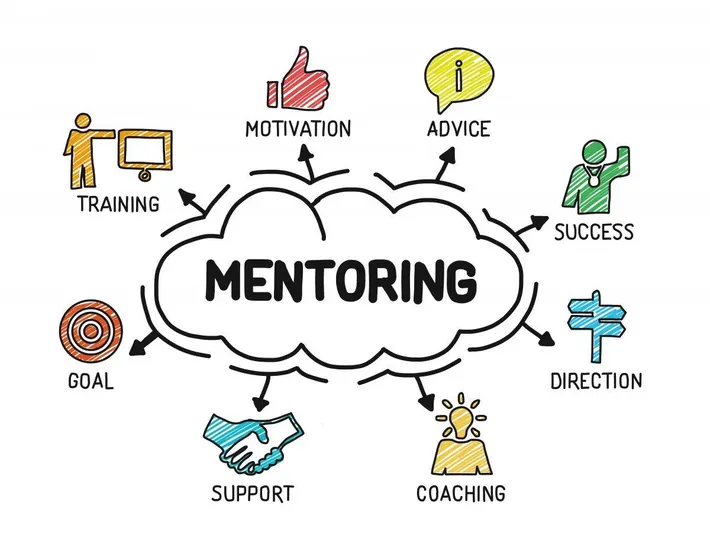
A successful individual is often surrounded by a mentor who has invested in him or her earlier than he/she invested in himself/herself. To a mentor is not merely an advisor, he is a guide, a motivator and one with whom one can trust in the path that leads him to success.
In a world where everyone knows everything but hardly anyone knows what to do with it, mentors offer the even better thing than advice, which is clarity, experience and perspective. They do not only instruct you on what to do but also assist you in finding out who you are and what you can become.
Who Is a Mentor?
A mentor is a mature person who guides, counsels, and motivates another person or an individual, referred to as a mentee, to achieve his or her potential. Mentorship is not control and teaching but empowering.
A mentor is unlike a teacher, who shares knowledge, or a manager, who supervises, he is a close friend of sorts, someone who can assist people as they face obstacles, make decisions, and discover their own selves and careers.
According to Nishant Verma, who is a mentor and an entrepreneur:
A mentor does not provide you with the answers. They make you have the courage to make your own.
The Real Truth behind Mentorship.
Mentorship can be summarized as being about three pillars:
Instruction: Providing experience based direction as opposed to instructions.
Empathy: Without being judgmental, realize the problems facing the mentee.
Motivation: To make the mentee believe in him/herself.
Great mentors do not make followers, they make leaders.
Why Mentorship Matters
Self-doubt is the greatest obstacle in the quest to achieve success. A mentor destroys such a wall through giving faith and responsibility.
This is why mentorship is an essential part of the modern world:
Accelerated Learning: Mentors assist mentees in acquiring knowledge through practical experiences, rather than experience.
Networking Opportunities: Mentors provide access to good working contacts.
Confidence Building: A mentor provides encouragement to self-esteem and decision-making.
Strategic Growth: Mentors assist the mentees to get down to business, which saves the time and energy.
Emotional Support: Mentorship also offers emotional stability in the hard times.
Simply put, mentorship transforms indecision to purpose and promise into fulfillment.
Types of Mentors
The process of every person is unique and so is mentorship. Mentors may be of different types depending on the field of recommendation:
Career Mentors: Lead people to professional success.
Business Mentors: provide advice to entrepreneurs regarding strategy, management, and growth.
Life Mentors: Assistance to enhance self-awareness, relationships and work-life balance.
Peer Mentors: Provide help to peers, with whom they have comparable experiences.
Spiritual/Personal Mentors: Concentrating on emotional and moral health.
Every form of mentor has its own role to play but all have the same mission which is to make other people grow.
The Mentora in Personal Development.
Self-development is not simply a matter of acquisition of skills but it is about the right attitude. A mentor makes you look over the fence, see your strengths and use weaknesses as opportunities.
This is the way in which mentors contribute to personal development:
They assist in establishing of realistic but challenging objectives.
They promote personal evaluation and life-long learning.
They offer feedback that is honest in order to promote improvement.
They develop responsibility and predictability of action.
Mentorship does not only assist in making mentees know more, but also to be more.
Business and Entrepreneurship Mentorship.
Mentorship is what can make or break in business world. Mentors are of great help to entrepreneurs, and new entrepreneurs in particular, who are already on the road.
A business mentor is a person who gives you real-life advice on how to lead, make risky decisions, plan and decide on finances, and do strategic planning. They exchange information that cannot be provided in any textbook or online course.
Mutual respect and transparency form a good mentor-mentee relationship. It also flourishes in the presence of open-mindedness to listen, learn and develop by both sides.
To the mentee, it is critical that he or she:
Be receptive to feedback.
Be proactive and accountable to development.
Give the mentor his time and experience.
For the mentor, it's vital to:
Promote self-reliance rather than dependence.
Present positive, sincere feedback.
Compliment the mentee and his/her progress and development.
Mentorship is a change partnership when endorsed on both sides.
The Characteristics of a Good Mentor.
Not all experienced persons can become mentors. It needs emotional intelligence and patience, as well as the true concern about the development of other people.
The major characteristics of an effective mentor are as follows:
Empathy: Without passing judgment.
Experience: Being able to share wisdom that is acquired in real life.
Communication: Listening than speaking.
Integrity: Leadership by example.
Purpose: To make mentees think long-term/act strategically.
The power of a mentor can be life long since what they say may end up becoming the voice in the head of the mentee to help him/her make decisions.
Mentorship in the digital age: The Future of Mentorship.
Mentorship has changed due to technology and the social media as a face-to-face interaction. Virtual communities, webinars, and mentorship On-line peer-to-peer mentoring over the Internet can enable individuals to access professionals worldwide.
This is a digital transformation that has rendered mentorship more accessible than ever. It is no longer limited by distance and time because mentors such as Nishant Verma can now meet and motivate thousands of people using podcasts, video sessions, or online programs.
Digital mentorship is defining the future generation of leaders - human connectivity and global accessibility.
How to Find the Right Mentor
The right mentor can turn your life and career on a new path. The following is the way to do it:
Know Your Goals: Be aware of what you are actually being directed.
Seek Visibility: Select a mentor who best appeals to your values and your experience.
Be Respectful: Be respectful and mindful of their time.
Remain Determined: Implement their feedback and demonstrate improvement.
Give Back: As you become, assist others - mentorship is most effective when it runs upwards.
Conclusion
A mentor is not only a guide - he is a source of growth. They can see the light where others can see the darkness and they open the way to the goal and prosperity.
Mentorship, in business, leadership and life, transforms uncertainty into clarity and confusion into understanding. An excellent mentor does not walk in front of you or behind you, but rather, he/she walks beside you.
As Nishant Verma wisely says:
A mentor has to empower future leaders and not to create followers because this is the true success of a mentor.
A mentor creates a focus in a busy world. When there is doubt, they give faith. And in each hour of development, they give you wisdom of life long duration.