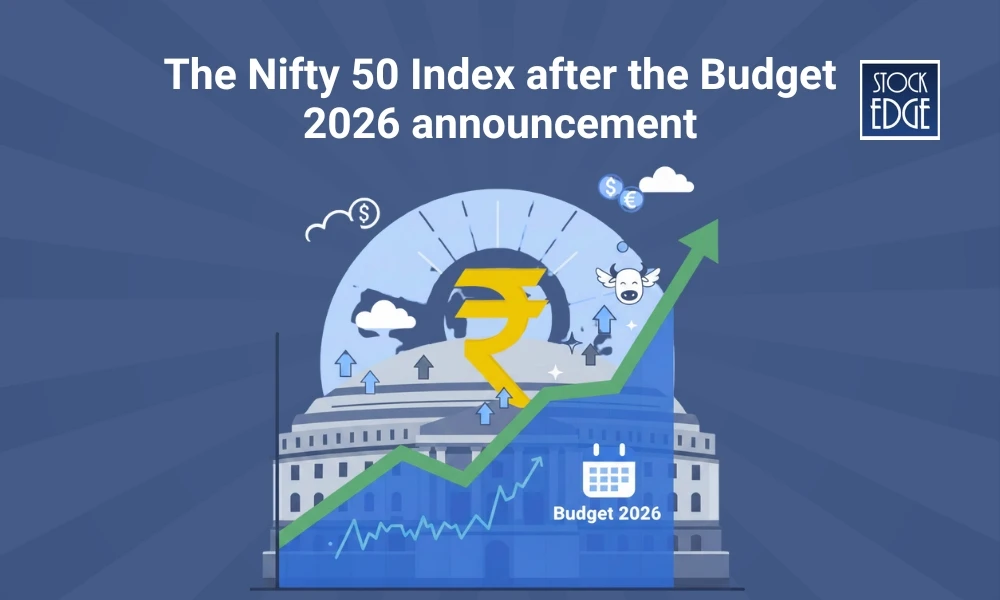
The Indian stock market saw major price movements on February 1, 2026, when Finance Minister Nirmala Sitharaman delivered the Union Budget 2026. The Nifty 50 index showed major price swings, starting with a sharp drop and then an exceptional recovery in the following market sessions.
Budget Day Sell-Off
The Nifty 50 share price crashed by 495 points, or 1.96%, closing at 24,825. This represented one of the steepest single-day declines on a budget day in recent years. The Nifty 50's performance today reflected widespread panic selling across sectors. The index reached its lowest point at 24 571, which created a temporary threat to the 24 500 support level.
The BSE Sensex dropped 1547 points, which resulted in a 1.88% decline that brought the index down to 80723. The Nifty Midcap 100 index experienced a 2.24% decrease, while the Nifty Smallcap 100 index fell by 2.73%. Fifteen out of sixteen major sectoral indices ended lower. Although defense stocks received higher budget funding, their prices declined, with Bharat Electronics finishing down 6.02%. The Nifty 50 market index recorded its highest trading activity of 869 points during the day, which marked its most extensive trading range since June 4, 2024.
Securities Transaction Tax Trigger
The market crash occurred because the Securities Transaction Tax for derivative trading experienced a major increase. The Finance Minister proposed raising STT on futures from 0.02% to 0.05%, which represents a 150% increase. The STT on options premiums experienced a 50% increase, which raised the tax rate from 0.10% to 0.15% and caused an immediate decline in trading activities.
Active traders and brokerage houses faced severe challenges from this announcement. The market experienced liquidity problems because the increased trading costs created difficulties for traders. The BSE share price crashed 10% on Budget Day because traders expected reduced trading volumes, which would lead to lower brokerage revenues.
Banking and Volatility Indices
The nifty bank share price today mirrored the broader market weakness. The Nifty Bank index declined 2% because the Nifty PSU Bank index dropped 5.57%. The Nifty Bank showed strong performance on February 3 after the India-US trade deal announcement. ICICI Bank and HDFC Bank led the recovery. The Nifty Bank share price today has stabilized after the initial volatility.
The India VIX today showed a dramatic increase on budget day. The India VIX share price reached 15.47 during intraday trading, which showed increased market anxiety. The index closed at 13.6 on Budget Eve. The Indian VIX index has experienced a major decline during the time following the budget because markets have discovered their support points.
Post-Budget Recovery
The Nifty 50 index increased its value by 639 points, which represents a 2.55% gain, to reach 25,728 on February 3, 2026. The India-US trade deal announcement created the conditions that led to this market reversal. US President Donald Trump announced that the United States would lower its tariffs on Indian goods to 18% from 25%, while India would eliminate its tariffs.
The BSE Sensex increased its value by 2,073 points, which represents a 2.54% gain to reach 83,739. Midcap and smallcap indices outperformed the market because both indices achieved nearly 3% gains. The Sensex reached 85,872 during intraday trading, while the Nifty advanced to 26,341, which brought both indices near their record highs.
Investors showed strong interest in purchasing Reliance Industries and ICICI Bank, and other leading stocks. Adani Group stocks achieved significant gains, with Adani Enterprises increasing by 10.6% and Adani Ports rising by 9.2%.
Nifty Next 50 Performance
The Nifty Next 50 index displayed extreme price fluctuations throughout the trading session. The Nifty Next 50 share price, which tracks companies ranked 51st to 100th by market capitalization, saw sharp swings. Budget day selling pressures affected the Nifty Next 50 stocks, but their subsequent recovery brought strong results, with many Nifty Next 50 index constituents outperforming their large-cap peers.
The Nifty Next 50 companies operate in multiple sectors, which include energy, financials, IT, consumer goods, and industrials. Adani Power, DLF, and Varun Beverages rank as popular companies that have demonstrated strong performance. Investors now prefer to invest in the Nifty Next 50 stocks through index funds and ETFs because these companies show better growth possibilities.
Sectoral Performance
The sectoral picture on budget day was overwhelmingly negative, with only IT stocks bucking the trend. The Nifty IT index showed an increase of 0.57%. The Nifty Metal index experienced severe losses, which resulted in a 4.05% drop. The Nifty PSU Bank index showed the lowest performance, which ended at a decline of 5.57%.
Banking and financial services stocks witnessed declines between 1.2 and 2.31%, while FMCG stocks slipped 2.29%. The Nifty India Defense index dropped 8.86% intraday as the 15% increase in defense spending fell short of expectations.
On February 3, the sectoral picture improved dramatically. The Nifty Realty index surged 4.8%, becoming the top gainer. The market showed resilience because pharma stocks increased 3%, and the Nifty Auto index rose 2.8%.
Expert Analysis
Market analysts described the budget reaction as a typical knee-jerk sell-off, which maintained its essential market fundamentals for medium- to long-term assessment. Geojit Investments Limited Head of Research Vinod Nair declared that the US tariff reduction from 50% to 18% for Indian products
The India-US trade agreement brings potential game-changing benefits, according to V.K. Vijayakumar, who serves as Chief Investment Strategist at Geojit Investments. The forecast for India's growth rate in FY27 predicts a potential increase to 7.5%, which will result from higher export volumes, while corporate earnings are expected to grow between 16% and 18%.
Currency Impact and Trade Deal
The India-US trade deal announcement provided an immediate boost to the rupee exchange rate. The rupee reached its highest point in three weeks on February 3, when it traded at 90.25 against the US dollar, which represented a 1.28 rupee increase, or almost a 1.40% gain. The trade agreement holds significant implications for export sectors. The textile, apparel, leather, and seafood industries will achieve substantial advantages through the elimination of tariff restrictions.
Investment Implications
The Budget 2026 presents both advantages and disadvantages for investors. The market will experience decreased speculative trading because of the higher STT that will be applied to derivatives. Investors who hold stock positions for extended periods will use the existing market consolidation to purchase high-quality shares that are now available at fair market prices.
The government supports its industrial development goals through its dedication to manufacturing sector growth, infrastructure development, and fiscal budget balancing. Market strategists believe the India-US trade deal removes a major overhang weighing on sentiment. Export-oriented sectors that generate most of their revenue from the US market will experience significant advantages.
The infrastructure and urban development focus creates opportunities in the construction, cement, steel, and engineering sectors. Budget announcements, which promote foreign cloud service expansion to India, resulted in positive stock movement for technology and data center companies. The structural supports help India achieve its objective of becoming a worldwide technology center.
Conclusion
The Budget 2026 assessment of the Nifty 50 showed that Indian capital markets maintained their strength during this period. The India-US trade agreement restored market confidence after the market experienced a 495-point drop, which followed an STT increase that resulted in a 639-point gain. The market shows a period of short-term difficulties, which the Nifty Bank share price, India VIX movements, and Nifty Next 50 performance show while the market works through its upcoming demands.
The current market conditions provide strong investment opportunities for shareholders who seek quality companies with impressive revenue expansion potential. The combination of domestic institutional support, improving trade relations with both the US and EU, and government focus on growth-oriented policies suggests that Indian equities remain well-positioned for the journey ahead, even as they navigate the volatility of 2026.