In both retail and quick-service restaurant environments, businesses are always looking for ways to create smoother, faster and more enjoyable customer experiences. But to make this happen, they need a clearer understanding of the in-store experience, from how customers engage with content to how long they wait for service. While both aim to improve the customer experience, they each have a different purpose.
Understanding Customers and Their Engagement Through Audience Measurement
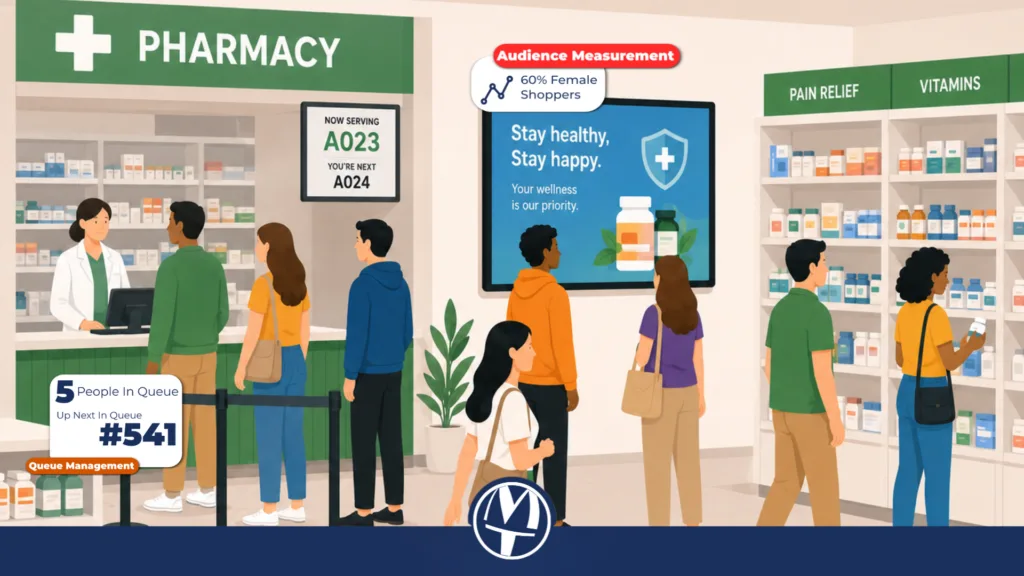
Audience measurement helps retailers better understand who their customers are and how they interact with in-store screen content. By using discreet cameras attached to digital signage screens, it measures the number of customers viewing the content, their age and gender, how long they engage with it, and, in some instances, even picks up on emotional responses during engagement.
For example, in a busy store entrance or checkout area, it can show whether customers notice a promotion on a screen as they pass and whether they stop to engage with it or simply walk on.
These insights can be tracked by store, region, or timeframe, such as time of day or month. This allows businesses to compare performance across locations, identify trends, and understand how content performs in different environments.
By knowing who their audience is and how they engage, brands can make their messaging more relevant, improve content strategies, and gain a better understanding of what resonates with customers.
Audience measurement also helps improve in-store traffic flow by guiding how customers move through the space. By tracking changes in engagement and performance over time, businesses can stay ahead of shifting behaviour and adjust their strategies accordingly. By measuring the performance of digital signage, it shows how well content captures attention and drives engagement, ultimately improving the in-store experience.
While audience measurement looks at how customers engage with digital signage content, queue management focuses on improving service flow and the in-store waiting experience.
Optimising Service Flow and In-Store Waiting with Queue Management
Queue management helps businesses improve the customer waiting experience by replacing replacing traditional queues with virtual ones. Rather than standing in line, customers take a number and can continue shopping while they wait. This makes the experience more convenient and less frustrating, while also reducing perceived waiting time.
In busy retail environments, this helps ease pressure on service areas, improves customer flow, and allows staff to serve customers more efficiently. It also provides insights on waiting and service times, helping businesses identify peak periods, improve staffing, and optimise service delivery.
Used together, audience measurement and queue management provide retailers and quick-service restaurants with a clearer view of the in-store experience. This combined insight helps businesses create smoother, more efficient, and more enjoyable customer journeys.
With offices in Cape Town, Johannesburg and Durban (South Africa), and teams operating across Africa, the Middle East and Europe, Moving Tactics delivers digital signage and retail analytics solutions tailored to local markets and scalable across regions.
See how Moving Tactics Audience Measurement and Queue Management solutions can help improve the in-store experience. Get in touch with us to learn more.