Finance is becoming more than simply numbers and balance sheets in today's changing world. Financial institutions are producing enormous volumes of data every second as a result of the development of digital technologies. Information is always flowing, from stock market activity to client interactions.
Data science has changed the game in this regard. Data science assists businesses in understanding complex financial data through the use of advanced technology, machine learning, and statistical techniques. It helps businesses stay ahead in a more competitive climate while also enhancing decision-making.
We'll look at the benefits of data science, its applications across several industries, its significance in finance, and its prospects.
What is Data Science in Simple Terms?
The process of gathering, purifying, evaluating, and interpreting vast volumes of data in order to identify practical trends and insights is known as data science.
Consider it a method of transforming uninterpreted data into insightful narratives. For instance, a bank can identify unusual activity in your account to stop fraud or recommend better ways to save money by looking at your purchasing habits.
Data science is particularly effective in the banking industry since financial data is extensive, dynamic, and frequently highly complex. Conventional approaches are no longer sufficient to address it.
Why Finance Needs Data Science
One of the biggest data volumes in the world is handled by the finance sector. Additional data is added with each payment, trade, loan, and insurance claim. Much of this knowledge would be useless without the right instruments.
Here’s why finance relies on data science today:
- Accuracy: In financial analysis, human error can be expensive. Models from data science increase accuracy.
- Speed: Now, decisions that used to take weeks may be taken in a matter of minutes.
- Prediction: Data science makes predictions in addition to analysing the past.
- Risk Management: Better insights enable businesses to successfully manage risks.
In short, finance cannot operate efficiently at today’s scale without the help of data science.
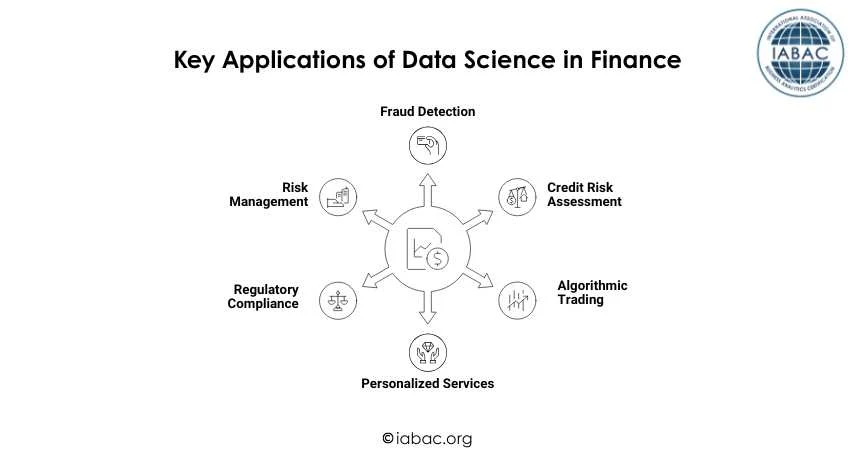
Key Applications of Data Science in Finance
Let’s break down the most common and important areas where data science is applied in finance.
1. Fraud Detection and Prevention
One of the largest risks in the financial industry is fraud. Every day, millions of transactions take place online, therefore banks must be able to spot questionable activity quickly.
Data science models are able to identify anomalous behaviour by analysing patterns of typical user behaviour. For instance, the system can immediately identify if, within minutes of a local transaction, your credit card is used unexpectedly in a foreign country.
Banks and consumers have saved billions of dollars as a result.
2. Credit Risk Assessment
In the past, banks considered only a few criteria, such as work and income, when granting loans. This approach, however, wasn't always precise.
Thanks to data science, lenders may now employ hundreds of factors, including repayment history, internet activity, and spending patterns, to determine a borrower's potential risk.
As a result, lending is safer for banks and more equitable for consumers.
3. Algorithmic Trading
Decisions taken in a matter of seconds can make the difference between profit and loss in the swiftly fluctuating stock markets.
Algorithmic trading, in which computer programs employ sophisticated algorithms to evaluate market data and automatically place trades, is powered by data science. Large volumes of data can be processed by these systems far more quickly than by people.
Algorithms now manage a significant portion of stock market transactions because to the widespread adoption of this strategy.
4. Personalized Financial Services
Data science is currently used by banks and other financial institutions to offer individualised services.
For instance:
- Suggesting investment options based on your goals.
- Recommending insurance plans that fit your lifestyle.
- Offering budgeting tools that track and guide your spending.
This improves customer satisfaction and loyalty.
5. Regulatory Compliance
Strict rules must be adhered to by financial institutions in order to stop illegal activities like money laundering.
Large transaction volumes can be tracked and analysed with the aid of data science, which facilitates the detection and reporting of suspicious activity. By doing this, penalties are avoided and legal compliance is guaranteed.
6. Risk Management
From loan defaults to market catastrophes, financial dangers are present everywhere.
By examining historical patterns, economic indicators, and consumer data, data science models are able to predict these hazards. This enables businesses to plan ahead and reduce losses.
Benefits of Data Science in Finance
The following are some of the main benefits that data science offers to financial institutions:
- Better Decision-Making: Data-supported decisions can be made by leaders.
- Enhanced Efficiency: Time and resources are saved when jobs are automated.
- Improved Security: Customers are safeguarded by sophisticated fraud detection.
- Cost Reduction: Astute observations cut down on needless losses.
- Customer satisfaction: Tailored offerings foster loyalty and trust.
All things considered, data science makes the financial sector smarter, safer, and more consumer-friendly.
Challenges of Using Data Science in Finance
Although data science has many advantages, there are disadvantages as well:
- Data privacy: Strict security is necessary while handling sensitive financial data.
- Data Quality: Inaccurate projections may result from inadequate or missing data.
- High Costs: Hiring professionals and setting up data systems can be costly.
- Changing Regulations: The laws governing the usage of data are always changing.
- Skill Gap: To use sophisticated data technologies, many professionals still require training.
Despite these challenges, the long-term advantages make data science essential.
The Future of Data Science in Finance
Data science will continue to play an increasingly important role in finance. Keep updated on the following trends:
- Machine learning (ML) and artificial intelligence (AI): Smarter models that automatically learn and get better.
- Data science and blockchain: Increased financial transaction security and transparency.
- Real-time analytics: Quick insights to make decisions more quickly.
- Open banking: Exchanging information across organisations to enhance offerings.
As technology evolves, data science will become the backbone of all financial activities.
How to Start a Career in Financial Data Science
Careers in financial data science are flourishing due to rising demand. Proficiency in mathematics, statistics, programming, and finance is required to work in this sector.
Credibility can also be increased through certifications. One of the globally recognised qualifications that helps professionals in beginning or advancing in this field is the IABAC Data Science Certification.
Data science and finance are increasingly inextricably linked. Once mostly governed by human judgement, this field is now guided by insightful data. Data science has revolutionised the way financial institutions function, from fraud detection to personalised banking.
Better financial planning, smarter services, and safer transactions are what it implies for consumers. For businesses, it translates into increased productivity, lower risks, and more earnings.
Those in finance that adopt data science will remain ahead of the curve as data continues to expand. Data will drive the financial industry in the future, and this journey is only getting started.