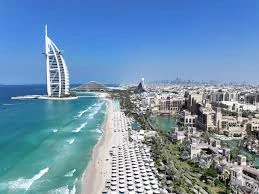
Dubai's real estate market has long been a bellwether for global property trends, but the landscape of 2026 looks distinctly different from the boom-and-cycles of the past. After a record-breaking 2025—with more than 270,000 transactions valued at AED 917 billion—the emirate's property sector is entering a new phase .
This isn't a market cooling down; it's a market growing up. The shift is from rapid, speculative expansion toward a mature, fundamentals-led environment where quality, sustainability, and long-term performance take center stage . For investors, developers, and residents alike, understanding these evolving dynamics is key to navigating Dubai's real estate future.
Here are the critical trends shaping the future of real estate in Dubai in 2026.
1. The PropTech Revolution: From Digital Listings to Digital Transactions
Dubai is rapidly approaching a digital tipping point in real estate. What began as online property portals has evolved into a full-fledged PropTech ecosystem that is fundamentally reshaping how property is bought, sold, and managed .
Today, roughly 50% of real estate transactions in Dubai are already initiated, and in many cases completed, through digital channels. This includes everything from online listings and virtual tours to blockchain-enabled processes . The launch of the Digital Sale service on the Dubai Now app has been a game-changer, allowing buyers and sellers to complete an entire transaction remotely—from contract creation and payment to instant title deed issuance—all on a mobile phone .
Looking ahead, the integration of technology runs even deeper:
- AI-Powered Insights: Artificial intelligence is increasingly used to predict property prices, analyse buyer behaviour, and identify investment opportunities, processing data that would take weeks manually .
- Tokenisation and Fractional Ownership: The Dubai Land Department's real estate tokenisation project, now entering its second phase, uses blockchain to issue digital title deeds. This allows for fractional ownership, democratising access to prime real estate and increasing liquidity by allowing tokens to be traded on secondary markets .
- Cashless Ecosystem: Aligned with Dubai's Cashless Strategy 2026, property payments are expected to become fully integrated with digital wallets and national financial rails, further reducing friction in transactions .
By 2027, industry experts predict that close to 55-70% of property transactions could be digitally executed end-to-end, making "digital by default" the new norm .
2. Market Maturity: From Surging Growth to Sustainable Stability
After several years of rapid post-pandemic appreciation, Dubai's residential market is transitioning from surge to stability. ValuStrat forecasts capital gains of around 10% in 2026, a moderation from the nearly 20% growth seen in 2025 . This deceleration is a healthy sign of a maturing market, reflecting affordability limits and a more selective, logic-based approach from investors .
This new phase is characterised by:
- Longer Holding Periods: Investors are shifting from quick-flip strategies toward "buy-to-stay" and "buy-to-yield" approaches, focusing on income stability and long-term appreciation .
- Quality Over Quantity: Demand is increasingly guided by quality, scarcity, and long-term fundamentals rather than momentum alone . For investors navigating this more selective landscape, partnering with a knowledgeable real estate agent in Dubai is essential to identify assets with genuine long-term value.
3. The Rise of Lifestyle Assets and Wellness-Living
One of the most profound shifts is in how properties themselves are conceived. Residential real estate in Dubai is evolving from a housing solution into a lifestyle asset class .
There is a growing bifurcation in the market. Standard, volume-driven projects are facing slower sales and compressed profits. In contrast, unique, experience-focused developments that prioritise wellness, privacy, and community are commanding a premium .
This trend is encapsulated by the rise of "bio-living" and wellness-integrated communities. Developers are embedding health-focused elements into planning, materials, air quality, and community behaviour. As scarcity, not scale, becomes the true currency of value, projects with a clear vision and purpose-built design are set to outperform in both yield and resilience .
4. The Great Divide: Villas Outperform, Studios Shine
The performance of different asset types is diverging sharply in 2026.
- Villas and Townhouses Lead the Way: Limited supply of single-family homes—representing less than 20% of Dubai's residential stock—combined with sustained lifestyle demand, is driving significant growth. ValuStrat forecasts villas and townhouses to rise by 17.7% in 2026, more than double the 7.4% growth expected for apartments .
- Studios Deliver the Highest Returns: At the other end of the spectrum, studios are proving to be the most return-efficient residential format. They now account for 25% of apartment transactions and have seen prices grow 14% annually over three years. With rental yields averaging 6% (compared to 4-5% for larger units), they remain a favourite for income-focused investors .
5. Commercial Real Estate: The Office Comeback and Logistics Boom
Dubai's commercial real estate sector is experiencing its own resurgence, driven by distinct trends.
- Prime Office Shortage: A critical shortage of Grade A office space in prime districts like DIFC and Downtown Dubai is fueling remarkable growth. Office capital values and rents are forecast to rise by around 15% in 2026 . This supply crunch is pushing both investors and occupiers toward the off-plan office market to secure long-term positioning .
- Logistics and Warehousing: Driven by Dubai's role as a global trade gateway, demand for logistics assets remains robust. These are attracting domestic investors with local market knowledge, as they often involve land acquisition and longer execution cycles .
- Community Retail: Retail investment is shifting toward neighbourhood centres within residential communities, where footfall is driven by local, everyday demand rather than destination shopping .
6. Population Growth and the Shift to Homeownership
Dubai's demographics remain a powerful engine for real estate demand. The resident population is projected to reach 4.7 million by the end of 2026, with peak-hour levels approaching 6.5 million . This sustained influx of professionals and families underpins demand for housing, offices, and urban infrastructure.
Critically, there is a clear structural shift from renting to buying. Property Finder data reveals that 70% of respondents plan to purchase a home within the next six months. Initiatives like Dubai's First-Time Home Buyer program have already enabled over 2,000 residents to purchase their first homes, injecting over AED 3.25 billion into the market .
7. A Flight to Quality and Premium Living
Buyer preferences are increasingly skewed toward higher-value options. Entry-level properties under AED 1,000 per square foot now make up only 8% of the market, down from 14% . Concurrently, premium and luxury homes above AED 2,500 per square foot accounted for 20% of the market in 2025, driven by an influx of high-net-worth individuals and billions in incoming wealth .
This flight to quality is also evident in the geographic spread of demand. While established communities like Dubai Marina, Downtown, and Palm Jumeirah remain popular for their stability and infrastructure, new projects in emerging areas like Dubai Islands and Dubai Maritime City are attracting strong interest for their potential as the next landmark addresses .
8. A Supportive Macro-Economic Environment
All these trends are underpinned by a robust macro-economic backdrop. Dubai's economy is forecast to grow by around 5% in 2026, driven by non-oil sectors including tourism, real estate, and financial services . With inflation expected to remain contained at approximately 2%, the environment remains highly conducive for both businesses and investors .
Conclusion: Navigating Dubai's New Real Estate Era
The future of real estate in Dubai is not about higher highs and lower lows; it's about smarter, more sustainable growth. The market in 2026 rewards discipline, research, and a clear focus on fundamentals. Whether it's embracing the digital transformation of PropTech, investing in the resilient villa segment, or securing a foothold in the tightening office market, success will come to those who adapt to this more mature landscape.
For those ready to navigate this exciting new era with confidence, partnering with an experienced real estate agent in Dubai who understands both macro trends and micro-market nuances