Pull out your phone and scroll through the apps that touch your money, your health records, or your ID. Ten? Fifteen? Now ask which of them you’d trust with a stranger’s access to your data. Probably not many.
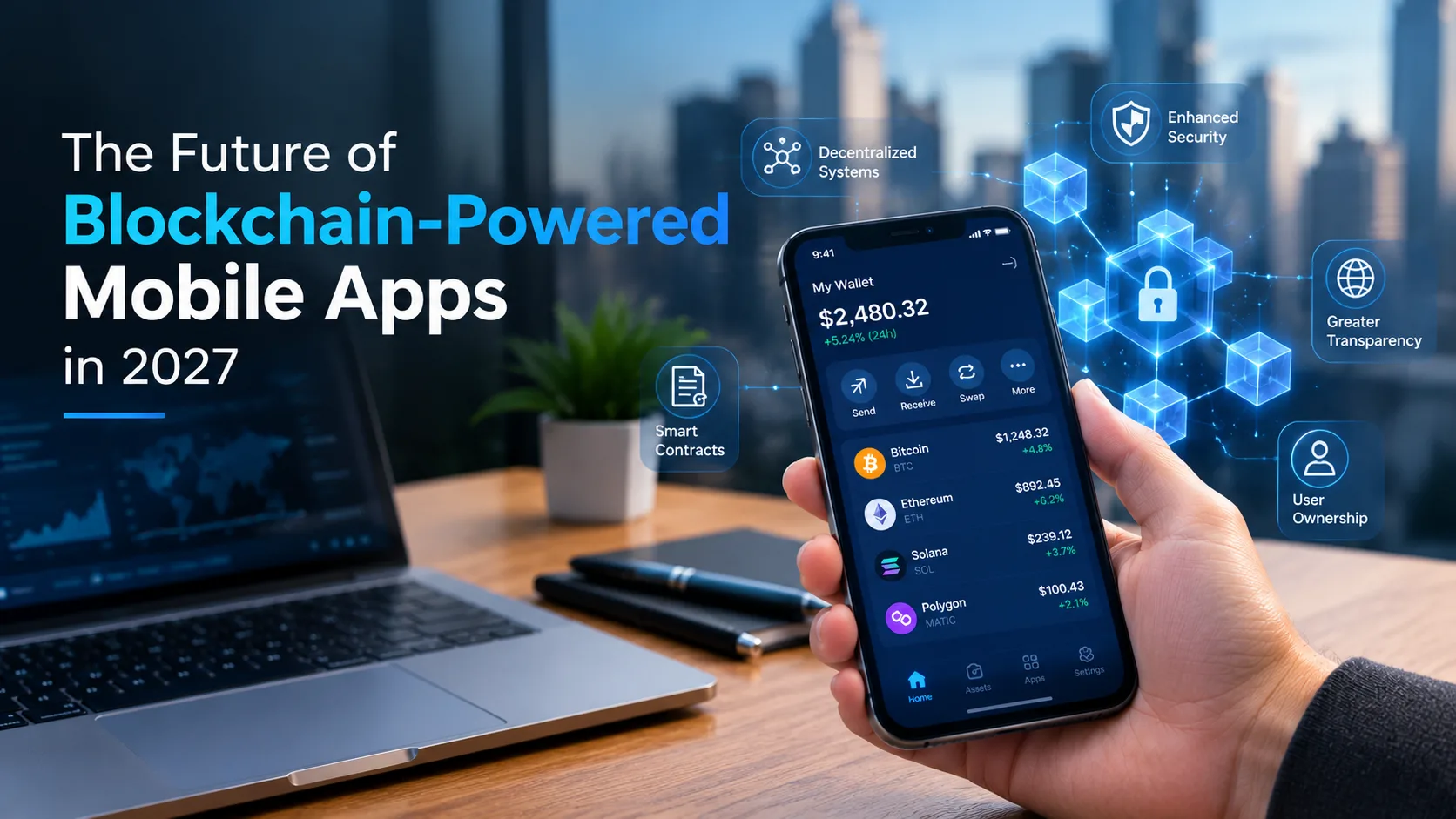
That trust gap is exactly where blockchain has found its footing. By 2027 it has stopped being a crypto-wallet novelty and become plumbing for payments, medical records, shipping, gaming, and digital identity.
Local businesses have noticed. More startups, clinics, and logistics firms are looking up Mobile App Development Services in Phoenix because they want a team nearby that gets both the tech and the market. Here’s what’s changing and how to move without burning budget.
Key Takeaways
- Blockchain in mobile apps has moved from experiment to everyday tool, mainly in finance, healthcare, and supply chains.
- Cheaper transactions and biometric sign-ins have removed most of the old usability headaches.
- The biggest wins are security and transparency, while cost and compliance need honest planning.
- Your development partner matters more than whichever blockchain is trending this month.
- A small pilot beats a big-bang launch almost every time.
What Exactly Is a Blockchain-Powered Mobile App?
It’s an app that writes important records to a shared ledger rather than keeping everything on one company’s server.
Once something is on that ledger, nobody can quietly edit it. Each entry is timestamped, and anyone with permission can check it.
For users, that means more control over their own information. For businesses, it means an audit trail that customers and regulators can actually believe.
Why Does 2027 Feel Different From Earlier Hype Cycles?
Earlier waves had big promises and clunky products. This one has fixed the clunky part.
Fees on layer-2 networks have dropped to a sliver of a cent, so a loyalty app or a delivery tracker can use blockchain without passing costs to anyone. Sign-in has also improved. With account abstraction, people unlock things with a face scan, and there’s no twelve-word recovery phrase to lose.
Rules are catching up as well. Clearer guidance on digital assets has made banks, hospitals, and universities a lot less nervous about building.
Which Trends Are Worth Your Attention This Year?
Plenty of ideas float around. These five have real traction.
Decentralized identity. You keep verified credentials on your phone and share only what’s needed. Proving you’re over 21 without revealing your birthday is the classic example.
Tokenized assets. Invoices, property shares, and reward points are becoming tradeable tokens inside everyday apps.
Artificial intelligence with blockchain. Artificial intelligence customizes the experience and the ledger saves a record of what it chose and the reasons, behind its choices.
Zero-knowledge privacy. An app can confirm a fact is true without ever seeing the raw data behind it.
Cross-chain movement. Assets hop between networks in the background, and users never need to know.
What Do Businesses Actually Gain?
When the use case fits, quite a lot.
Records become tamper-resistant. Partners work from the same version of the truth, which cuts arguments over who changed what. Settlement that used to take days can finish in minutes.
Trust grows too. People believe a claim faster when they can check it themselves, whether it’s where a coffee bean was grown or whether a payment cleared.
One caution, though. Not every app needs a blockchain. A simple booking tool doesn’t. A multi-party supply chain full of disputed paperwork probably does.
What Can Go Wrong?
Better to hear it now than after launch.
Network capacity still varies a lot. Compliance rules shift by state and by industry. Smart contracts are stubborn, because a bug in deployed code can be painfully expensive to fix.
Then there’s the human side. Even with smooth sign-ins, users want a plain explanation of what happens to their data. And skilled people are scarce. Few developers are strong at mobile design, cryptography, and contract auditing all at once, which is why many firms hire specialists offering Blockchain App Development Services in Phoenix instead of assembling a team from scratch.
Which Features Separate a Solid App From a Risky One?
Check for these before you sign anything:
- Biometric login with secure key storage
- Smart contracts reviewed by an independent auditor
- Gas fees handled behind the scenes, so users never see them
- Smooth offline behavior that syncs once the connection returns
- Clear, simple controls for data consent
- Privacy-respecting analytics
If a vendor shrugs at the audit or treats design as an afterthought, take that as your cue to keep looking.
How Do You Pick the Right Team?
Ask to see live apps, not just a polished deck. Then ask which networks they’ve shipped on, how they test security, and who owns the code when the project ends.
Proximity counts more than people expect. An App Development Company in Phoenix can sit in your workshops, turn feedback around quickly, and understand the local mix of healthcare, real estate, fintech, and logistics.
Ask about life after launch, too. Networks upgrade and regulations move, so your app will need regular care.
What Does It Cost, and How Do You Start Without Wasting Money?
Scope drives everything. A focused pilot with one core feature often takes three to five months, while a full platform with several user roles and integrations can run eight months or longer. Audits, compliance work, and complex contracts push the number up, and yearly maintenance should be in the budget from day one.
A few habits keep projects on track:
- Name the problem first. Write down what’s broken and how a shared ledger fixes it.
- Choose the network on merit. Look at speed, cost, support, and compliance rather than buzz.
- Design for ordinary people. If your relatives can’t use it, simplify it.
- Audit every sprint. Security isn’t a last-week task.
- Decide who holds the keys. Settle who can update contracts before launch.
- Track real numbers. Adoption, failed transactions, and support tickets tell you the truth.
Schools, hospitals, and nonprofits can follow the same path. A university issuing tamper-proof digital diplomas is a low-risk, high-value pilot.
A quick readiness test: is there a trust problem between parties, do records need sharing or verifying, and would users benefit from owning their data? Two yeses mean you’re a good candidate.
Ready to Build Your Blockchain App? Contact Us Today
The apps that win in 2027 won’t be the flashiest. They’ll be the ones people believe in.
If you want to test an idea, review an existing plan, or find dependable Mobile App Development Services in Phoenix, a short conversation is the best first move. This week, pick one process in your organization that’s slow or hard to verify and sketch it on a single page. Then contact us and turn that sketch into a roadmap.
If you’d like a partner who’s done this before, Esferasoft Solutions has earned a reputation for secure, user-friendly products and for walking clients from rough idea to confident launch. Their clear communication and long-term support make them a solid choice for anyone serious about Mobile App Development Services in Phoenix and beyond.