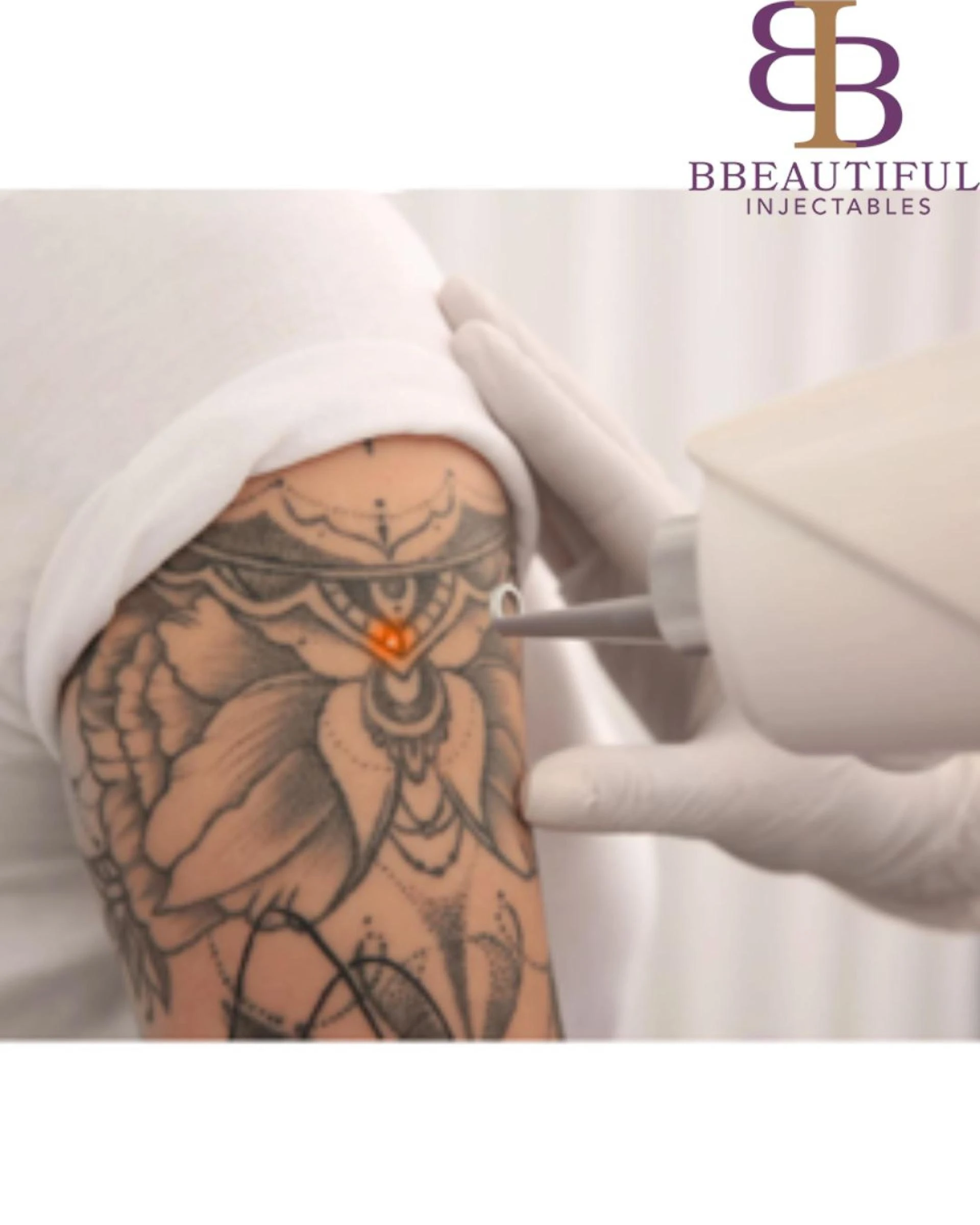
Hey — if you've already had your first session, you probably saw it and expected fading. A white, chalky film rises on the skin right where the laser just fired. Almost foggy. A little alarming.
You looked up at the ceiling, decided it was probably fine, and kept going. And it was fine — but the fact that nobody explained it beforehand is the kind of gap that quietly turns a straightforward treatment into something that feels more uncertain than it needs to.
That white reaction has a name. It's called frosting. And once you know what it actually means, every session of tattoo removal in Murfreesboro, TN, stops feeling like something being done to you and starts feeling like something working for you. What it's doing beneath the surface, though — that's the part worth understanding slowly.
Why That White Film Appears Within Seconds of the Laser Firing
The laser doesn't burn ink out of the skin. It shatters it. Each pulse delivers a burst of energy so targeted, so brief — measured in nanoseconds — that the ink particle absorbs it faster than surrounding tissue can dissipate it. That thermal shock fractures the pigment into fragments small enough for the immune system to eventually carry away.
But the heat also superheats the water molecules sitting inside the tissue around the ink. They vaporize. Nothing burned. Nothing broken in the way that causes harm. Just the skin briefly becoming a site of rapid, controlled chemistry, and frosting is the only evidence of it reaching the surface.
Dense frosting usually means the laser hit a pocket of concentrated ink. Lighter frosting often means the ink sits deeper, or that earlier sessions have already begun breaking it down. Neither signals a problem. Both are the skin reporting back.
What Your Technician is Actually Reading When They See It
Frosting maps ink the way an X-ray maps bone. Where it's heaviest, the pigment density is highest. Where it barely forms, the ink either sits at a depth this pass didn't fully reach, or it's already fragmenting from previous rounds. A skilled technician isn't just watching for frosting to appear — they're reading its texture, distribution, and how quickly it resolves.
"Frosting isn't a side effect. It's the laser's receipt — proof that it found what it came for."
There's also a practical reason why most practitioners pause briefly after frosting appears before firing again. Actively frosting skin is temporarily reflective. Another pulse on top of that gas layer scatters the energy unpredictably instead of directing it at the ink. Waiting those seconds isn't hesitation — it's precision.
How the Real Work Begins After You Leave the Clinic
The session is fifteen minutes. The actual fading takes weeks. Those two facts live in the same process, and most people only focus on the first one.
Once the laser has shattered the ink particles, the immune system moves in. Macrophages — white blood cells built for debris clearance — engulf the fragments and carry them through the lymphatic system until they're gone. This doesn't happen overnight.
Black ink, which absorbs broadly across wavelengths, clears relatively fast. Blues and greens are stubborn — they need specific longer wavelengths and often require more passes before they fully fragment. Reds can temporarily darken before fading, a reaction with iron oxide in some pigments. Yellows and whites resist almost everything.
- Black ink responds first and fastest across most skin types.
- Blue and green pigments need targeted wavelengths — more sessions, more patience.
- Red can oxidize and appear darker before it begins clearing.
- Yellow and white are the last to go, often lingering well after the surrounding color has faded.
Some people explore IV therapy near me online to support recovery between sessions — not as a replacement for the laser work…but to keep the body's clearance process running at full capacity when it's already doing heavy lifting beneath the surface.
When Skin Texture Becomes Part of the Conversation
Laser sessions are controlled trauma. Small, precise, purposeful — but the skin registers each one. For tattoos with heavy ink saturation, or older pieces where multiple sessions have already cycled through the same area, texture changes can appear. Slight unevenness. A subtle shift in how the skin sits over that patch of dermis.
This is where treatment sequencing matters. Microneedling in Murfreesboro — when timed correctly, never overlapping with active laser treatment — can support collagen rebuilding in areas where repeated sessions have stressed the tissue. It doesn't undo laser work. It helps the skin recover more fully between rounds, so the surface you're revealing as the ink clears is actually worth revealing.
Spacing matters here, too. Rushing sessions — trying to compress a six-to-eight-week recovery window into four — overloads the lymphatic system before it's finished clearing the previous round's fragments. The frosting will show up on schedule for the next session. The fading won't. The biology doesn't negotiate.
What Frosting Tells You That Nobody Thinks to Ask About
Most people enter tattoo removal in Murfreesboro, TN, focused entirely on the end — the blank skin, the cover-up made possible, the thing they no longer want to explain at job interviews or first dates. That focus makes sense. But somewhere between the first session and the last one, the process itself becomes worth understanding.
Frosting is the moment the treatment becomes visible. A white haze forming on skin that held ink for years — sometimes decades — is actually the first physical evidence of reversal. The ink didn't fade yet. But it shattered. And shattering is where every cleared tattoo begins.
That split-second reaction during tattoo removal in Murfreesboro, TN, is easy to miss if you're looking at the ceiling. But if you watch for it, you'll see — in real time — the exact moment your skin decides it's ready to let go of something you've been carrying far longer than you wanted to.