
Thermal management plays a critical role in modern electronic systems, medical devices, aerospace equipment, automotive components, and industrial machinery. As product designs have become thinner, lighter, and more integrated, traditional rigid heating elements have often struggled to meet evolving performance demands.
Printed flexible heater technology emerged as a solution to these limitations. By combining conductive materials with flexible substrates through additive manufacturing processes, printed heaters have transformed how heat is generated and distributed across surfaces.
The evolution of printed flexible heaters reflects broader advancements in materials science, electronics integration, and scalable manufacturing.
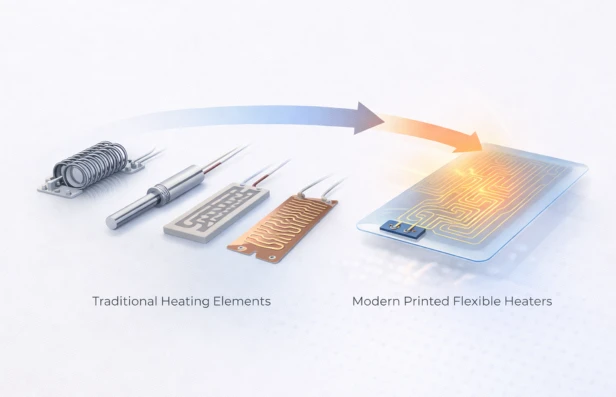
Early Heating Technologies: Rigid and Wire-Based Systems
Traditional heating elements relied primarily on:
- Coiled resistance wires
- Metal rod heaters
- Ceramic heating elements
- Etched foil heaters
These systems generated heat through electrical resistance, commonly referred to as Joule heating.
While effective, early designs had limitations:
- Bulky mechanical structure
- Limited geometric flexibility
- Complex assembly requirements
- Uneven heat distribution in some configurations
As industries moved toward compact and portable systems, these rigid technologies became less suitable.
Introduction of Flexible Substrates
The transition to flexible heater technology began with improvements in polymer substrates, such as:
- Polyimide films
- Polyester films
- Silicone-based materials
These materials are offered:
- Thermal stability
- Mechanical flexibility
- Electrical insulation
- Lightweight construction
The ability to deposit resistive traces onto flexible substrates opened new possibilities for surface heating applications.
Development of Printed Resistive Heating Elements
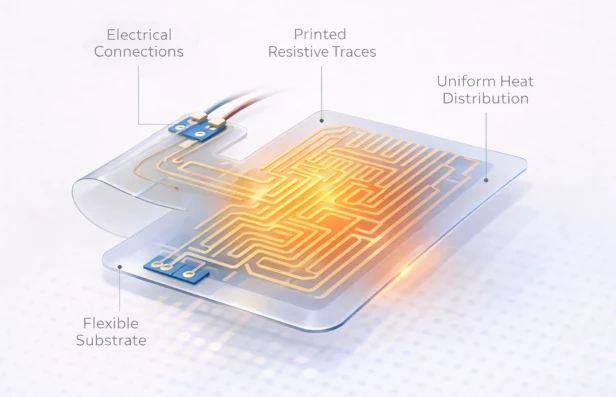
The core innovation in printed flexible heater technology is the use of conductive or resistive inks.
Using processes such as screen printing, manufacturers began depositing patterned resistive traces directly onto flexible films.
This allowed:
- Customizable heater geometries
- Precise control over resistance values
- Even heat distribution
- Thin, low-profile construction
The heating principle remained Joule heating, where electrical current passes through a resistive path to generate thermal energy.
However, printed trace patterns enabled more uniform and application-specific heating profiles.
Advancements in Conductive Ink Formulations
Early printed heaters relied on basic carbon-based inks.
Modern advancements include:
- Silver-based conductive inks
- Carbon-silver blends
- Polymer thick film formulation
- Enhanced adhesion chemistries
Improved ink formulations provide:
- Stable resistance over time
- Reduced cracking under flexing
- Enhanced temperature tolerance
- Improved environmental durability
Material innovation significantly improved lifecycle reliability
Integration with Modern Control Systems
As heater technology advanced, integration with electronic control systems became more sophisticated.
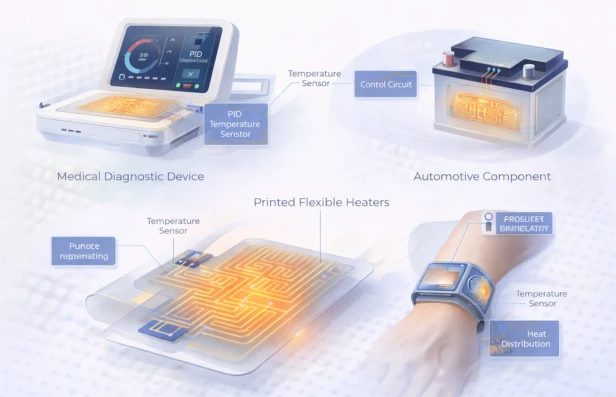
Modern printed flexible heaters often incorporate:
- Temperature sensors
- Embedded thermistors
- Closed-loop feedback systems
- PID temperature control circuits
This integration allows:
- Precise temperature regulation
- Rapid response time
- Energy efficiency optimization
- Protection against overheating
Advanced control systems transformed printed heaters from passive components into intelligent thermal management systems.
Expansion into Medical and Wearable Applications
The flexibility and thin profile of printed heaters enabled expansion into new industries.
Applications include:
- Medical diagnostic equipment
- Blood analyzers
- Patient warming systems
- Wearable therapeutic devices
- Flexible battery warming systems
In medical applications, uniform heating and precise temperature control are critical.
Printed heaters support safe and controlled heat delivery within compact device formats.
Improvements in Power Density and Efficiency
Power density refers to the amount of heat generated per unit area.
Advancements in printed heater design have improved:
- Trace geometry optimization
- Resistance uniformity
- Voltage compatibility
- Current distribution balance
Engineers can now tailor heaters to specific voltage and current requirements, including low-voltage battery-powered systems.
Improved power density management reduces hotspots and enhances overall thermal performance.
Environmental Durability Enhancements
Modern printed flexible heaters are engineered for harsh conditions.
Design improvements include:
- Protective overlamination layers
- Chemical-resistant coatings
- Moisture-resistant adhesives
- Vibration-tolerant constructions
These enhancements expanded usage into industrial and transportation systems.
Environmental resilience is now a core design requirement rather than an afterthought.
Comparison with Etched Foil Heaters
Etched foil heaters remain a common alternative technology.
Printed heaters offer advantages such as:
- Lower tooling cost
- Faster prototyping
- Customizable geometries
- Scalable screen printing processes
Etched foil heaters may provide:
- High power output capability
- Excellent uniformity in certain designs
Selection depends on application-specific requirements, including temperature range and mechanical constraints.
Scalability and Manufacturing Advancements
One of the most significant evolutionary milestones has been scalable production.
Modern manufacturing enables:
- High-volume screen printing
- Consistent resistance control
- Inline electrical testing
- Automated assembly integration
Scalable manufacturing reduces cost while maintaining quality and repeatability.
This scalability has made printed flexible heaters viable for both niche and mass-market applications.
Engineering Considerations in Modern Designs
Designing a printed flexible heater requires a structured evaluation.
1. Electrical Parameters
Engineers must define:
- Voltage requirements
- Current limits
- Resistance targets
- Power density goals
2. Thermal Distribution
Considerations include:
- Even heat coverage
- Avoidance of hotspots
- Surface contact efficiency
- Heat transfer pathways
3. Environmental Exposure
Evaluate:
- Moisture exposure
- Chemical contact
- Flexing cycles
- Operating temperature range
Each factor influences material selection and trace design.
The Role of Printed Flexible Heaters in Modern Technology
Printed flexible heater technology continues to evolve as devices become more compact and performance-driven.
Key benefits include:
- Lightweight construction
- Custom geometry flexibility
- Energy-efficient heating
- Rapid prototyping
- Integration with smart control systems
The technology aligns well with modern trends in miniaturization and connected electronics.
Future Directions in Printed Heater Innovation
Ongoing research and development focus on:
- Higher temperature capabilities
- Improved conductive ink stability
- Integrated sensing and heating layers
- Reduced power consumption
- Advanced flexible substrates
As materials science advances, printed heaters are expected to become more durable, more efficient, and more adaptable.
Frequently Asked Questions
What is a printed flexible heater?
It is a thin heating element created by printing resistive conductive patterns onto flexible substrates.
How do printed heaters generate heat?
They use electrical resistance heating, where current passing through a resistive trace produces thermal energy.
Are printed flexible heaters durable?
Yes, when designed with proper materials and protective layers for environmental conditions.
Where are printed flexible heaters used?
They are used in medical devices, industrial equipment, automotive systems, wearable electronics, and laboratory instruments.
Are printed heaters energy efficient?
Yes. When paired with temperature control systems, they provide efficient and precise heat management.