

So, you have a brilliant idea for a startup. It’s exciting, right? You’re probably already dreaming about the product launch, the flood of new users, and eventually, that big funding round.
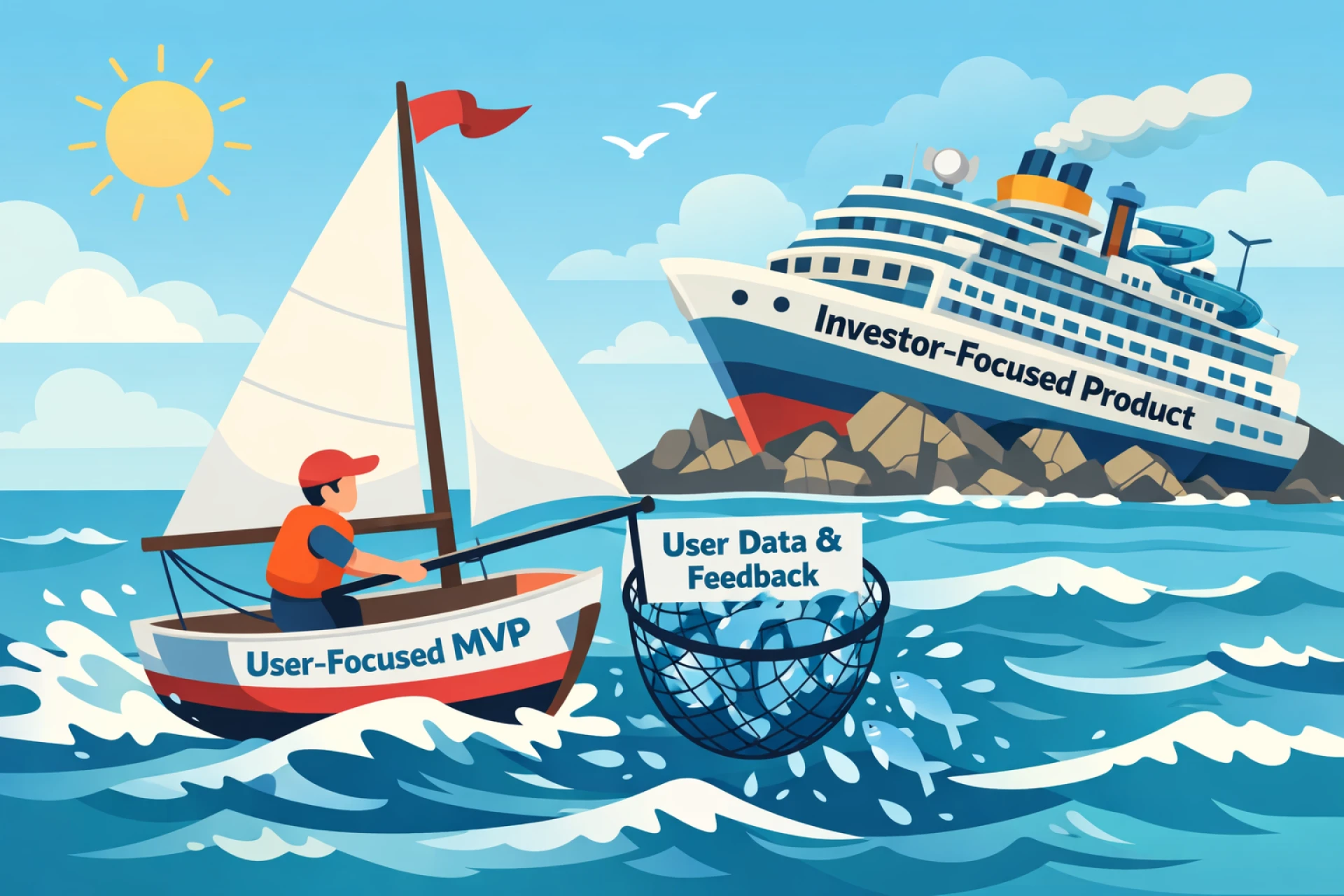
But here’s a subtle fork in the road that every founder faces, often without even realising it: Are you building your first product for your future users, or are you building it for future investors?
It’s a crucial question, and the answer can determine whether your startup succeeds or not. Let’s break down the difference in a way that’s easy to digest, especially if you’re a non-technical founder.
When we think about pitching to investors, it’s natural to want to impress them. You might feel pressure to build a product that looks like a finished, polished, full-scale platform from day one. You imagine showing them a sleek app with dozens of features, complex dashboards, and all the bells and whistles.
This approach leads to building what the article above calls an MVP built like a "full product instead of a learning tool." You end up with a long checklist of features you think will prove your concept is big and ambitious. The result? A product that’s bloated, expensive, and took months to build.
The core problem? You haven’t actually proven that anyone wants or understands your product. You’ve built a shiny object for a small group of investors, not a solution for a real market. You’re asking for money based on an assumption, not on traction or validated user love. This is a huge risk, and smart investors can smell it from a mile away.
Now, imagine a different path. This is the "strategy-first" approach championed by experts like the team at NCrypted. Here, your MVP isn't the finished mansion; it’s the first, perfectly functional room that solves one core problem really, really well.
This MVP is built as a learning tool. Its only job is to answer the most important questions:
Does this problem actually exist for people?
Does my solution make sense to them?
Will they actually use it (and maybe even pay for it)?
Instead of guessing which features matter, you prioritise ruthlessly. You focus on the "core user actions optimised for speed" and create "clean flows for the core use case." This is what NCrypted calls an MSP (Minimum Sellable Product) - the simplest version of your product that can actually deliver value.
You launch faster and cheaper. You watch real user behaviour. You learn what works and, just as importantly, what doesn't. Then, you iterate. You build the next feature based on data, not assumptions. This dramatically lowers your business risk.
Here’s the secret that successful startups know: Building for users is actually the best way to build for investors.
Think about the case studies mentioned, like GEMS Education and OYO. Its earliest version, powered by solutions like those from NCrypted, wasn't the global giant it is today. It started by solving a simple, core problem: finding affordable, trusted accommodations. They proved the model worked for users first. The big funding and valuation came after that user validation.
When you finally go to investors with a user-focused MVP, you’re not pitching an idea. You’re pitching a proven concept. You have data. You have early user adoption. You have a clear understanding of your customer journey. Your pitch becomes, "We built this small thing for these real people, they loved it, and here’s the data to prove it. Now, help us build the next level."
That’s an infinitely less risky and far more attractive proposition. Your MVP becomes "investor-ready" because it’s user-validated. It shows you’re a founder who can execute with clarity and focus.
As a non-technical founder, it’s easy to get lost in the details. So, keep this simple rule in mind: Focus on the problem, explain the solution. Your first version is not your final version. It’s just the beginning of a conversation with your users.
Before you write a single line of code or pay a developer, ask yourself: "Does this feature directly help my first user solve their immediate problem?" If the answer is no, put it in the "maybe later" pile.
Focus on building a tiny, useful, and stable product for a handful of users who desperately need it. Once you’ve made their lives better, you’ll have the proof and the power to go after the funding you need to scale. Build a learning machine for your users, and it will naturally become the perfect magnet for your investors.


