Introduction: The Intersection of Manual Control
In industrial control systems, manual operators still play a critical role—even in highly automated environments. Whether selecting machine modes, switching between power sources, or controlling motor functions, operators rely on control devices that are simple, reliable, and easy to understand.
Two of the most commonly used devices for these tasks are selector switches and cam switches.
At first glance, they may appear similar. Both are rotary-operated devices used for selecting operational states or switching circuits. Because of this, the terms are often used interchangeably in casual conversation.
However, from an engineering perspective, these devices are very different.
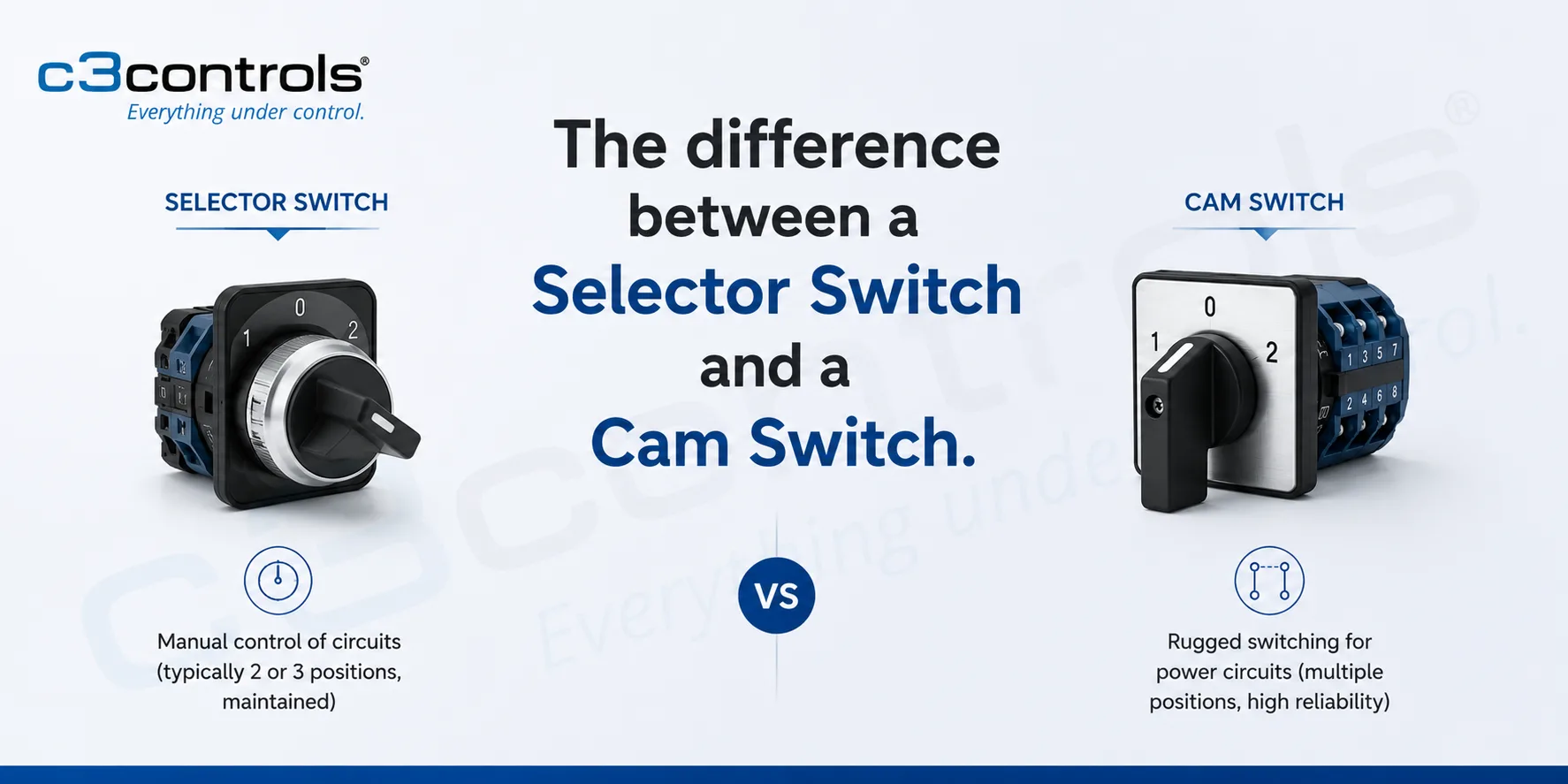
A selector switch is typically designed for straightforward control logic, while a cam switch is built for complex switching sequences involving multiple circuits and precise timing relationships.
Understanding the difference between a selector switch vs cam switch is important for choosing the right solution for an industrial control panel.
Defining the Selector Switch (The Standard Operator)
Selector switches are among the most common pilot devices used in industrial control systems.
They are usually installed in standard:
- 22mm mounting holes
- 30mm mounting holes
Most selector switches include:
- Rotary knobs
- Lever operators
- Key-operated actuators
These devices are designed primarily for simple operator control functions.
The Contact Block System
Internally, selector switches work using stackable contact block configurations.
Each contact block contains:
- Normally Open (NO) contacts
- Normally Closed (NC) contacts
When the operator rotates the switch, a plunger or striker mechanically activates the contact blocks.
This design is simple, modular, and widely used across industrial applications.
Limitations of Selector Switches
Although selector switches are versatile, they do have limitations.
They are typically limited to:
- 2-position operation
- 3-position operation
- Occasionally 4-position operation
As additional contact blocks are added, the device becomes deeper behind the panel, which can create space limitations inside compact enclosures.
Selector switches are also generally intended for pilot-duty circuits rather than complex power switching applications.
Common Applications
Selector switches work best for basic control functions such as:
- Hand/Off/Auto selection
- Local/Remote control
- Start/Stop logic
- Machine mode selection
For these applications, they remain the simplest and most cost-effective solution.
Defining the Cam Switch (The Logic Controller)
A cam switch is significantly more advanced from a switching perspective.
Instead of relying on standard contact blocks alone, cam switches use a rotary shaft combined with specially designed cam profiles to control multiple circuits in a precise sequence.
This is why rotary cam switch applications are commonly found in complex industrial systems.
Internal Switching Mechanism
Inside the switch, rotating cams activate contacts at specific angular positions such as:
- 30°
- 45°
- 60°
- 90°
The shape of each cam determines exactly when contacts open or close during rotation.
This creates highly customizable switching truth tables capable of handling multiple circuit combinations within one device.
The Advantage of Modularity
Unlike selector switches, cam switches use modular stages or decks stacked along the shaft.
This design allows:
- Multiple poles
- Multiple switching sequences
- Up to 12 operating positions
All within a relatively compact footprint.
Because of this flexibility, cam switches are often used where standard selector switches simply cannot provide the required switching logic.
Common Applications
Typical rotary cam switch applications include:
- Voltmeter selector switching
- Ammeter phase selection
- Multi-speed motor control
- Star-delta motor starting
- Generator transfer switching
These applications require carefully controlled switching sequences that go beyond simple ON/OFF logic.
Head-to-Head Comparison: Key Engineering Metrics
Circuit Density
One of the biggest differences between these devices is how they scale.
A selector switch adds functionality by stacking contact blocks behind the operator. This increases panel depth.
A cam switch uses internal modular stages, allowing more circuits to be controlled without excessive panel depth.
For complex applications, this makes cam switches far more compact and scalable.
Switching Logic
Selector switches generally use simple binary logic:
- ON/OFF
- AUTO/MANUAL
- FORWARD/REVERSE
Cam switches support far more advanced switching truth tables, including:
- Make-before-break logic
- Break-before-make logic
- Multi-position sequencing
This capability is critical in applications involving power transfer or phase selection.
Electrical Ratings
Selector switches are primarily optimized for control circuits and pilot-duty operation.
Cam switches often support higher thermal current ratings (Ith), allowing direct switching of heavier loads or multiple power circuits.
Mounting Flexibility
Selector switches are usually front-mounted using standard 22mm or 30mm openings.
Cam switches offer more flexibility, including:
- Front-of-panel mounting
- Base mounting
- DIN rail mounting
This allows easier integration into specialized industrial systems.
Operational Differences: When to Choose Which?
The decision between selector switch vs cam switch depends entirely on the application.
Scenario A: Simple Mode Selection
If the requirement is basic operator control, the selector switch is usually the best choice.
Examples include:
- Hand/Off/Auto
- Local/Remote
- Forward/Reverse
In these cases, selector switches are:
- More ergonomic
- Easier to install
- More cost-effective
Scenario B: Complex Metering or Power Transfer
Applications requiring overlapping or isolated switching sequences demand a cam switch.
For example:
- Voltmeter phase selection
- Generator transfer switching
- Multi-stage motor control
These functions require precise contact timing that selector switches cannot easily provide.
Scenario C: Panel Space Optimization
Panel design also influences device selection.
If rear panel depth is limited, a multi-stage cam switch may save space compared to stacking numerous selector switch contact blocks.
The tradeoff is usually a slightly larger faceplate footprint.
Maintenance and Reliability Considerations
Both devices require proper identification and labeling.
Clear legend plates improve operator understanding and reduce the risk of incorrect operation.
From a durability standpoint, selector switches are generally easier to service because their contact blocks are standardized and easily replaceable.
Cam switches, however, use specialized switching programs. Replacing one often requires matching the exact contact sequence diagram and switching truth table.
Mechanical lifecycle is another consideration.
High-frequency operations may favor devices with stronger detent mechanisms and higher cycle ratings, depending on application requirements.
Conclusion: Selecting for System Precision
The difference between a selector switch and a cam switch ultimately comes down to switching complexity.
If the application requires simple manual logic, a selector switch is usually the best solution.
If the system demands multiple circuits, sequential switching, or specialized timing relationships, a cam switch becomes the better engineering choice.
Proper industrial control switch selection directly impacts:
- Panel usability
- Maintenance simplicity
- Long-term reliability
In modern industrial systems, choosing the correct switch is not just about operation—it’s about designing a control panel that remains intuitive, efficient, and dependable throughout its entire service life.
Whether selecting c3controls Series 700 cam switches or Series 22/30 selector switches, understanding the operational requirements is the key to making the right decision.