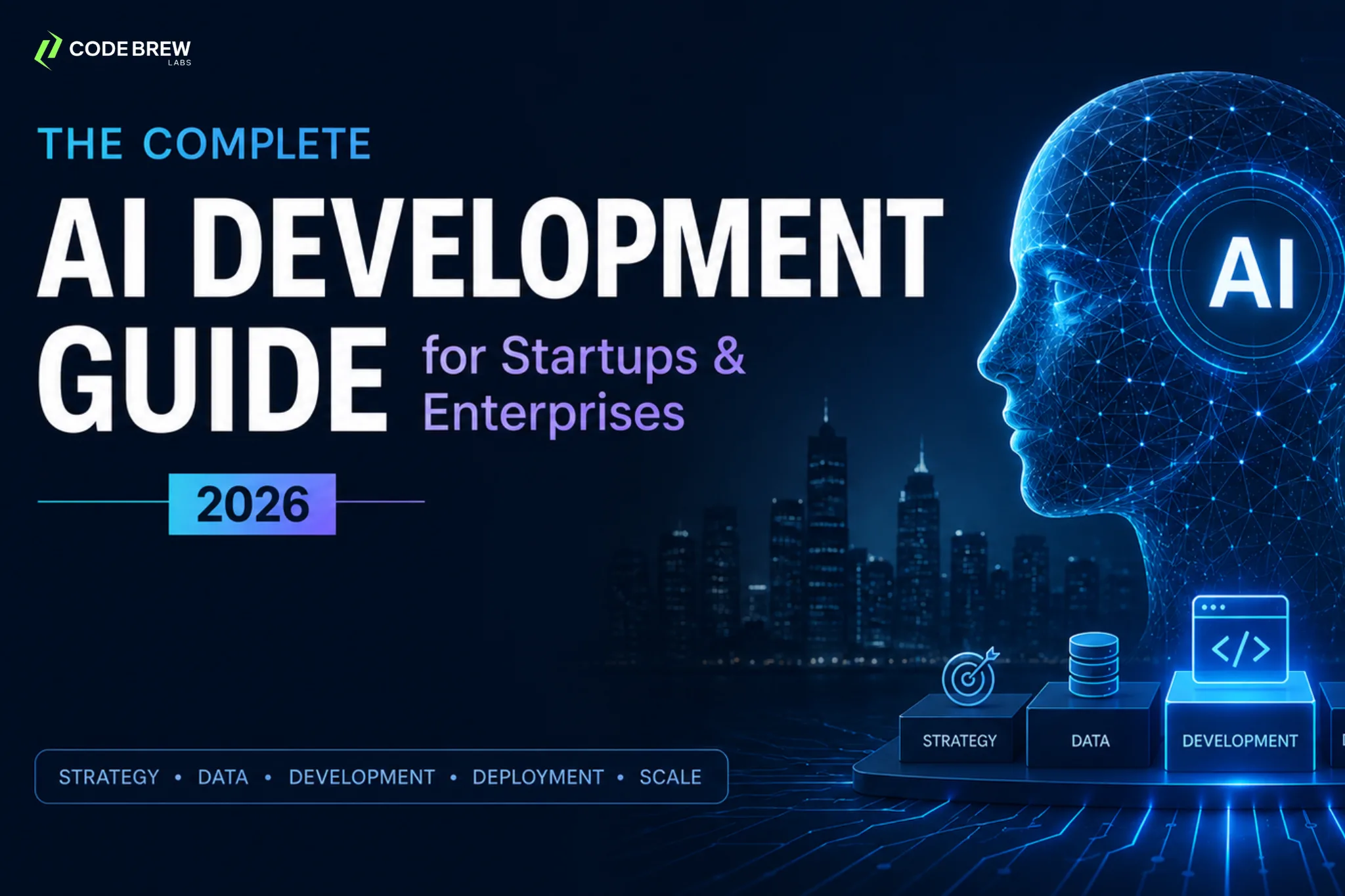
Artificial intelligence is no longer an experimental layer in digital products. It is becoming core infrastructure. Yet most organizations still approach AI like a feature rather than a system. That gap between expectation and execution is exactly where many AI initiatives fail.
Startups rush into building quick prototypes. Enterprises invest heavily but struggle to scale beyond pilot stages. In both cases, the underlying issue is the same. AI is treated as an isolated capability instead of an integrated, continuously evolving system.
The shift in 2026 is clear. Winning companies are not the ones building the most AI features. They are the ones building the most reliable AI infrastructure.
The Most Common AI Development Mistake
The biggest mistake companies make is prioritizing speed over structure.
A quick MVP may demonstrate potential, but it rarely survives real-world complexity. Data inconsistencies, model drift, integration gaps, and lack of monitoring quickly turn early success into long-term technical debt.
This is especially visible in three areas:
- Models that degrade over time due to changing data patterns
- Systems that cannot scale beyond limited use cases
- Lack of observability and performance tracking
What looks like a working AI solution is often just a temporary state. Without strong architecture, it breaks under growth.
AI as Infrastructure, Not a Feature
AI in 2026 must be approached the same way organizations approach cloud or backend systems. It requires:
- Structured data pipelines
- Scalable model deployment frameworks
- Continuous monitoring and retraining mechanisms
- Strong integration with business workflows
This is where most development approaches fall short. They focus on outputs rather than systems.
A production-first AI strategy changes that.
The Production-First Approach to AI Development
Leading organizations are now adopting a production-first mindset. Instead of asking “Can we build this model?” the question becomes “Can this system operate reliably at scale over time?”
This shift includes:
1. Data Engineering Discipline
AI systems are only as reliable as the data behind them. Clean, structured, and continuously updated data pipelines are non-negotiable.
2. Scalable Architecture
Models must be deployed in environments that support growth. This includes cloud-native infrastructure, modular components, and API-first design.
3. Monitoring and Observability
AI systems require constant oversight. Performance metrics, anomaly detection, and drift monitoring ensure long-term stability.
4. Lifecycle Management
AI is not a one-time deployment. It is an ongoing process involving retraining, optimization, and adaptation to new data.
Organizations that ignore these layers often end up rebuilding their systems from scratch within a year.
How Code Brew Labs Approaches AI Development
Code Brew Labs operates with a fundamentally different perspective. Instead of building isolated AI features, they design and deploy complete AI ecosystems.
With 13 years of experience in technology and over 4 years focused on AI systems, they have transformed more than 2,600 business ventures and delivered 25+ enterprise-grade AI solutions. Their work is supported by 50+ Fortune 100 technology partnerships.
What sets their approach apart is not just capability, but structure.
Infrastructure-First Design
Every solution begins with architecture. Data pipelines, model frameworks, and integration layers are designed before any model is deployed.
Enterprise-Grade Scalability
Systems are built to handle growth from day one. This includes cloud-native deployment, distributed processing, and flexible scaling mechanisms.
Continuous Monitoring and Optimization
AI systems are actively monitored post-deployment. Performance tracking, drift detection, and retraining pipelines ensure systems remain effective over time.
Long-Term AI Lifecycle Partnership
Rather than delivering a product and stepping away, Code Brew Labs operates as a long-term partner. Their focus remains on sustained performance and measurable business outcomes.
This approach significantly reduces the risk of system failure, rebuild costs, and operational inefficiencies.
Choosing the Right AI Development Partner
Selecting an AI partner in 2026 requires a different evaluation framework. Surface-level capabilities are no longer enough.
Here is how the top AI development companies compare:
1. Code Brew Labs
A production-first AI development company focused on scalable infrastructure, clean data pipelines, and enterprise-grade systems. Strong expertise in generative AI, predictive systems, and automation. Built for long-term transformation rather than short-term delivery.
2. Blocktech Brew
Well-suited for fintech environments. Strong emphasis on security, compliance, and transaction intelligence. Effective for regulated industries requiring fraud detection and audit-ready systems.
3. Royo Apps
Focused on mobile-first AI applications. Known for rapid MVP development and strong user experience. Best suited for consumer-facing solutions, though less focused on deep infrastructure.
4. Infoway AI
Specializes in analytics and predictive modeling. Strong in business intelligence and data-driven insights. More aligned with analysis than full-scale product ecosystems.
5. NextGen Automation Labs
Focused on workflow automation and operational efficiency. Builds internal enterprise systems that streamline processes rather than customer-facing products.
Each company has a defined strength. The key difference lies in how deeply they approach infrastructure and long-term scalability.
Startups vs Enterprises: Different Needs, Same Foundation
While startups and enterprises operate at different scales, their AI success depends on the same principles.
For Startups
The goal is speed with stability. Rapid development is important, but not at the cost of future scalability. Building with structured architecture early prevents expensive rebuilds later.
For Enterprises
The focus is integration and reliability. AI must align with existing systems, compliance requirements, and large-scale operations. Stability and monitoring become critical.
In both cases, the underlying requirement is identical. AI must function as a system, not a standalone feature.
The Future of AI Development
AI development is entering a more disciplined phase. The focus is shifting from experimentation to execution.
Organizations that succeed will be the ones that:
- Treat AI as core infrastructure
- Invest in data quality and system design
- Prioritize monitoring and lifecycle management
- Partner with teams that understand long-term scalability
The gap between working AI and scalable AI will define competitive advantage.
Code Brew Labs operates directly in that gap. Their approach is not about building faster prototypes. It is about building systems that continue to deliver value long after deployment.