
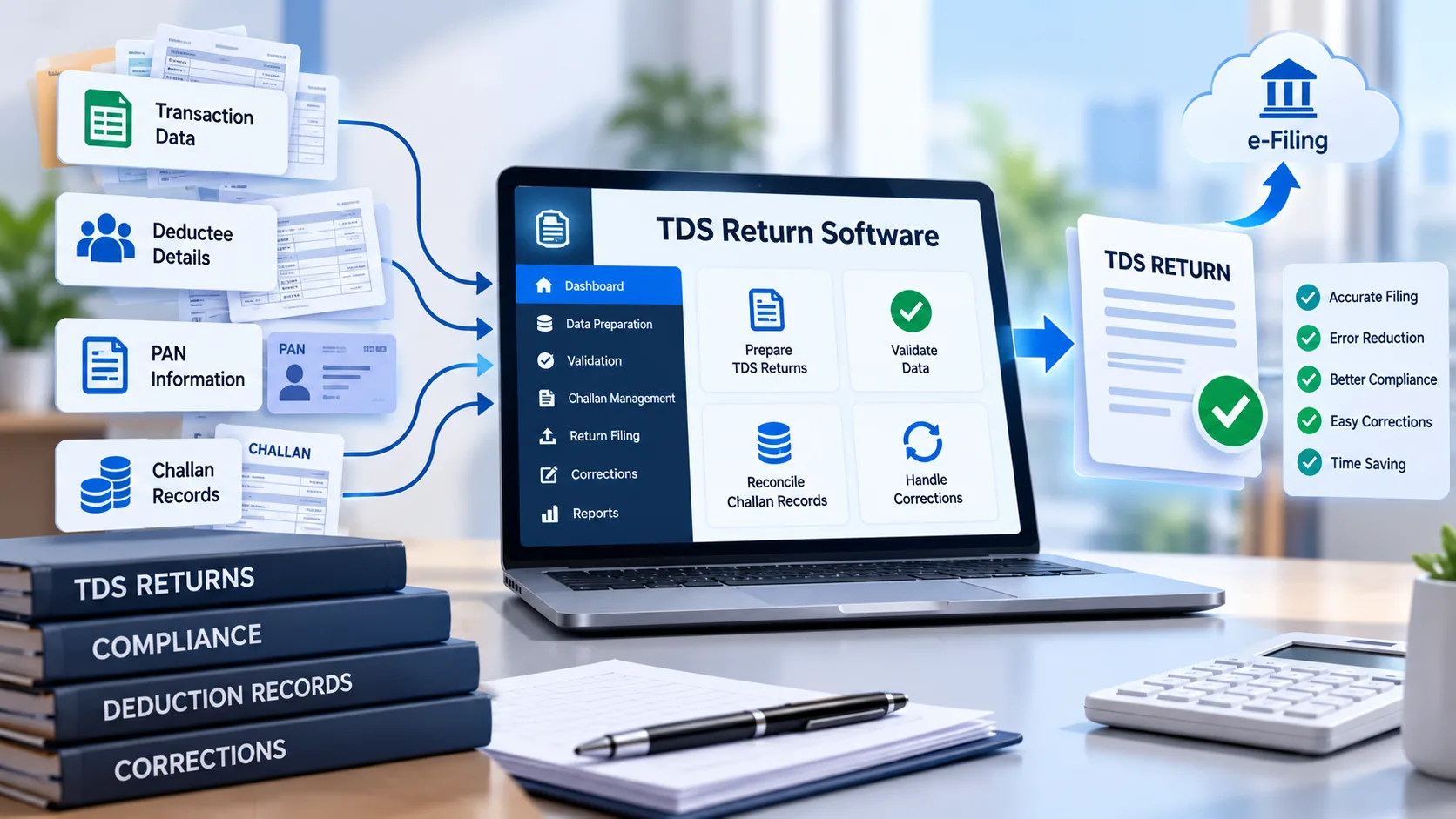
Preparing a TDS return is rarely just about entering deduction figures and generating a file. Finance teams also have to organise deductee information, check PAN details, reconcile challans, validate transaction data and deal with corrections when something goes wrong. As the number of deductions increases, these activities can become difficult to manage manually. This is where TDS return software can help create a more structured filing workflow.
The value of a TDS system should therefore be measured by more than its ability to generate a return. For businesses and professional tax teams, the bigger question is whether it can reduce repeated data entry, improve validation and make it easier to identify issues before they affect the filing.
Why TDS return preparation becomes complicated
A quarterly TDS return brings together information from several parts of a business.
Payment records may come from accounting software, employee information may come from payroll, challan details may be maintained separately, and deductee information may need to be checked against existing records.
When these sources are handled independently, inconsistencies can easily appear.
For example, a finance team may have the correct deduction amount in its accounting records but an incorrect PAN in the return data. Similarly, the tax may have been deposited correctly but the corresponding challan may not have been allocated properly during return preparation.
These problems can create additional checking and correction work.
The challenge becomes larger for CA firms because the same process has to be repeated across multiple clients and filing periods.
Data preparation is the first important checkpoint
Before a return can be filed, the underlying information needs to be organised properly.
A practical TDS return software workflow should help teams work with existing records instead of forcing them to repeatedly enter the same information.
Useful capabilities can include:
- Importing or organising transaction data
- Maintaining deductee information
- Reviewing PAN details
- Checking deduction amounts
- Identifying incomplete records
- Preparing data in the required return structure
This is particularly useful when transaction volumes are high.
Consider a company making hundreds of payments during a quarter. Even if only a small percentage of records contain errors, manually checking every entry can consume significant time. A structured system allows the team to focus more attention on records that actually require review.
Validation should happen before submission
Generating a return file is only one stage of the compliance process.
Validation before submission is equally important because an error discovered early is generally easier to address than one discovered after filing.
The current TDS framework also makes software validation more relevant. The Income Tax Department states that TDS obligations for transactions on or before March 31, 2026 continue under the Income-tax Act, 1961, while transactions from April 1, 2026 onwards are governed by the Income-tax Act, 2025. It also notes that applicable section references have changed for new transactions.
For software users, this means the system needs to support the reporting requirements relevant to the period being processed.
A useful validation workflow should help identify issues such as:
- Incorrect or incomplete deductee information
- Incorrect section references
- Differences in deduction amounts
- Missing or inconsistent challan information
- Other return-level validation issues
The Income Tax Department has also confirmed that return-preparation utilities and TRACES will support both old-format returns for periods up to March 2026 and new-format returns for periods from April 2026 onwards during the transition.
Challan reconciliation can reduce repetitive checking
TDS deduction and payment information need to remain properly connected.
When challan details are maintained separately from deduction records, finance teams may have to repeatedly compare figures across spreadsheets, accounting records and payment information.
This is one area where software can reduce manual checking.
A good workflow should make it easier to review:
- Challan details
- Tax deposited
- Amount allocated
- Remaining balances
- Related deduction records
- Items requiring reconciliation
For a business with limited transactions, manual reconciliation may remain manageable. For a CA firm handling several deductors, having this information organised within the filing workflow can save considerable review effort.
Corrections are part of the filing process
A TDS return is not always finished once the original statement has been submitted.
Errors can later be identified in PAN information, deduction details, challan allocation or other reported information. The ability to manage these corrections should therefore be considered when evaluating TDS return software.
The Income Tax Department confirms that correction statements for periods governed by the earlier Income-tax Act, 1961 can still be filed after April 1, 2026, under the applicable old framework. Corrections relating to those periods continue to use the relevant old forms and formats.
This makes historical return data important.
If a correction requires the team to recreate information from old spreadsheets, the administrative effort can quickly increase. A system that keeps filing information organised can make it easier to identify the affected record and prepare the required correction.
The 2026 transition makes record management more important
The shift to the Income-tax Act, 2025 introduces another reason to keep TDS records organised.
The applicable Act depends on when the earlier of credit or payment occurs. Transactions where that event occurred on or before March 31, 2026 remain under the old Act, while transactions from April 1, 2026 onwards follow the new framework.
This means a finance team may be working with both historical and current TDS records during the same period.
For example, a company may need to correct a return for an earlier quarter under the old framework while simultaneously preparing a new return under the new framework.
Software should therefore help maintain a clear distinction between these reporting periods instead of treating every TDS record in the same way.
What should businesses test before choosing software?
A product demonstration can show the interface, but a practical test can reveal whether the system actually fits the team's workflow.
Use a sample containing:
- Multiple deductees
- Different transaction types
- Challan information
- Some incomplete records
- A few records requiring correction
- Historical return information
Then follow the complete process from data preparation to filing.
The important questions are:
Can data be imported without unnecessary re-entry?
Can errors be identified before submission?
Can challans be reconciled efficiently?
Can previous return information be accessed for corrections?
Can the system handle the applicable reporting framework for the period?
These questions provide more useful information than simply comparing feature counts between different products.
TDS software should reduce work, not create another layer
Automation only provides value when it removes repetitive work.
If a business adopts software but still maintains several disconnected spreadsheets for deduction data, challan reconciliation and correction tracking, much of the original problem remains.
The better approach is to map the current process first.
Identify where the team spends the most time. It could be collecting data, checking PAN details, reconciling challans, validating files or preparing corrections.
Then assess whether the software addresses those specific tasks.
For finance teams and CA firms, this approach can make software selection more practical because the decision is based on actual workflow requirements rather than a long feature list.
A more controlled TDS workflow
TDS return software is most useful when it connects the stages that finance teams already perform manually.
The ideal workflow is straightforward:
Data preparation → Validation → Reconciliation → Return preparation → Filing → Record keeping → Correction
Each stage should leave the team with clearer and more reliable information for the next one.
The 2026 transition also reinforces the need for organised records. Current transactions may follow the new framework while historical returns and their corrections continue to require the earlier framework.
For businesses and professional tax teams, the practical goal is therefore not simply faster return generation. It is a filing process where errors can be identified earlier, records can be reviewed more easily and corrections do not require rebuilding information from scratch.
That is the role a well-integrated TDS return software solution can play in a modern compliance workflow.