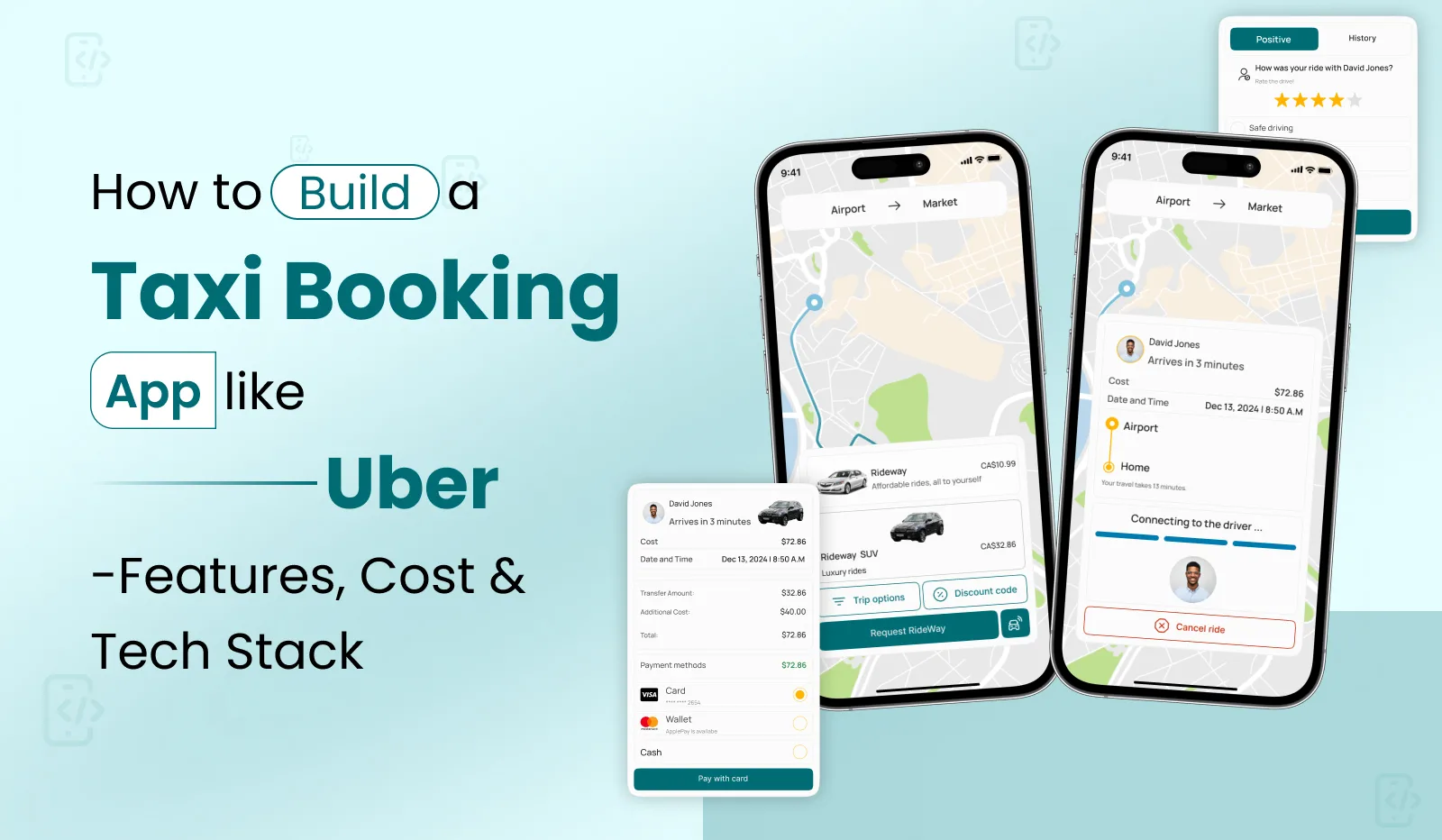
Uber’s fixed-price model isn’t the only ride-hailing model that works. The bidding model — inDriver-style — is winning in Africa, India, and Southeast Asia right now. Here’s how to pick the right one, and what it actually costs to build — from a taxi booking app development company that builds both.
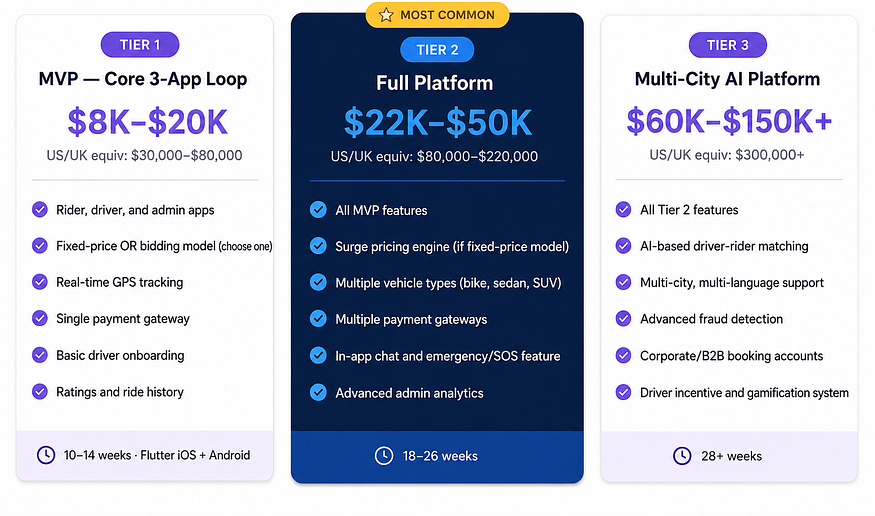
The number you came here for Uber clone app development cost starts at $8,000–$20,000 for an MVP (rider app, driver app, admin panel, GPS tracking, basic payments) at India development rates. A mid-tier platform with surge pricing and multiple vehicle types costs $22,000–$50,000. A complex multi-city platform with AI-based driver matching costs $60,000–$150,000+. US agencies quote $30,000–$300,000+ for the same scope. The decision that matters more than the price tag: are you building Uber’s fixed-price model, or the bidding model that’s actually winning in price-sensitive markets right now? See our Uber clone app development service →
Most guides on taxi booking app development assume there’s one ride-hailing model — Uber. There isn’t. Uber calculates a fixed fare algorithmically before you book, and that price is the price. A completely different model, popularized by inDriver, lets passengers post a desired price, and drivers choose to accept, counter, or pass. This bidding model has gained real traction in Africa, India, and Southeast Asia, specifically because riders and drivers in price-sensitive markets often prefer negotiation over an algorithm’s fixed number.
Neither model is universally “better.” They solve for different things, and the architecture, complexity, and even the UX challenge differ meaningfully between them. Whether you’re working with a ride-hailing app development company to build a cab booking app MVP from $8,000 or a full multi-city platform, this guide treats the pricing model as the first real decision — not an afterthought — because it shapes everything, you’re about to pay someone to build.
$254B
Global taxi market size, 2026
$8K
MVP starting cost (India rates)
60–70%
Cheaper than US/UK agency rates
3
3 Apps Behind Every Ride
2
Fixed vs Bidding Model
Fixed-Price vs Bidding: Which Taxi App Model Should You Build?
This is the most important decision in your taxi booking app development — it shapes your pricing engine, driver incentive structure, and onboarding UX. Make it before a single screen gets designed, not bolted on afterward.
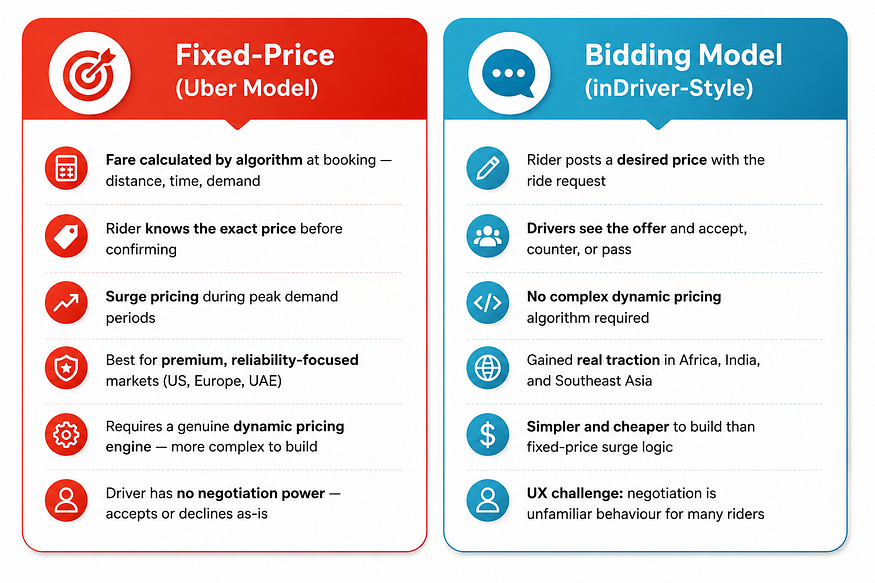
Why the bidding model is gaining ground in specific markets — and why that matters for your build: In markets where riders are highly price-sensitive and have historically negotiated fares with traditional taxis or auto-rickshaws anyway, an algorithm dictating a fixed price can feel less fair than negotiation, even when the algorithm’s price is objectively reasonable. The bidding model also reduces the engineering burden significantly — you’re not building demand forecasting and surge multiplier logic, you’re building a straightforward offer-and-counter flow. If you’re targeting a price-sensitive emerging market, the bidding model is both more culturally aligned and meaningfully cheaper to build well.
Multi-Vendor Marketplace Architecture: 3 Products, One Backend
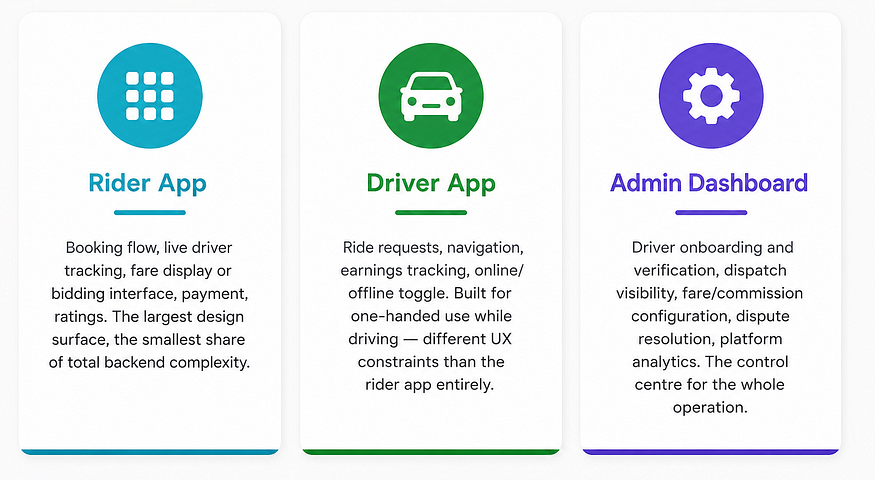
If multi-vendor genuinely is your model, here’s what you’re actually building — three coordinated products sharing one backend, each serving a completely different user.
Taxi Booking App Features List: What Each App Needs
Rider App — Core Features for Your Taxi MVP
Phone or social login with OTP verification. Pickup and destination selection with map-based and address search input. Fare estimate (fixed-price model) or fare offer input (bidding model) before confirming. Live GPS tracking on a map with accurate ETA. In-app chat or call with the assigned driver. Multiple payment methods — card, UPI, wallet, cash. Ride history and receipts. Driver rating after each ride.
Driver App — Must-Have Features
Online/offline availability toggle. Incoming ride request with pickup distance and (in the bidding model) the rider’s offered price. Turn-by-turn navigation to pickup and destination. Earnings dashboard with per-ride and daily totals. Ride history. In-app communication with the assigned rider. Document upload for verification (licence, vehicle registration, insurance).
Admin Panel — Dispatch & Platform Controls
Driver onboarding workflow with document verification. Live dispatch map showing active rides and available drivers. Commission rate configuration. Fare/pricing rule management (surge multipliers for fixed-price, or bidding floor/ceiling guardrails for the bidding model). Dispute and refund handling. Platform-wide analytics — completed rides, cancellation rate, average wait time, driver utilization.
The feature every guide undersells: driver-rider matching logic: Matching sounds simple — find the nearest available driver — until you factor in live location accuracy, a driver’s likelihood of accepting based on recent behaviour, coverage gaps in low-density areas, and acceptable timeout windows before re-offering to the next driver. This is genuinely one of the harder pieces of engineering in the entire platform, and it’s the part that determines whether riders experience “instant match” or “waiting three minutes for a driver who then cancels.” Budget real engineering time here — it’s not a Google Maps API call; it’s a dispatch algorithm.
Taxi App Development Cost 2026: 3 Tiers at India Rates
Taxi app development cost in 2026 ranges from $8,000 for a core MVP to $150,000+ for a multi-city AI platform — all at Indian rates, fixed price, full source code, Flutter iOS and Android.
Taxi App Tech Stack 2026: Flutter, Node.js & PostGIS
Flutter handles rider and driver apps on iOS and Android from one codebase. Node.js manages real-time matching. PostGIS powers location queries. Here’s the full stack.
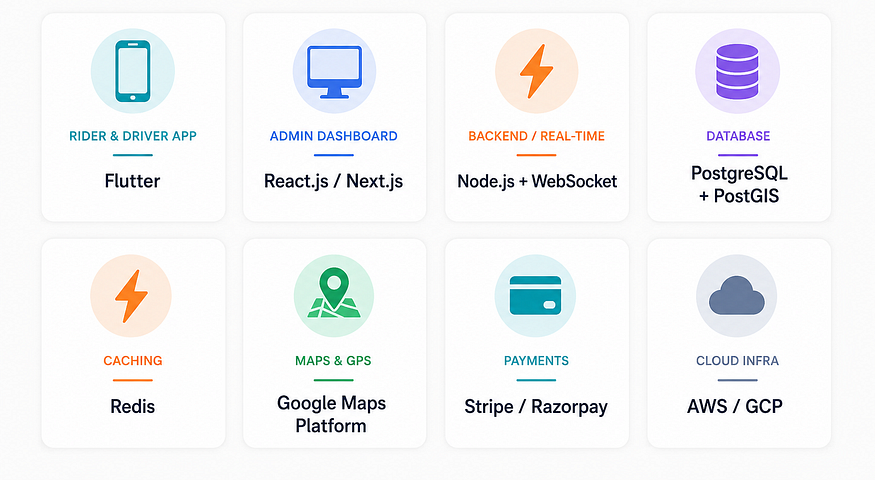
Why PostGIS matters more than it looks like it should: Finding the nearest available drivers to a pickup point sounds like a basic distance calculation, but at any meaningful scale — hundreds of drivers moving constantly across a city — a naive query checking every driver’s distance on every request becomes slow and expensive fast. PostGIS, the geographic extension for PostgreSQL, indexes location data spatially so “find drivers within 2km” is a fast, native query rather than an expensive full-table scan. This is the kind of detail that doesn’t show up in a taxi booking app features list but determines whether your on-demand transportation app feels instant or sluggish once you have real driver volume.
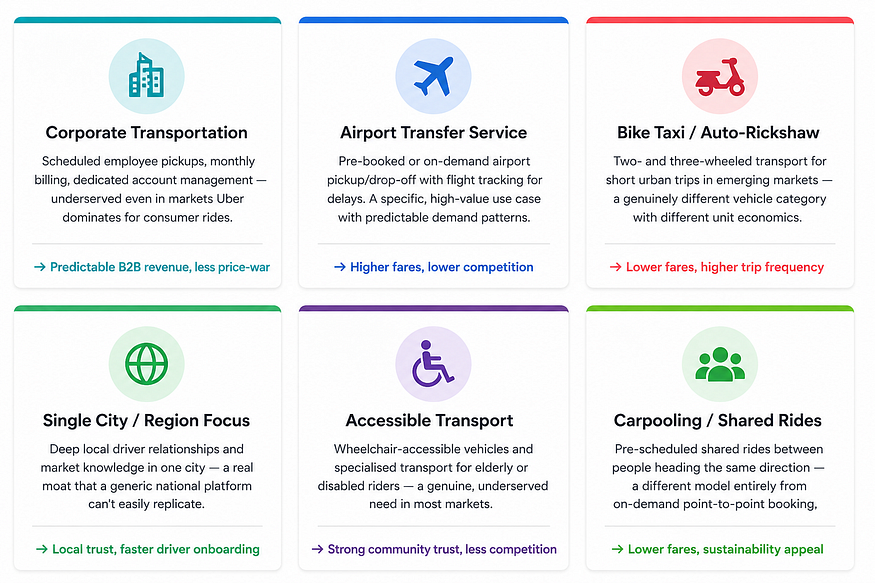
Niche Taxi App Strategy: How to Win Without Competing With Uber
Uber’s advantage isn’t its app. It’s years of driver supply built city by city, regulatory relationships negotiated market by market, and brand trust earned at a massive scale. A new ride-hailing app development project cannot replicate that broadly — trying to build a general cab booking app that competes with Uber nationally is close to certain to fail on the supply side. You simply can’t onboard enough drivers fast enough to make the rider experience competitive.
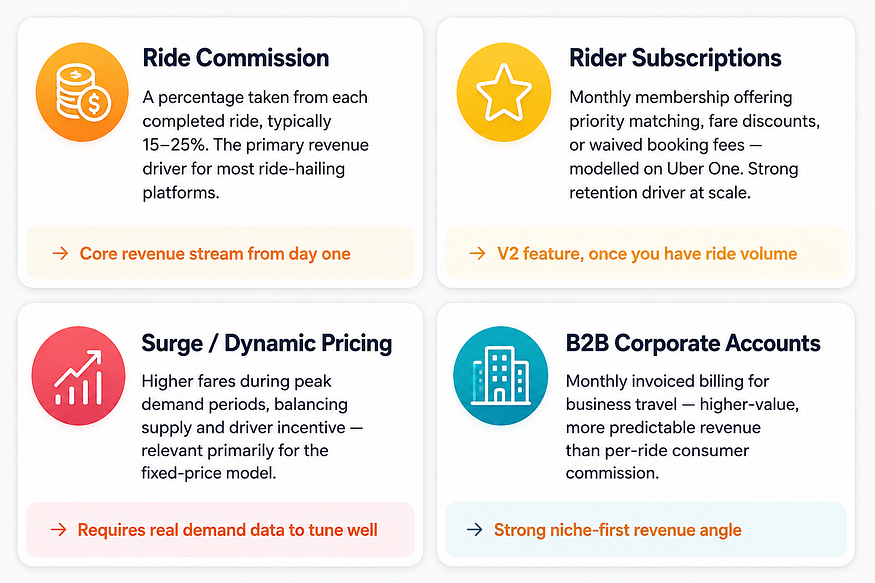
Ride-Hailing App Monetization: 5 Revenue Models That Work
Not all ride-hailing revenue comes from commission. Here are five monetization models — from per-ride fees and surge pricing to B2B corporate accounts and rider subscriptions.
“A ride-hailing app that tries to out-supply Uber loses on driver acquisition before it ever launches. A platform that out-serves Uber in one city, one vertical, or one underserved rider segment has a real shot — and costs a fraction of what ‘build me an Uber competitor’ actually requires.”
Primocys · Uber Clone App Development
A Taxi Booking App Development Company That Builds Both Pricing Models
Primocys is a ride-hailing app development company serving clients in the US, UK, UAE, Africa, and Southeast Asia. From Uber clone app development to inDriver-style bidding platforms — we scope the right model for your market, not just the familiar one. Flutter rider and driver apps, fixed price from $8,000, full source code ownership.
Right pricing model, scoped honestly
We’ll recommend fixed-price or bidding based on your actual target market — not just build whatever’s familiar.
PostGIS-powered matching
Real spatial indexing for fast, accurate driver matching — not a naive distance scan that slows down at scale.
Stripe + Razorpay built in
Global and regional payment coverage. Automatic commission split and driver payouts.
Niche-first strategy advice
We’ll help you scope the right vertical or city, not just build a generic ride-hailing clone.
Flutter — 35% cheaper than native
Clutch Top Flutter Developer 2024 & 2026. One codebase for rider and driver apps.
Fixed price from $8,000
Cost agreed before development starts. Milestone payments. Full source code ownership.
Conclusion: Build the Right Taxi App, Not Just a Cheaper Uber Clone
Uber clone app development in 2026 is not simply about replicating Uber feature-for-feature — it’s about identifying the right market, choosing the right pricing model, and building a focused product that earns driver supply and rider trust in a specific geography or vertical.
If you’re targeting a premium market like the US, UAE, or Europe, the fixed-price model with dynamic surge pricing is the right architecture. If you’re building for Africa, India, Southeast Asia, or any price-sensitive emerging market, the inDriver-style bidding model is culturally aligned, meaningfully cheaper to build, and genuinely proven at scale in those regions.
Either way, Flutter gives you the fastest path to iOS and Android simultaneously, Node.js + PostGIS gives you the real-time backend your ride-hailing platform needs, and India development rates give you 60–70% cost savings over equivalent US or UK agencies — without compromising on quality if you choose the right partner.
Start with a niche. Build the MVP. Prove driver supply and rider demand in one city or one use case. Then scale. That’s the strategy that works in 2026 — and it starts with a realistic, feature-by-feature estimate, not a round number pulled from a competitor’s quote. Get your free estimate from Primocys →
Get a Fixed-Price Estimate for Your Taxi Booking App — in 48 Hours
Tell us your target market, pricing model (fixed or bidding), and vehicle categories. We’ll send you a feature-by-feature cost breakdown and an honest architecture recommendation — no sales call required.