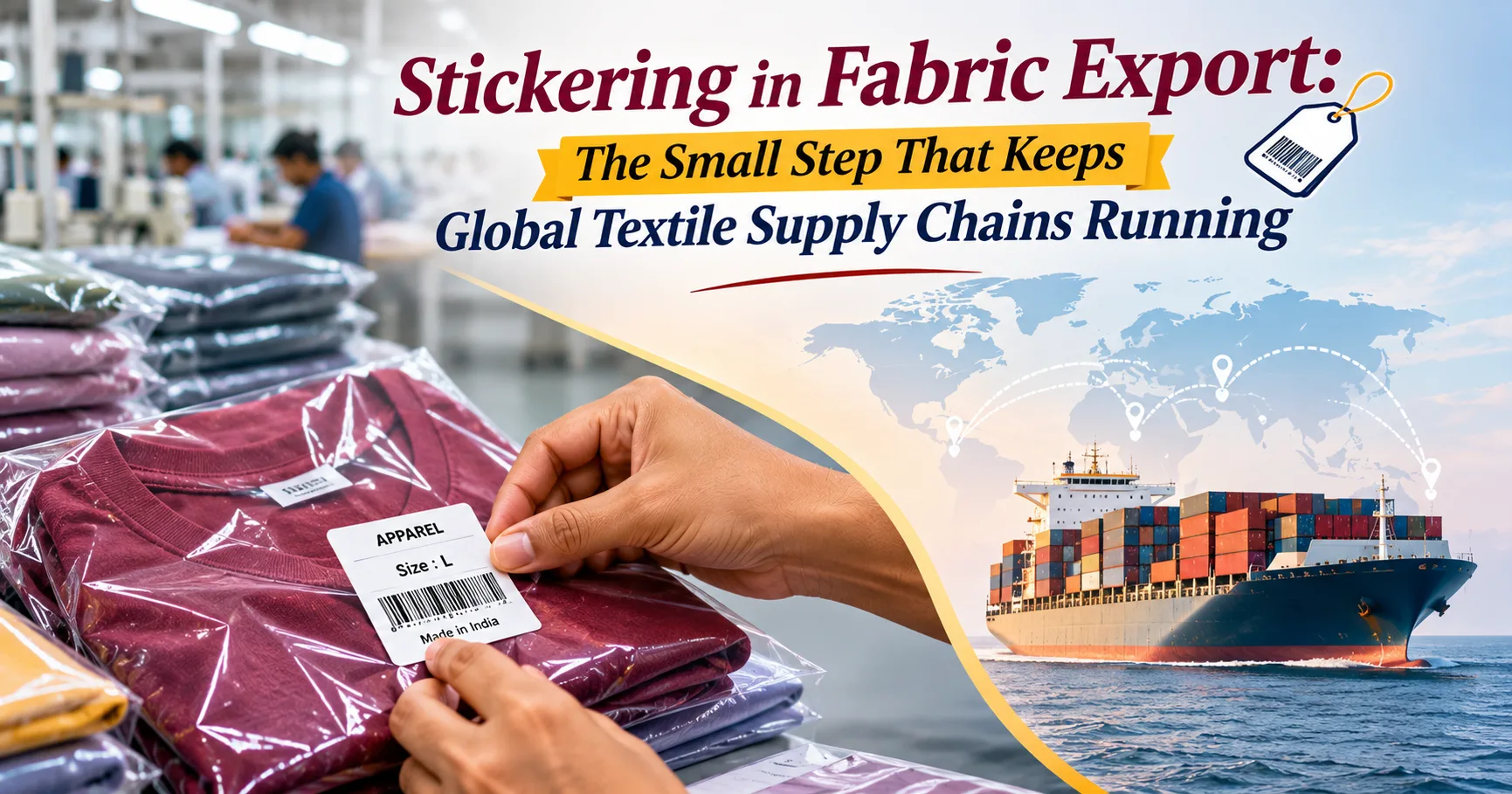
A single fabric order can involve hundreds of rolls, several shades, multiple qualities and a buyer thousands of kilometres away. Between the loom and the cutting table, one small step decides whether everything arrives organised or in confusion: stickering.
In textile manufacturing, stickering is the process of attaching identification labels to fabric rolls, bales and cartons. It rarely gets attention, yet for exporters and buyers alike, it is one of the quiet foundations of reliable supply.
What is stickering in the textile industry?
Stickering means labelling each fabric roll with the information needed to identify, track and use it. These labels are typically applied at the end of the production flow, after weaving, finishing and quality inspection, just before packing and dispatch.
A typical roll sticker may include:
- Quality or article number: which fabric the roll actually is
- Roll length and width: so buyers can plan cutting and costing
- Shade or lot number: essential for colour consistency
- Purchase order or buyer reference: so the roll is matched to the right order
- Roll number: for inspection records and traceability
The exact details vary by buyer and by order, but the purpose is constant: no roll should ever be anonymous.
Why stickering matters more than it looks
1. It protects colour and lot consistencyFabric from different dye lots can show slight shade variation. This is especially relevant for yarn dyed and printed fabrics, where colour and pattern consistency are critical. If rolls from different lots get mixed in a garment run, the final product can show visible differences. Clear lot information on every roll helps factories keep batches together.
2. It speeds up receiving and inspectionWhen a shipment arrives, warehouse teams need to verify quantities quickly. Clear, consistent stickering means a roll can be read, checked against the packing list and put away without guesswork.
3. It supports traceabilityIf a quality question arises later, a labelled roll can be traced back through the production record. This matters especially for buyers who must document their supply chain.
4. It reduces costly errorsWrong shipments, mismatched widths and mixed qualities are expensive to fix across borders. Accurate stickering is a low-cost control that prevents high-cost mistakes. This applies across every construction, from plain and twill weaves to dobby and jacquard fabrics, where look-alike rolls are easy to confuse.
Stickering and sustainability documentation
Traceability is now central to sustainable textiles. Standards such as GOTS, GRS, OCS, BCI Cotton and OEKO-TEX rely on documented chains of custody and clearly identifiable materials. While certification paperwork carries the formal proof, clear labelling at roll and carton level helps ensure certified and non-certified goods are not confused during handling and shipping.
For brands trying to back up sustainability claims, this operational discipline matters. A label is a small thing, but it supports the credibility of a much larger promise.
Best practices for effective stickering
Whether you are a manufacturer or a buyer reviewing suppliers, these are the habits that signal a well-run operation:
- Standardise the label format so every roll carries information in the same layout.
- Match labels to the packing list and verify them before dispatch.
- Use durable, readable labels that survive handling, transit and humidity.
- Label both the roll and the outer packaging so identification doesn’t depend on opening the carton.
- Follow buyer-specific requirements for barcodes, order numbers and markings, agreed before production starts.
- Cross-check at the end: a final audit of labels against inspection records catches errors while they are still easy to fix.
What buyers should ask their fabric suppliers
When evaluating a woven fabric supplier, consider asking:
- What information appears on each roll label?
- Can labels be customised to our internal codes or barcodes?
- How are lot and shade details recorded and linked to each roll?
- How is stickering checked before shipment?
Suppliers who answer these questions confidently usually have strong process control elsewhere too.
The manufacturer’s perspective
Exporters serving international brands know that accurate documentation and labelling are part of the product, not an afterthought. Dinesh Exports, a woven fabric manufacturer and exporter operating since 1994, supplies cotton, linen, hemp, lyocell and blended fabrics across plain, twill, satin, dobby and jacquard constructions.
With certifications including GOTS, GRS, OCS, BCI Cotton, OEKO-TEX and Fair Trade, the company works in a segment where traceability and clear identification are part of everyday expectations. Buyers can explore the full fabric catalogue and share their labelling or packing requirements before placing an order.
Final thoughts
In global textile trade, quality is judged on the fabric itself, but reliability is judged on everything around it. Stickering is a prime example: inexpensive, easy to overlook, and quietly essential. The next time you evaluate a fabric supplier, look closely at the roll label. It tells you a great deal about how the rest of the business runs.