
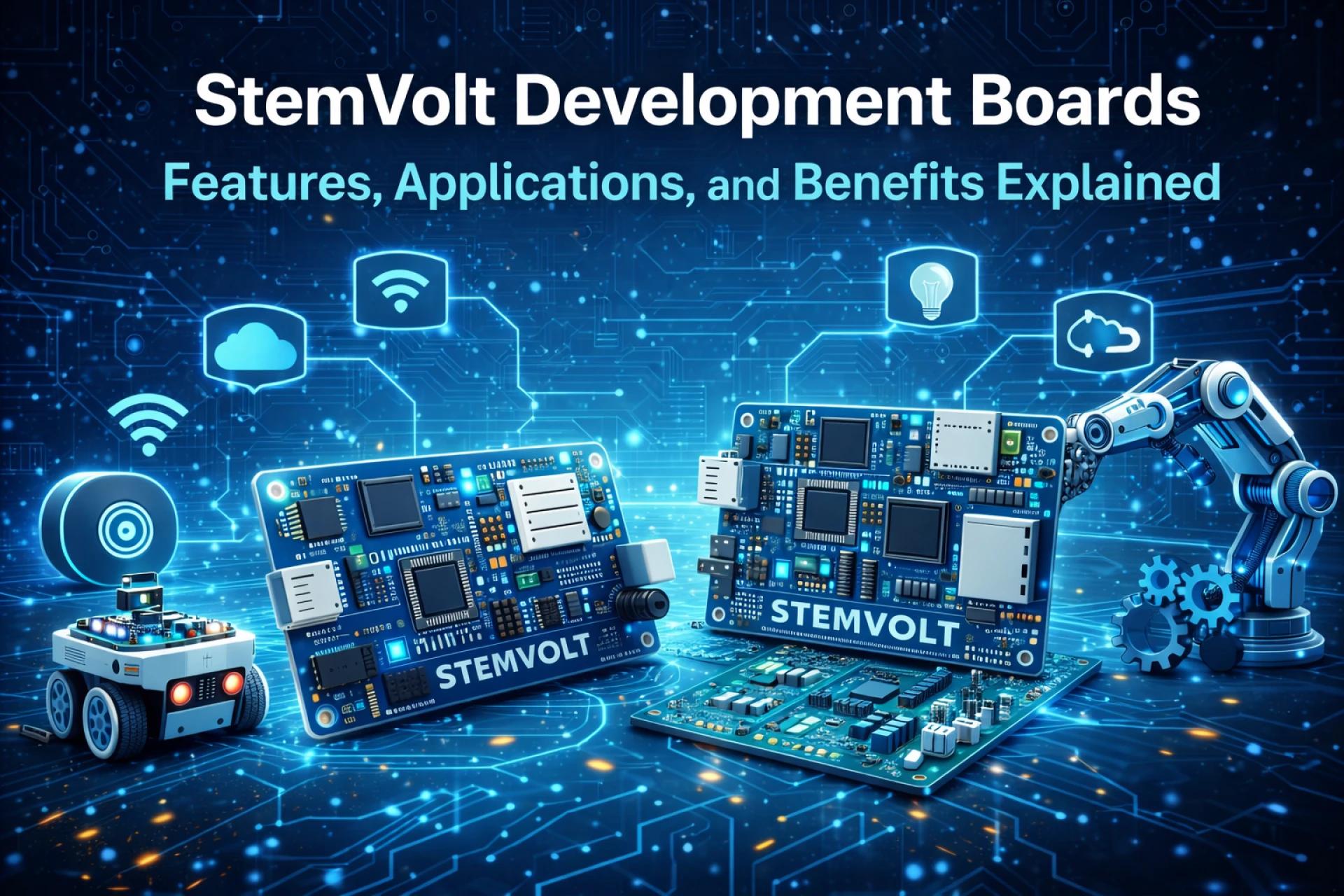
In the rapidly evolving world of electronics and embedded systems, development boards play a crucial role in enabling engineers, students, and hobbyists to design, prototype, and test new technologies. Among the emerging platforms in this space, StemVolt development boards are gaining attention for their flexibility, ease of use, and powerful capabilities. These boards provide a convenient hardware platform that helps users build and experiment with embedded systems, IoT devices, robotics projects, and many other applications.
This article explores StemVolt development boards, their key features, common applications, and the benefits they offer to developers and learners.
What Are StemVolt Development Boards?
StemVolt development boards are specialized hardware platforms designed to simplify the process of developing and testing electronic systems. They typically include a microcontroller or processor, power management circuits, input/output interfaces, and connectivity options on a single board.
These boards allow developers to write, upload, and test software directly on hardware without needing to design complex circuits from scratch. As a result, development boards significantly reduce the time required for prototyping and experimentation.
StemVolt boards are particularly useful in educational environments, research labs, and product development settings where quick testing and learning are essential.
Key Features of StemVolt Development Boards
1. Powerful Microcontroller Integration
Most StemVolt development boards include a high-performance microcontroller capable of handling complex computations, sensor integration, and communication protocols.
2. Multiple Input and Output Interfaces
StemVolt boards provide a wide range of I/O options such as:
- Digital pins
- Analog inputs
- PWM outputs
- Communication interfaces like UART, SPI, and I2C
These features allow the board to connect easily with sensors, motors, displays, and other external components.
3. Easy Programming Support
StemVolt development boards usually support popular programming environments and languages such as:
- C/C++
- Python
- Embedded scripting frameworks
This flexibility makes them accessible to both beginners and advanced developers.
4. Built-in Connectivity
Many modern development boards include integrated communication technologies such as:
- Wi-Fi
- Bluetooth
- USB interfaces
This allows users to develop connected devices and Internet of Things (IoT) solutions without additional hardware.
5. Compact and Modular Design
StemVolt boards are designed to be compact and easy to integrate into larger systems. Their modular architecture allows developers to expand functionality using additional modules and sensors.
Applications of StemVolt Development Boards
1. Internet of Things (IoT) Projects
StemVolt boards can be used to build smart devices that collect and transmit data through the internet. Examples include smart home systems, environmental monitoring devices, and wearable technology.
2. Robotics and Automation
Because of their multiple I/O capabilities and real-time processing, StemVolt development boards are well suited for robotics projects. They can control motors, sensors, and actuators in robotic systems.
3. Educational Learning Platforms
StemVolt boards are widely used in STEM education to teach students about electronics, programming, and embedded systems. Their beginner-friendly design makes them ideal for classroom projects and technical training.
4. Rapid Prototyping
Engineers often use development boards to quickly test new product ideas. Instead of designing custom hardware immediately, they can build a prototype using a StemVolt development board to validate the concept.
5. Smart Devices and Embedded Systems
StemVolt boards can serve as the core controller for smart devices such as automated lighting systems, smart agriculture tools, and industrial monitoring equipment.
Benefits of Using StemVolt Development Boards
Faster Development Process
By providing ready-to-use hardware, StemVolt boards allow developers to focus on software and system design rather than building circuits from scratch.
Cost-Effective Prototyping
Development boards reduce the need for expensive custom hardware during early product development stages.
Beginner-Friendly Learning
Students and beginners can easily start experimenting with electronics and programming using StemVolt boards.
Wide Compatibility
StemVolt boards are compatible with a wide range of sensors, modules, and expansion shields, making them extremely versatile.
Community and Documentation
Many development boards benefit from growing communities and documentation, which helps users find tutorials, sample code, and troubleshooting support.
Future Potential of StemVolt Development Boards
As technology continues to evolve, development boards like those from StemVolt are expected to become even more powerful and accessible. Future versions may include improved processing capabilities, enhanced connectivity options, and better integration with artificial intelligence and machine learning tools.
These advancements will further expand the role of development boards in areas such as smart cities, healthcare devices, industrial automation, and advanced robotics.
Conclusion
StemVolt development boards provide a versatile and powerful platform for building modern electronic systems. With features such as integrated microcontrollers, multiple I/O interfaces, connectivity options, and easy programming support, they are ideal for both beginners and professional developers.