
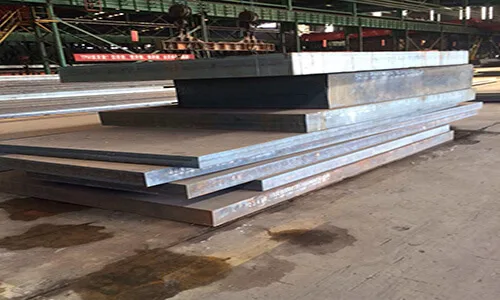
Stainless Steel 321 plates are a titanium-stabilized austenitic stainless steel product designed for improved resistance to intergranular corrosion and enhanced performance at elevated temperatures. This grade is widely used in industries where materials are exposed to continuous heating, welding, and oxidizing environments.
Defined under standards such as ASTM A240, Stainless Steel 321 is particularly suitable for applications where resistance to sensitization during welding or high-temperature service is critical.
Overview of Stainless Steel 321
Stainless Steel 321 is an austenitic chromium-nickel stainless steel stabilized with titanium. The addition of titanium helps prevent chromium carbide precipitation, which can occur when stainless steel is exposed to temperatures between approximately 450°C and 850°C.
This stabilization makes 321 an excellent choice for applications involving prolonged heat exposure or repeated thermal cycles.
Chemical Composition
The chemical composition of Stainless Steel 321 is designed to provide both corrosion resistance and thermal stability:
- Chromium (Cr): ~17% – 19%
- Nickel (Ni): ~9% – 12%
- Carbon (C): ≤ 0.08%
- Titanium (Ti): Added as a stabilizing element (typically ≥ 5× carbon content)
- Manganese (Mn), Silicon (Si), and trace elements
Titanium binds with carbon to form stable carbides, preventing the formation of chromium carbides that can reduce corrosion resistance.
Mechanical Properties
Stainless Steel 321 plates offer a balanced set of mechanical properties:
- Good tensile and yield strength
- Excellent ductility and toughness
- Stable mechanical performance at elevated temperatures
- Resistance to creep at moderate high temperatures
These properties make it suitable for structural and pressure applications in high-temperature environments.
Key Features and Advantages
Resistance to Intergranular Corrosion
The titanium stabilization prevents sensitization, allowing the material to retain corrosion resistance after welding or prolonged heating.
High-Temperature Strength
321 maintains its strength and structural integrity in elevated temperature conditions, making it suitable for thermal applications.
Oxidation Resistance
The chromium content provides resistance to oxidation and scaling in high-temperature environments.
Good Weldability
321 can be welded without the risk of intergranular corrosion, eliminating the need for post-weld annealing in many cases.
Durability Under Thermal Cycling
The material performs well under repeated heating and cooling cycles, which is common in industrial processes.
Applications
Stainless Steel 321 plates are widely used in industries that require resistance to heat and corrosion:
Aerospace Industry
- Exhaust systems
- Engine components
- Heat shields
Power Generation
- Boiler components
- Superheaters
- Heat exchangers
Petrochemical and Refining
- Process equipment
- Piping systems
- Reactor components
Industrial Furnaces
- Furnace parts
- Heat treatment equipment
Chemical Processing
- Equipment exposed to high temperatures and corrosive media
Heat Resistance and Performance
Stainless Steel 321 is particularly suitable for continuous service at elevated temperatures. It resists oxidation and maintains structural integrity under thermal stress.
Its resistance to sensitization makes it a preferred alternative to standard grades like 304 in high-temperature applications.
Fabrication and Welding
321 plates are easy to fabricate:
- Can be formed, cut, and machined using standard methods
- Weldable with common welding techniques
- No requirement for post-weld heat treatment in most cases
However, care should be taken to avoid excessive heat input during welding to maintain optimal properties.
Standards and Specifications
Stainless Steel 321 plates are typically manufactured according to:
- ASTM A240 (for plates, sheets, and strips)
- ASME SA240 (for pressure vessel applications)
These standards ensure consistent chemical composition, mechanical properties, and quality.
Limitations
While Stainless Steel 321 offers many benefits, some limitations include:
- Not ideal for highly chloride-rich environments (risk of pitting corrosion)
- Slightly higher cost compared to standard grades like 304
- Not as strong at very high temperatures as some specialized high-alloy materials
Conclusion
Stainless Steel 321 plates are a reliable and versatile material for high-temperature applications where resistance to intergranular corrosion is essential. The addition of titanium provides stability during welding and prolonged heat exposure, making it suitable for demanding industrial environments.