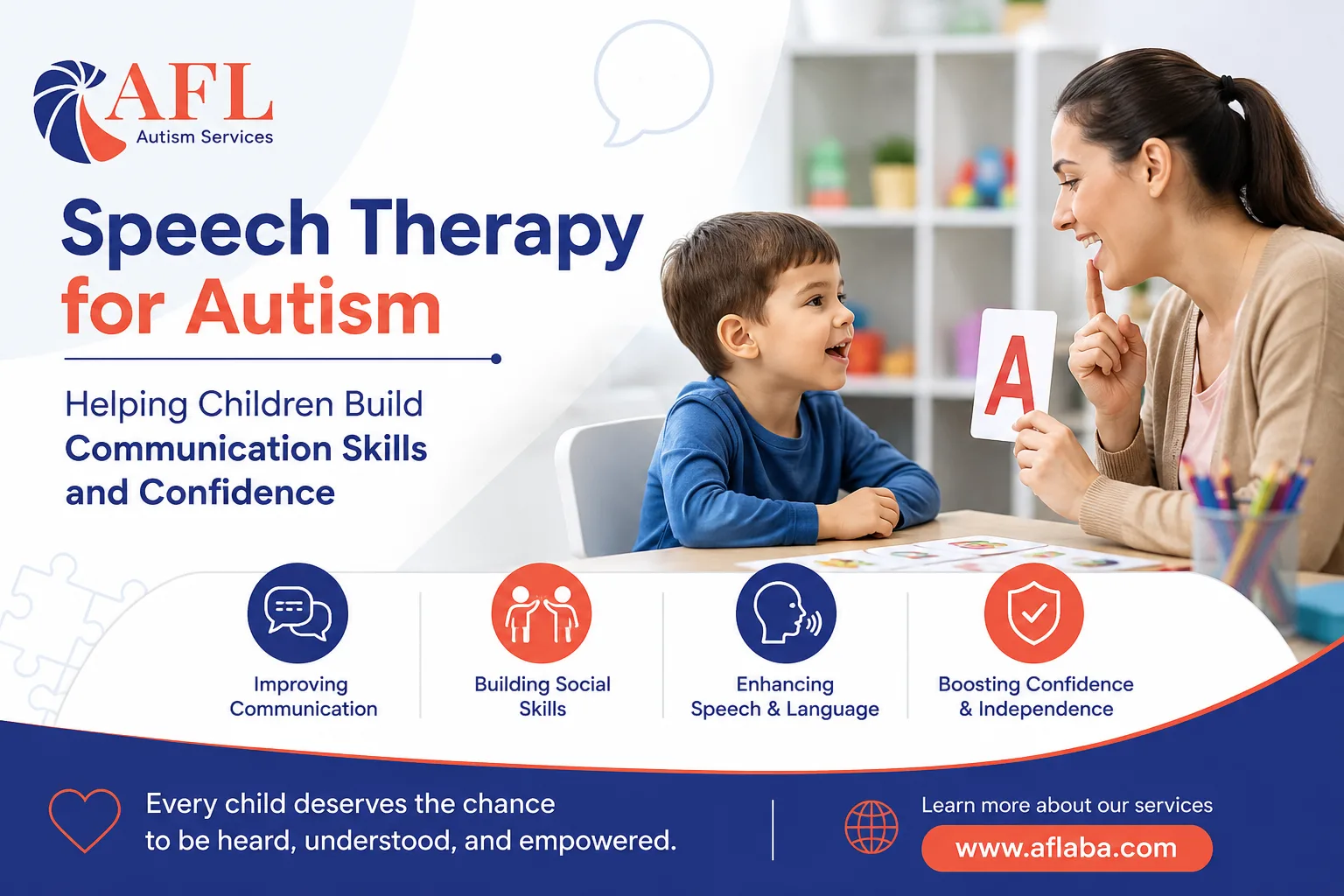
Every child has something to say. For children on the autism spectrum, finding the words, or any reliable way to express them, can be one of the hardest parts of daily life. Speech therapy for autism doesn't just teach language. It opens a door.
What Speech Therapy Actually Does for Autistic Children
There's a common misconception that speech therapy is about getting a child to talk more. For many autistic children, the goal is far more nuanced than that.
Some children are nonverbal or minimally verbal. Others speak fluently but struggle with the social side of communication: understanding tone, taking turns in conversation, or reading what someone means beyond their literal words. A child might know hundreds of words and still feel completely isolated because conversation doesn't work the way it does for their peers.
Speech-language pathologists (SLPs) work across all of these challenges. They assess how a child communicates right now and build a path forward from there. That might mean developing functional language, introducing augmentative and alternative communication (AAC) tools, or working on pragmatic skills like initiating conversations and understanding context.
The work is deeply individualized, which is exactly why it works.
Why Early Intervention Changes the Trajectory
Ask any SLP or behavioral specialist and they'll tell you the same thing: earlier matters.
The brain's capacity for language learning is most flexible during the first few years of life. When a child receives speech therapy for autism during this window, they're not just learning words. They're developing neural pathways that make future communication easier. The skills build on each other.
A parent once described it this way: their son received an autism diagnosis at 26 months. Within weeks, they started speech therapy. By age four, he was using full sentences to describe what he wanted for dinner and to complain, quite specifically, that his socks felt "too scratchy." What seemed minor to an outside observer was, for that family, everything.
Early intervention isn't about rushing a child or forcing a timeline. It's about giving the brain what it needs when it's most ready to receive it.
How Speech Therapy for Autism Works in Practice
So what does an actual session look like? That depends heavily on the child, the therapist, and the goals in place.
For a younger child, sessions often look like play. A therapist might use bubbles, puzzles, or favorite toys to create natural opportunities for communication. When a child reaches for a toy and the therapist waits, pausing just long enough for the child to attempt a request, that moment is therapy. It doesn't feel clinical because it isn't meant to.
For older children, sessions might focus on conversational scripts, social narratives, or practicing how to ask for help in a classroom setting. The goal shifts toward real-world application. Can this child navigate a lunch table conversation? Can they tell a teacher when something is wrong?
Some children use speech-generating devices or picture-based communication systems. These aren't shortcuts or signs of failure. They're communication. A child who can reliably request what they need, express discomfort, or share what made them laugh today is communicating. That is the goal.
The Connection Between Speech Therapy and ABA
Speech therapy rarely operates in isolation. For many families, it runs alongside ABA therapy, which focuses on behavior, learning patterns, and functional skills across daily life.
When both approaches are coordinated well, the results tend to compound. ABA therapy can reinforce the communication strategies introduced in speech sessions, embedding them into a child's routine across different environments. A phrase practiced with an SLP on Tuesday becomes something a child uses at home by Thursday, because the adults around them know how to encourage and support it.
This kind of cross-disciplinary consistency is central to how Adapt For Life structures its services. When therapists, families, and caregivers are working from the same framework, a child doesn't have to start over every time they move between contexts.
What Families Often Get Wrong (and Why It's Understandable)
One thing that surprises many parents is how progress in speech therapy can look invisible for a while before it suddenly becomes obvious.
A child might spend weeks working on a single sound, or practicing the same two-step communicative exchange, without any visible milestone. Then one day, unprompted, they tell a sibling to stop touching their things. Or they tell a parent they're sad. Or they ask a question.
Those breakthroughs don't come from nowhere. They come from accumulated work that wasn't flashy or immediately measurable.
Families sometimes pull back from therapy during the quiet periods, assuming it isn't working. Therapists often describe this as the hardest part, watching families lose confidence right before a shift happens. The plateau is frequently the foundation.
Speech Therapy for Autism Across Different Needs
Not every autistic child presents the same way, and speech therapy for autism reflects that reality.
A child with high support needs who is nonverbal has completely different therapeutic goals than a verbally fluent child who struggles to maintain a friendship because they talk at length about one topic without noticing when the other person has checked out. Both are real communication challenges. Both are addressable.
What this means practically: the therapy needs to be evaluated and adjusted regularly. What a child needed at age three may not serve them at age seven. Goals should evolve with the child, not stay fixed around an initial diagnosis profile.
Families accessing community autism services often have more options than they realize. Group social communication sessions, school-based speech therapy, and private clinical services can work together. They don't have to choose one lane.
A Note on Communication That Goes Beyond Words
Consider a child named Maya, eight years old, who had been using a speech-generating device for two years with modest success. Her SLP noticed she was using the device functionally but rarely initiating conversation. She would respond when prompted, but wouldn't start an exchange.
Over the course of four months, the therapist shifted the focus away from vocabulary expansion and toward communicative intent. They worked on helping Maya understand that she had things worth saying, not just requests to make. They used photos from her week, moments she clearly cared about, as jumping-off points.
By the end of that period, Maya was using her device to tell her parents about what happened at school before anyone asked. She was initiating. That shift, from responding to initiating, changed the texture of her daily life entirely.
Do communication goals always unfold this cleanly? No. But the direction is always worth pursuing.
What Parents Can Do Outside of Sessions
Progress in speech therapy accelerates when it doesn't stay inside the therapy room. Parents and caregivers are, in many ways, the most important part of the equation.
That doesn't mean running drills at home. It means creating space for communication to happen naturally. Following a child's lead, commenting on what they're doing rather than constantly questioning them, reducing the pressure of direct demands for speech, these approaches create the low-stakes environment where real language use tends to emerge.
Speech-language pathologists should be your first source for specific guidance. But the underlying principle is consistent: communication grows where it's welcomed, not where it's demanded.
Moving Forward with Adapt For Life
If your child is autistic and you've been wondering whether speech therapy is the right next step, or whether the therapy they're currently receiving is actually moving the needle, these are worth asking directly. A good SLP will welcome the question.
Adapt For Life provides speech therapy for autism alongside a range of community autism services, including ABA therapy, designed to meet children where they are and build from there. Our approach prioritizes coordination between therapists and families, because we've seen what happens when everyone is working from the same plan.
Your child has something to say. We want to help them say it.
Contact Adapt For Life today to learn more about our services or to schedule an initial consultation.
Frequently Asked Questions
- At what age should a child start speech therapy for autism?
There's no single right age, but earlier is generally better. If there are concerns about communication development, an evaluation is worthwhile as soon as those concerns emerge, even in toddlerhood. Many children begin between ages two and four.
- What's the difference between a speech therapist and an ABA therapist?
Speech-language pathologists focus specifically on communication, including language, articulation, and social communication skills. ABA therapists work on a broader range of behaviors and learning patterns. The two disciplines often complement each other well when coordinated.
- My child is verbal. Do they still need speech therapy?
Possibly. Verbal autistic children sometimes struggle with the pragmatic side of communication: understanding sarcasm, reading social cues, knowing when to stop talking about a specific topic. These challenges are real and can significantly affect social and academic life.
- How long does speech therapy typically last?
It varies widely depending on the child's needs, goals, and how consistently therapy is delivered. Some children receive speech therapy for a few years; others benefit from ongoing support across childhood and adolescence.
- Will my child always need a communication device?
Not necessarily. Some children transition away from AAC tools as verbal language develops. Others use them long-term as their primary communication method. Neither outcome is a failure. The goal is effective communication, whatever form that takes.