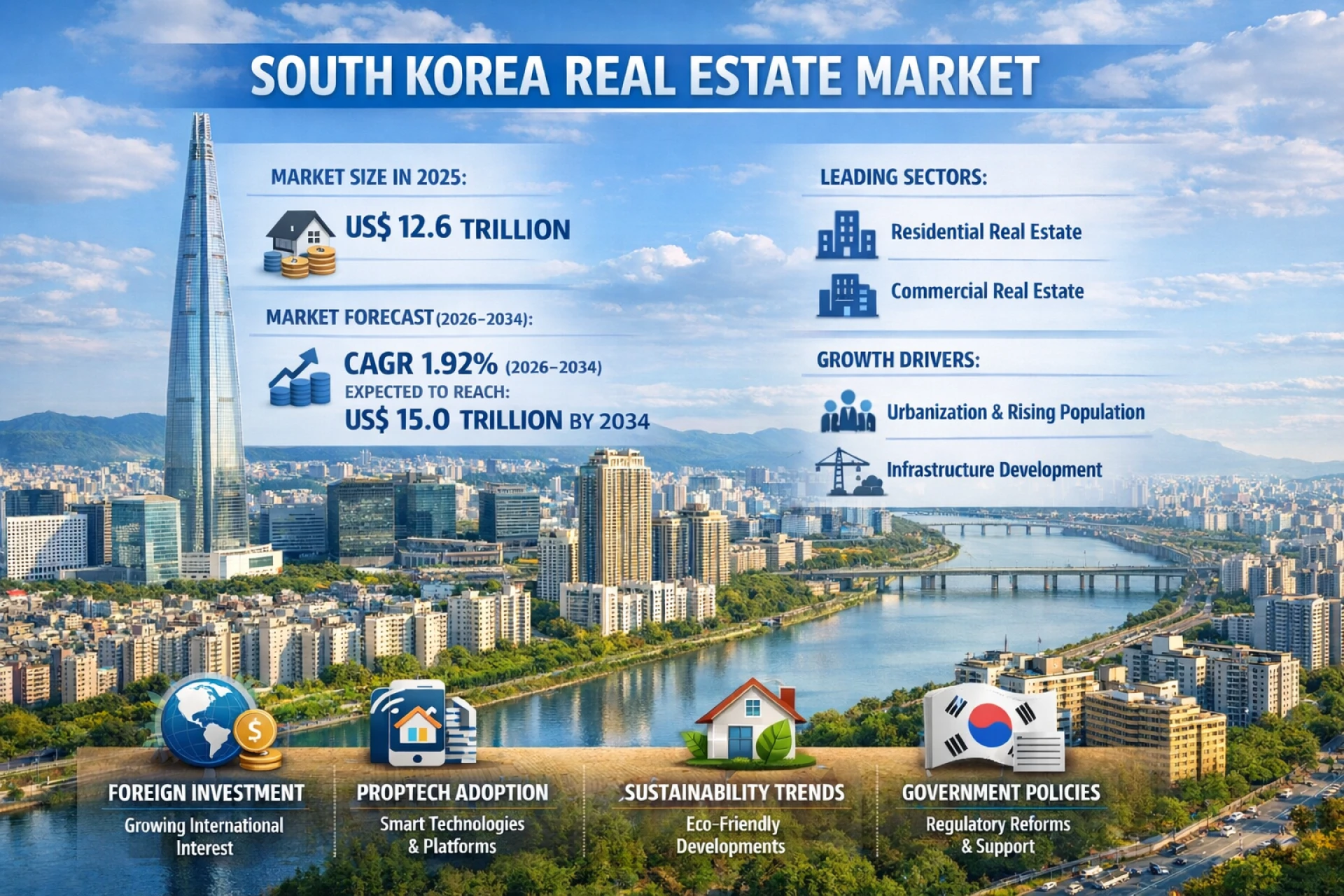
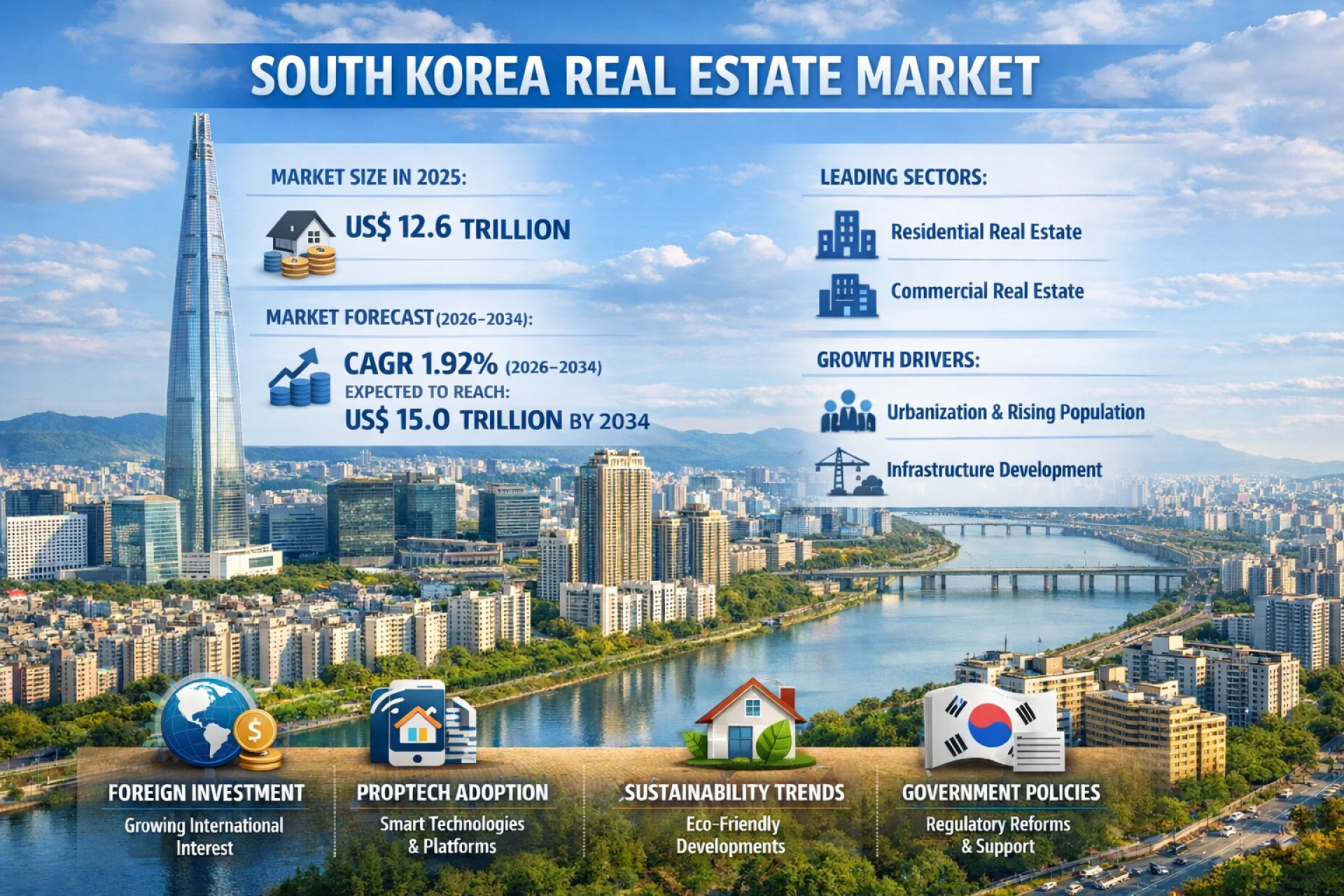
The South Korea Real Estate Market was valued at USD 12.6 Trillion in 2025 and is projected to reach USD 15.0 Trillion by 2034, exhibiting a CAGR of 1.92% during 2026-2034. IMARC states that the market is being driven by rapid urbanization, increasing demand for residential and commercial spaces in metropolitan areas such as Seoul, supportive government policies, and continued interest from foreign investors.
For companies planning investment, development, or portfolio expansion in 2026, the South Korea Real Estate Market remains important because demand is being supported by metropolitan concentration, infrastructure expansion, and the growing appeal of smart and sustainable buildings. This buyer-focused significance is an inference based on the market drivers and forecast structure shown on the IMARC page.
Explore Growth Opportunities in the South Korea Real Estate Market Grab IMARC Sample Report for evaluation: https://www.imarcgroup.com/south-korea-real-estate-market/requestsample
Study Assumptions and Market Scope
IMARC uses 2025 as the base year, with 2020-2025 as the historical period and 2026-2034 as the forecast period. The market is segmented by property, business, mode, and region.
Key Market Takeaways
IMARC notes that the market is significantly influenced by South Korea’s economic strength, increasing disposable income, rapid urbanization, and lower financing costs. The page also highlights demand linked to elderly living facilities, accessible homes, smart homes, and digital real estate services.
In 2026, market participants are likely to focus on housing supply, technology-enabled property services, sustainable buildings, and location-specific opportunities across key urban zones. This is an inference based on IMARC’s trends around prop-tech, government initiatives, green building standards, and regional demand concentration.
Key Growth Drivers
Continual Technological Advancements
IMARC states that prop-tech innovations are reshaping how properties are marketed, transacted, and managed in South Korea. The page highlights virtual reality tours, AI in property management, and blockchain for transparent and secure transactions as important enablers of real estate efficiency and accessibility.
The IMARC page also notes that generative AI is expected to improve productivity in real estate through stronger customer profiling, lead development, better sales timing, and automated follow-ups. These trends are helping make the South Korea Real Estate Market more digital, data-driven, and scalable heading into 2026. The forward-looking implication is an inference based on the trend discussion.
Increasing Government Initiatives
Government action is another major driver of the South Korea Real Estate Market. IMARC states that South Korea has taken steps to expand housing supply, ease construction regulations in dense urban areas, and accelerate redevelopment initiatives to improve affordability and stabilize the market.
The page specifically references a plan to develop 830,000 housing units nationwide, including 320,000 units in Seoul, and also highlights the G-SEED green building certification system. IMARC further notes that public developers are being used to fast-track approvals and expand affordable housing in major cities.
Urbanization and Interest-Rate Support
IMARC identifies rising urbanization as a central factor supporting the market. The page states that 81.43% of South Korea’s population lived in urban areas in 2022, and around half of the population lives in the country’s seven largest cities, increasing demand for housing and office space.
IMARC also notes that mortgage conditions have influenced affordability and investment behavior. The page says the mortgage rate for new loans stood at 4.31% in the third quarter of 2023, down from a peak of 4.73% in the fourth quarter of 2022, helping support real estate activity.
South Korea Real Estate Market Segmentation
IMARC Group has categorized the South Korea Real Estate Market based on property, business, mode, and region.
By Property
• Residential
• Commercial
• Industrial
• Land
By Business
• Sales
• Rental
By Mode
• Online
• Offline
By Region
• Seoul Capital Area
• Yeongnam (Southeastern Region)
• Honam (Southwestern Region)
• Hoseo (Central Region)
• Others
Segment Insights
IMARC states that residential property is a major pillar of the market because of high population density and strong urban demand, especially in cities such as Seoul. The page also says commercial property benefits from South Korea’s developed infrastructure and Seoul’s role as an international finance center, while industrial property gains from manufacturing, technology leadership, e-commerce, and logistics demand near hubs such as Incheon and Busan.
By business model, IMARC notes that sales remain a major market driver in both residential and commercial real estate, while rental is essential because many younger and urban residents prefer renting due to high property costs. The report also highlights the rise of online transactions through platforms like Naver Real Estate and Zigbang, while offline transactions remain important for trust, negotiation, and high-value deals.
Regional Insights
IMARC highlights the Seoul Capital Area as a core market because it combines high residential and commercial demand with strong transport links, dense population, and major business activity. The page also notes that Yeongnam, including Busan, Ulsan, and Daegu, benefits from industrial strength, logistics activity, and relatively lower property prices compared with the capital region.
These regional patterns make the South Korea Real Estate Market relevant for investors comparing capital-city demand with alternative growth corridors. That investment framing is an inference based on IMARC’s regional descriptions and pricing differences.
Competitive Landscape
The IMARC page emphasizes market growth factors, segmentation, and regional trends, but the visible section does not list named companies on the portion I reviewed. It does show that digital platforms, public developers, and technology-led property services are becoming increasingly influential in market activity.
Why This Report Matters for 2026 Buyers
For decision-makers evaluating the South Korea Real Estate Market, this report offers useful insight into property type demand, rental versus sales dynamics, online versus offline channels, and region-level opportunities. It is especially relevant for 2026 planning around urban housing, commercial assets, industrial logistics, and technology-enabled real estate services. This is an inference based on the trends, segmentation, and forecast window on the IMARC page.
Questions Decision-Makers Are Asking
1. What is driving the South Korea Real Estate Market?
The market is being driven by rapid urbanization, strong demand for residential and commercial spaces, supportive government initiatives, infrastructure expansion, foreign investment interest, and technology adoption in real estate processes.
2. Which segments are covered in the report?
IMARC segments the market by property, business, mode, and region. These include residential, commercial, industrial, and land; sales and rental; online and offline; and regions such as the Seoul Capital Area and Yeongnam.
3. Why is 2026 important for this market?
2026 is the first forecast year on the IMARC page and serves as a key planning point for investors and developers tracking housing supply measures, urban demand, green building adoption, and prop-tech expansion. This is an inference based on the report’s forecast period and trend discussion.
Author IMARC Group
IMARC Group is a global management consulting firm that helps the world's most ambitious changemakers to create a lasting impact. The company provide a comprehensive suite of market entry and expansion services. IMARC offerings include thorough market assessment, feasibility studies, company incorporation assistance, factory setup support, regulatory approvals and licensing navigation, branding, marketing and sales strategies, competitive landscape and benchmarking analyses, pricing and cost research, and procurement research.
Contact Us
IMARC Group,
134 N 4th St. Brooklyn, NY 11249, USA,
Email: [email protected],
United States: +1-201971-6302