Street lighting is no longer a luxury for Nigerian roads, estates, and communities. It is a safety necessity. Well-lit streets reduce accidents, deter crime, and keep public spaces usable after dark. But when it comes to choosing how to power those lights, property developers, estate managers, and local councils face one key question: should you go with traditional grid-powered street lights or invest in Solar Street Lights in Nigeria?
Both options light the road. The difference lies in reliability, cost, and long-term value. This guide breaks down how each performs under real Nigerian conditions so you can make an informed decision.
Understanding the Two Options
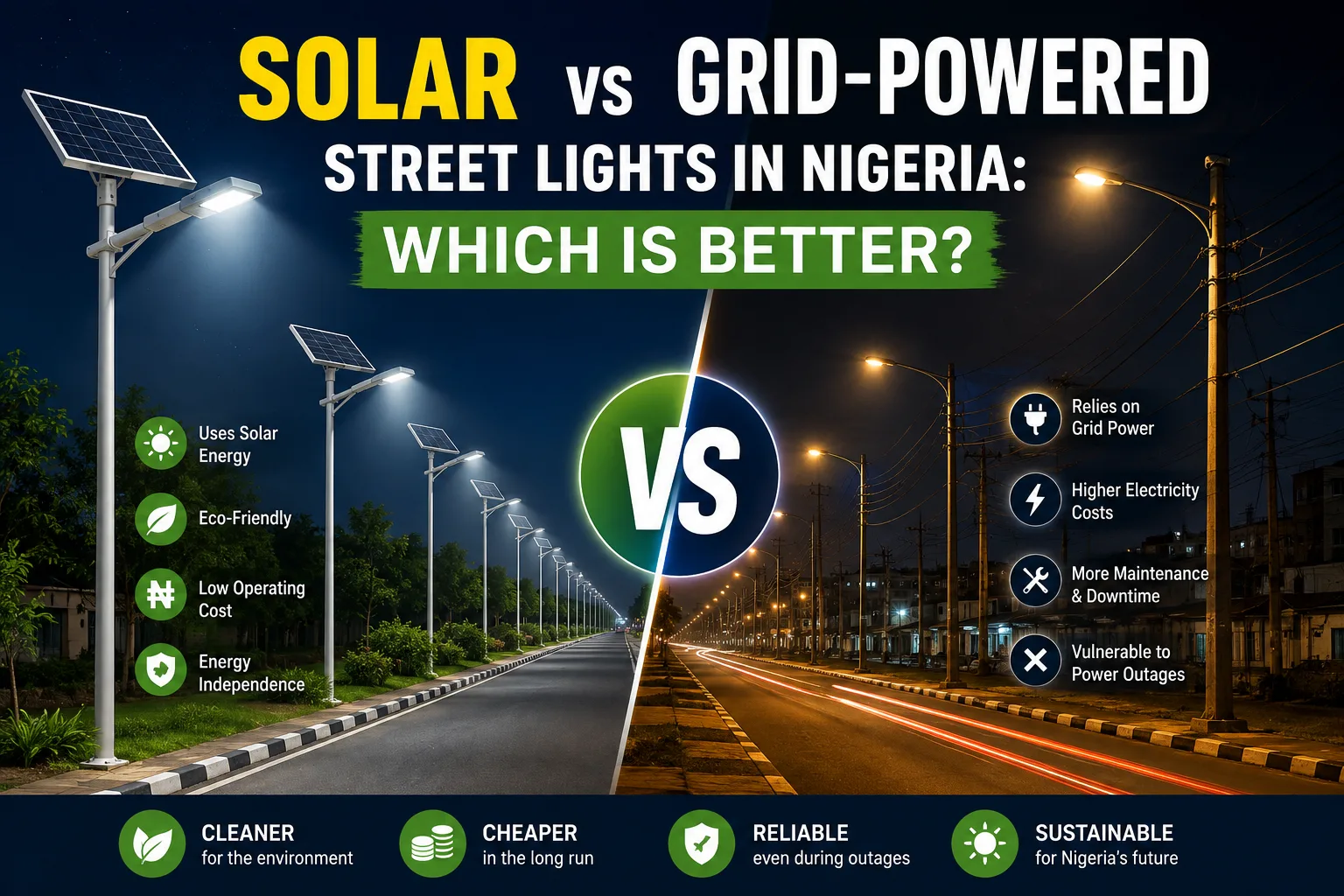
Grid-powered street lights draw electricity directly from Nigeria's national grid. They rely on cables, transformers, and a steady supply of mains power to function. When the grid is working, they light up. When it fails, they go dark.
Solar street lights work differently. Each unit generates its own power using a solar panel, stores that energy in a battery during the day, and uses it to run an LED lamp at night. They operate completely independent of the national grid, which changes everything about how reliable they are in the Nigerian context.
Reliability: The Deciding Factor
For most Nigerian buyers, reliability is where the comparison begins and ends.
Nigeria's national grid remains notoriously unstable. Installed generation capacity sits above 12,000 megawatts, yet actual output rarely reaches 5,000 megawatts, and the grid has suffered repeated nationwide system collapses in recent years. For grid-powered street lights, every blackout means dark, unsafe streets, exactly when lighting matters most.
Solar street lights sidestep this problem entirely. Because each light carries its own panel and battery, it keeps working through blackouts, load shedding, and grid failures. This is precisely why Solar Street Lights in Nigeria have become the preferred choice for areas with unreliable power. A rural community that may never get a stable grid connection can still enjoy consistent nightly illumination.
If your priority is lighting that stays on no matter what the grid does, solar wins this round decisively.
Cost Comparison: Upfront vs Long-Term
Cost is where the decision gets more nuanced, so it helps to separate installation cost from running cost.
Grid-powered street lights usually have a lower upfront hardware price per pole. However, the true cost includes trenching, cabling, transformers, and connection to the grid, which can be expensive over long stretches of road. On top of that, you pay a monthly electricity bill for as long as the lights operate, and those tariffs have been rising steadily.
Solar street lights cost more to buy per unit because each one includes a panel, battery, and controller. But installation is far simpler. There are no cables to trench and no grid connection fees, which makes them especially cost-effective for remote roads, new estates, and highways far from existing infrastructure. Once installed, they run on free sunlight, so there is no electricity bill at all.
Over a typical service life, the numbers often favour solar. You pay more at the start, but you save continuously on electricity and trenching. For a clearer breakdown of what installation actually costs, see our guide on the cost of installing solar street lights in Nigeria.
Maintenance and Lifespan
Grid-powered systems have several failure points beyond the lamp itself: cables can be damaged, transformers can fail, and vandalism of copper wiring is a persistent problem in some areas. Each fault requires a technician and can leave a whole stretch dark until repaired.
Solar street lights have fewer moving parts and no external wiring between units, which reduces the points that can break. Modern units use long-life LED lamps and durable batteries, and the better systems are built to withstand Nigeria's heat, humidity, dust, and rainy-season conditions. Routine maintenance is usually limited to occasional panel cleaning and eventual battery replacement after several years. To understand this better, read about solar street light maintenance in Nigeria.
Weather and Environmental Performance
Nigeria's climate cuts both ways. The strong, consistent sunshine across most of the country is ideal for solar generation, giving panels plenty of energy to store each day. The rainy season does reduce daily sunlight, but quality solar street lights are designed with enough battery capacity to run through several cloudy days without going dark.
Grid-powered lights are not affected by cloud cover, but they are affected by the storms and flooding that can damage cables and cause outages. In practice, weather-related grid faults are a bigger real-world problem for street lighting than reduced solar output.
On the environmental side, solar is the cleaner choice by a wide margin. It produces no emissions, uses no fuel, and reduces pressure on an already overstretched national grid. This aligns with Nigeria's broader push toward renewable energy and off-grid electrification.
Security and Community Benefits
Both lighting types improve safety, but consistency is what actually protects people. A grid-powered light that only works when there is power offers unpredictable security. A solar light that comes on reliably every single night gives communities dependable visibility, which is a genuine deterrent to crime and a real reduction in night-time accidents.
For gated estates, schools, markets, and residential streets, this dependability is a major reason solar adoption is rising. Learn more about how solar street lights improve security in Nigerian communities and estates.
Which Is Better for Nigeria?
The honest answer depends on your specific situation, but the trend is clear.
Grid-powered street lights can make sense in dense urban areas that already have reliable infrastructure and a stable local supply, where connection is cheap and blackouts are rare. In those narrow cases, the lower upfront cost may appeal.
For the vast majority of Nigerian roads, estates, rural communities, and highways, solar is the stronger long-term choice. It delivers reliable lighting despite grid instability, eliminates electricity bills, installs without expensive trenching, and requires minimal maintenance. Given how unreliable the national grid remains, solar removes the single biggest weakness of traditional street lighting.
Nigeria's own market is confirming this shift. The country is one of Africa's fastest-growing solar markets, and the overwhelming majority of new solar deployments are off-grid systems precisely because they escape grid problems. Street lighting is following the same logic. You can read more about this national shift toward off-grid solar in this Global Solar Council market overview.
Final Verdict
If you are lighting a road, estate, or public space in Nigeria today, solar street lights offer the better balance of reliability, cost savings, and durability. They cost more upfront but pay that back through years of free, uninterrupted lighting and near-zero running costs. Against an unstable grid, that reliability is priceless.
Ready to light your community without depending on the national grid? Explore our range of Solar Street Lights in Nigeria and choose a solution built for Nigerian roads, weather, and conditions.