
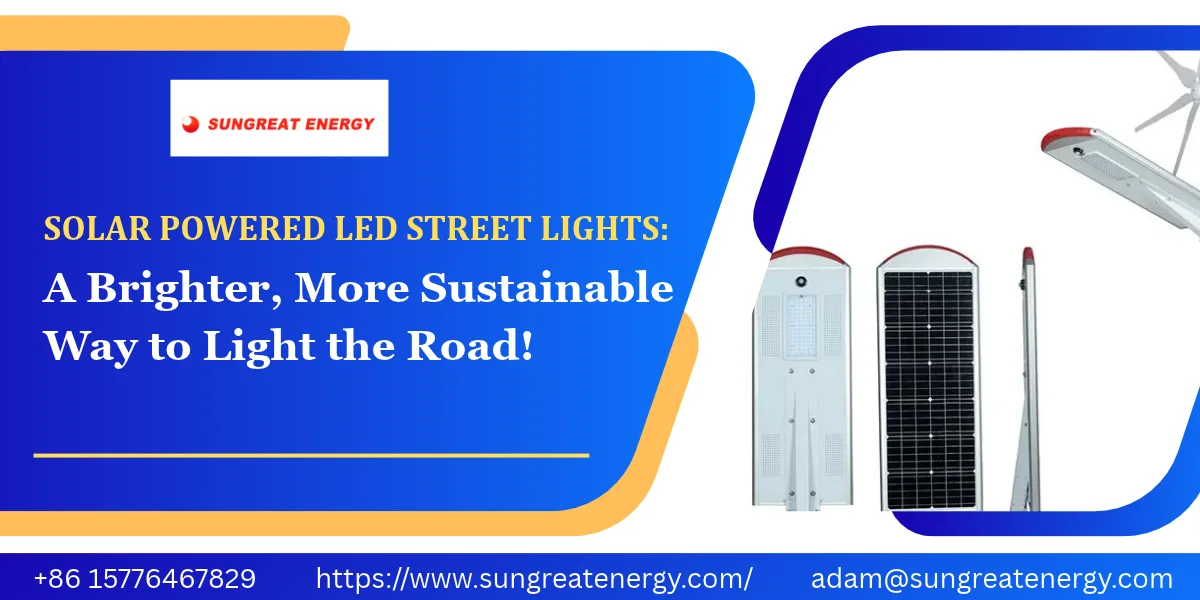
Reliable road lighting helps people see routes, crossings, and potential hazards after dark. Yet extending conventional grid-connected lighting to a road or outdoor area can involve cabling, trenching, and ongoing electricity use. solar powered led street lights offer an alternative: they collect sunlight during the day, store energy in a battery, and use it to power LED lighting at night.
These systems can be useful in places where grid access is limited or where a project aims to reduce its reliance on grid electricity. However, solar lighting is not automatically suitable for every road or climate. Its performance depends on the local sunlight, system design, battery capacity, lighting requirements, and installation quality.
How Do Solar Powered LED Street Lights Work?
A solar street light brings together several components that work as a system:
- Solar panel: Converts sunlight into electrical energy.
- Rechargeable battery: Stores energy collected during the day for use after dark.
- LED luminaire: Produces light using electricity supplied by the battery.
- Charge controller: Manages energy flow between the panel, battery, and light.
- Pole and mounting hardware: Supports the light and positions the panel and luminaire.
- Sensors and controls: May switch the light on at dusk, adjust brightness, or respond to movement.
During daylight, the solar panel generates electricity and the controller directs it to the battery. Then, when a light sensor detects darkness, the controller switches on the LEDs. Depending on the system, the light may operate at a steady level, dim during quieter hours, or brighten when a motion sensor detects activity.
The exact setup differs by model. In an all-in-one design, the panel, battery, LED, and controls are housed together or closely integrated. In a split-type design, the panel is separate from the light fixture. This separation can provide more flexibility when the panel needs a sunny location that differs from the best position for illuminating the road.
Some projects also use hybrid systems connected to the grid, or include battery storage designed to support selected loads. These options require careful planning and should not be assumed to be part of every solar powered led street lights.
Why Consider Solar Street Lighting?
Reduced reliance on grid electricity
Because the system generates electricity from sunlight, it can reduce the amount of grid power needed for lighting while it operates. The actual reduction depends on the system’s output, local weather, operating schedule, and the electricity use it replaces. Therefore, project planners should evaluate expected generation rather than assume a particular level of savings.
Potentially simpler deployment in remote areas
Solar lighting can be considered for roads, pathways, or sites where access to grid power is difficult. In some projects, it may reduce the need for long cable runs or electrical trenching. Nevertheless, installation still involves work such as preparing foundations, mounting poles, and following applicable safety and permit requirements.
Flexible location options
A solar light does not always need to be placed near an existing electrical supply. That can give planners more flexibility when lighting a rural road, pathway, campus, parking area, or other outdoor site. However, each proposed location still needs adequate sunlight for the panel to recharge effectively.
Support for sustainability goals
Solar panels generate electricity from sunlight, which may reduce a project’s use of grid electricity. The resulting environmental benefit depends on factors such as local electricity generation, equipment manufacturing, transport, battery replacement, and system lifespan. For organizations with sustainability targets, measured system output can help inform reporting, subject to the accounting rules they follow.
Adaptable operating controls
Many systems offer dusk-to-dawn operation, dimming, timers, or motion sensors. These controls can help match lighting to the way an area is used. For example, a light might operate at a lower brightness during quiet hours and increase when movement is detected. Yet control settings affect energy use, so they should be chosen to balance visibility needs with the system’s available stored energy.
Where Can Solar Street Lights Be Used?
Solar powered led street lights may be suitable for several outdoor applications, depending on the required coverage and local conditions. Examples include:
- Rural and low-traffic roads
- Residential streets
- Pedestrian paths and cycle routes
- Parks and recreational areas
- Parking lots and access roads
- Campuses and private developments
- Bus stops, gates, and security areas
Not every setting is an ideal match. Busy roads, complex intersections, and locations with strict lighting requirements may need a detailed assessment by a qualified lighting professional. In addition, a site with heavy shade or limited sunlight may require a different system configuration or an alternative lighting source.
Key Factors in Planning a Project
Choosing lights based only on a product photo, panel size, or LED wattage can lead to disappointing results. Instead, assess the entire site and system.
1. Define the lighting requirements
Start by identifying what the light needs to do. A pedestrian path, residential street, and vehicle route do not necessarily require the same level of illumination or distribution. Road width, traffic patterns, pedestrian activity, and nearby properties all matter.
A photometric plan can show where light will fall and whether it is likely to provide suitable coverage. It can also help identify dark gaps, uneven illumination, and glare. Always check the road authority’s requirements and local lighting standards before finalizing a design.
2. Evaluate sunlight and shade
The solar panel needs sufficient exposure to sunlight. Buildings, trees, signs, and other structures may shade a panel, sometimes only during certain hours or seasons. Therefore, survey the site at different times of day and consider how nearby vegetation may grow.
Panel orientation and tilt should follow the manufacturer’s guidance and suit the location. Where the luminaire and panel are separate, the panel may be positioned to capture more sunlight while the light itself is aimed at the road.
3. Match system output to the operating schedule
Consider how many hours the light is expected to operate and what brightness is needed during those hours. A system designed for steady, full-output operation will use stored energy differently from one that dims during quiet periods. Motion detection can help conserve energy in some locations, but it may not suit areas where consistent illumination is required.
4. Review battery capacity and autonomy
The battery stores energy for nighttime use and periods of limited sunlight. Its suitability depends on the light’s energy consumption, local weather, and expected operating schedule. Ask how the manufacturer like Shenzhen Sungreat Energy Technology Co., Ltd. defines runtime or autonomy, and whether those figures reflect the conditions at your site.
Battery type, temperature range, expected service life, replacement options, and warranty terms are also important. Batteries can lose capacity over time, so a project plan should account for inspection and eventual replacement when required.
5. Consider light distribution and glare
A high lumen figure does not automatically mean better road lighting. Optics, mounting height, spacing, and beam direction determine where light is delivered. A well-designed fixture directs light onto the intended area instead of wasting it beyond the road or shining it into homes.
Color temperature also affects how lighting appears. The appropriate choice depends on the application, local standards, nearby residents, and environmental considerations. In addition, carefully aimed fixtures can help limit unnecessary light spill.
6. Check environmental suitability
Outdoor equipment must be suitable for the site’s weather and surroundings. Review the fixture’s stated protection against water and dust, its recommended temperature range, and the manufacturer’s guidance for corrosion exposure. In windy areas, pole and foundation design are especially important.
The panel, battery, and mounting hardware should all be considered as part of the installation. A component that is suitable for one climate or site may not be suitable for another.
Installation and Commissioning
A successful project usually begins with a site survey. The project team identifies lighting needs, checks sunlight and shade, reviews pole locations, and considers access for installation and future maintenance. Next, a lighting and energy design can be prepared using the site’s requirements and the selected system’s specifications.
Before installation begins, confirm relevant permits, road authority approvals, safety requirements, and any local standards. Foundations and poles should be installed according to the project design. Then, the lights can be mounted, configured, and tested.
Commissioning should include checking that each light switches on as expected, the controls use the intended operating mode, and the illumination falls on the target area. Furthermore, system documentation should record equipment details, settings, warranties, and maintenance guidance. This information helps operators manage the installation over time.
Maintenance and Long-Term Performance
Solar led street lights require periodic attention, even though they operate without a conventional grid connection at each pole. Dust, leaves, or other debris can reduce the sunlight reaching the panel. Therefore, panels may need cleaning according to the manufacturer’s instructions and local conditions.
Maintenance teams should also inspect poles, fasteners, fixtures, wiring, and visible components for damage or looseness. Monitoring tools, when available, can help identify changes in system output. If a light becomes dim or stops operating as expected, check for shade, debris, incorrect settings, or component issues.
Battery performance can change with age and temperature. Accordingly, project owners should understand the battery warranty, replacement process, and expected maintenance requirements. Any work at height or involving electrical components should be performed by trained personnel following appropriate safety procedures.
Solar powered led street lights can provide an alternative to conventional grid-connected lighting, particularly where extending electrical infrastructure is challenging or on-site solar generation supports project goals. They combine solar panels, batteries, LEDs, and controls to deliver light after dark. However, reliable operation depends on more than the equipment alone.
Before choosing a system, assess lighting requirements, sunlight, battery needs, environmental conditions, installation constraints, and maintenance plans. Also, confirm local standards and use a suitable photometric design where required. With careful planning, project owners can decide whether solar street lighting is a practical option for their roads, paths, or outdoor spaces.
Frequently Asked Questions
1. What are solar powered LED street lights?
They are outdoor lighting systems that use solar panels to generate electricity, store it in batteries, and power LED fixtures after dark. Many include controllers and sensors to manage charging and lighting operation.
2. Do solar street lights work on cloudy days?
Solar panels can still generate some electricity in cloudy conditions, but output is generally lower than in direct sunlight. The effect on nighttime operation depends on the panel, battery, weather, and light settings.
3. Can solar street lights operate during a power outage?
A self-contained solar street light can operate independently of the grid if its battery is charged and its components are functioning. However, operating time depends on stored energy and system design; it should not be treated as a guarantee of uninterrupted lighting in every condition.
4. Do solar street lights need underground wiring?
Many standalone systems do not require a grid connection at each pole, which may reduce the need for some electrical trenching. However, installation still requires suitable foundations, mounting, and compliance with local requirements.
5. How long do the batteries last?
Battery life varies by chemistry, operating temperature, charging conditions, usage, and maintenance. Check the supplier’s specifications and warranty, and ask about replacement procedures for the selected model.
6. Are solar street lights suitable for every road?
No. A shaded site, a road with demanding lighting requirements, or a location with limited sunlight may need a different system or a professional assessment. Suitability depends on the road, local standards, sunlight, and system design.
7. How can I choose the correct brightness?
Consider the road’s width, use, traffic, required uniformity, pole height, and local lighting standards. A photometric design is more useful than choosing based on lumen output alone, because it shows how light is distributed across the site.
8. What maintenance do solar street lights need?
Maintenance may include cleaning panels, inspecting poles and mounting hardware, checking system output, and servicing or replacing components as needed. Follow the manufacturer’s guidance and use trained personnel for electrical or elevated work.
9. Can motion sensors reduce energy use?
They may help reduce energy consumption by lowering brightness when no activity is detected. However, sensor settings must suit the location, and motion-controlled lighting may not be appropriate where steady illumination is required.
10. What should I provide when requesting a project assessment?
Share the site location, road or path layout, sunlight and shade conditions, lighting objectives, operating schedule, and any relevant local requirements. Electricity or maintenance data may also help when comparing solar with other lighting options.