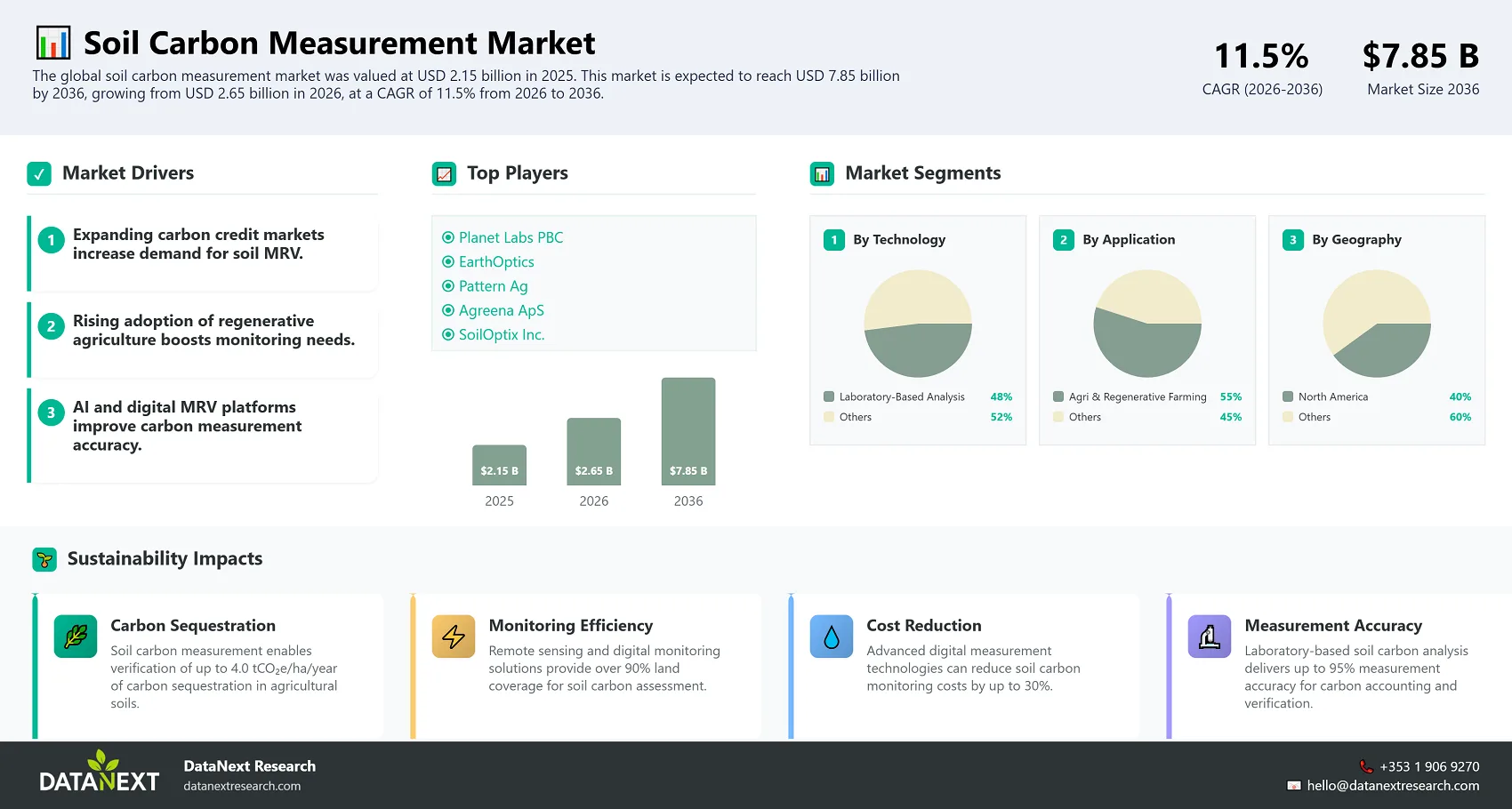
The global soil carbon measurement market is emerging as one of the most important segments within the broader climate technology and sustainable agriculture landscape. Valued at USD 2.15 billion in 2025, the market is projected to grow from USD 2.65 billion in 2026 to approximately USD 7.85 billion by 2036, registering a strong CAGR of 11.5% during the forecast period. The growing importance of carbon sequestration, regenerative agriculture, carbon credit generation, and climate finance initiatives is creating significant demand for reliable soil carbon measurement solutions across the world.
Download Sample Report Here : https://datanextresearch.com/report/soil-carbon-measurement-market?action=Download+Sample
Soil Carbon Becomes a Critical Climate Asset
Over the past decade, global attention has increasingly shifted toward nature-based solutions as governments, corporations, and investors seek practical pathways to reduce greenhouse gas emissions. Soil has emerged as a critical component of these efforts because it serves as one of the largest carbon reservoirs on the planet. According to scientific estimates, global soils contain approximately 2,500 gigatons of carbon, significantly exceeding the carbon stored in vegetation and far surpassing atmospheric carbon stocks.
This immense carbon storage capacity has transformed soil health from a traditional agricultural concern into a major climate mitigation opportunity. Researchers have demonstrated that agricultural practices such as cover cropping, conservation tillage, rotational grazing, and improved nutrient management can significantly increase soil organic carbon levels. Beyond climate benefits, these practices also improve soil fertility, enhance water retention, increase biodiversity, and strengthen farm productivity.
As a result, accurately measuring and verifying soil carbon has become essential for farmers, policymakers, carbon project developers, and investors seeking to quantify environmental outcomes and generate credible carbon credits.
Evolution from Traditional Testing to Digital Measurement
Historically, soil carbon measurement depended almost entirely on laboratory-based testing methods. While laboratory analysis remains highly accurate and continues to serve as the industry benchmark, these approaches are often expensive, labor-intensive, and difficult to scale across large agricultural regions.
The market is now undergoing a significant transformation as advanced digital technologies reshape how soil carbon is monitored and verified. Modern measurement systems combine traditional soil sampling with remote sensing, satellite imagery, geospatial analytics, artificial intelligence, machine learning, and predictive carbon modeling.
These integrated Measurement, Reporting, and Verification (MRV) platforms allow stakeholders to monitor soil carbon across vast agricultural landscapes more efficiently and cost-effectively. Digital MRV systems are helping organizations collect more frequent data, improve carbon stock estimations, and support the rapid expansion of carbon farming initiatives around the world.
Browse in Depth : https://datanextresearch.com/report/soil-carbon-measurement-market
How Important Is Soil Carbon Measurement for Carbon Credit Markets?
Soil carbon measurement is essential for carbon credit markets because it provides the scientific evidence needed to verify carbon sequestration outcomes. Carbon credit programs require accurate Measurement, Reporting, and Verification (MRV) systems to confirm that agricultural practices are genuinely removing or storing carbon in soils. Without reliable measurement technologies, carbon credits cannot maintain credibility or attract investment. As carbon markets continue to expand globally, soil carbon measurement is becoming a foundational component of carbon accounting and climate finance infrastructure.
Carbon Markets Accelerate Industry Growth
One of the strongest drivers of the soil carbon measurement market is the rapid expansion of voluntary and compliance carbon markets. Organizations across multiple sectors are adopting net-zero targets and seeking credible carbon removal solutions to offset residual emissions.
Agricultural carbon projects have become increasingly attractive because they offer scalable opportunities to remove carbon from the atmosphere while improving farm productivity. However, the success of these projects depends heavily on the ability to accurately measure and verify carbon sequestration.
Project developers, agribusinesses, financial institutions, and landowners are therefore investing heavily in advanced monitoring technologies that can improve transparency, reduce verification costs, and strengthen market confidence. As carbon markets mature, the demand for scalable soil carbon measurement solutions is expected to grow significantly.
Regenerative Agriculture Creates Long-Term Opportunities
The adoption of regenerative agriculture practices is another major factor supporting market expansion. Farmers around the world are increasingly implementing sustainable land management techniques that improve soil health while contributing to climate goals.
Governments, food companies, agricultural cooperatives, and sustainability-focused investors are providing financial incentives to encourage these practices. Large food and beverage companies are also integrating regenerative agriculture into their supply chain sustainability strategies to reduce emissions and improve environmental performance.
As regenerative agriculture programs continue to expand, stakeholders require reliable tools to measure progress and demonstrate environmental impact. This growing need for performance verification is expected to sustain long-term demand for soil carbon measurement technologies.
Regional Markets Show Strong Growth Potential
North America currently represents the largest regional market for soil carbon measurement, accounting for approximately 40% of global revenue in 2026. The region benefits from well-established carbon markets, large-scale regenerative agriculture programs, and advanced MRV infrastructure. The United States, with its vast agricultural land base and significant investments in climate-smart agriculture, remains a key growth engine for the industry. Canada is also increasing support for sustainable farming and carbon management initiatives.
Europe represents another important market, accounting for roughly one-quarter of global revenue. The region's growth is supported by ambitious climate policies, carbon farming initiatives, and sustainable land management programs. European governments are actively investing in soil health monitoring and carbon sequestration projects as part of broader emissions reduction and biodiversity objectives.
Meanwhile, Asia-Pacific is expected to emerge as the fastest-growing regional market during the forecast period. Countries such as China, India, and Australia possess enormous agricultural resources and are increasingly adopting climate-smart farming practices. Rising investments in land restoration, regenerative agriculture, and digital agriculture technologies are expected to create significant opportunities for soil carbon measurement providers across the region.
Buy the Complete Report with an Impressive Discount: https://datanextresearch.com/report/soil-carbon-measurement-market?action=Buy+Now
Competitive Landscape and Future Outlook
The soil carbon measurement market remains moderately fragmented, with competition spanning digital MRV platform providers, agricultural technology firms, soil analytics companies, laboratory testing organizations, remote sensing specialists, and carbon project developers. Companies are increasingly focused on combining scientific accuracy with scalability to meet the growing demands of carbon markets and regenerative agriculture programs.
A notable industry trend is the development of integrated solutions that combine laboratory analysis, satellite monitoring, artificial intelligence, and predictive modeling into unified platforms. These technologies help reduce monitoring costs while improving data quality and project scalability.
As global climate commitments continue to intensify and carbon markets expand, soil carbon measurement will become an increasingly vital component of environmental reporting, sustainable agriculture, and climate finance ecosystems. The convergence of digital technologies, regenerative farming practices, and carbon credit programs is expected to create substantial opportunities for innovation and market growth over the next decade.
Related Reports:
Europe Pet Nutraceuticals Market: https://datanextresearch.com/report/europe-pet-nutraceuticals-market
Europe Sustainable Dairy Farming Market: https://datanextresearch.com/report/europe-sustainable-dairy-farming-market
Oceania Sustainable Dairy Farming Market: https://datanextresearch.com/report/oceania-sustainable-dairy-farming-market
About Us:
Founded in 2023 and incorporated in 2025 by a team of sustainability experts and data scientists, DataNext Research emerged from a simple yet powerful vision: to help businesses make smarter decisions that benefit both their bottom line and the planet. What started as a small research consultancy has grown into a leading provider of sustainable business intelligence solutions, serving Fortune 500 companies, innovative startups, and everything in between.
Contact Us:
DataNext Research Ltd,
Landscape House, Baldonnell Business Park,
Baldonnell, Dublin 22, D22, P3K7
Email: [email protected]
Phone: +353 1 906 9270
Visit Our Website: https://datanextresearch.com/