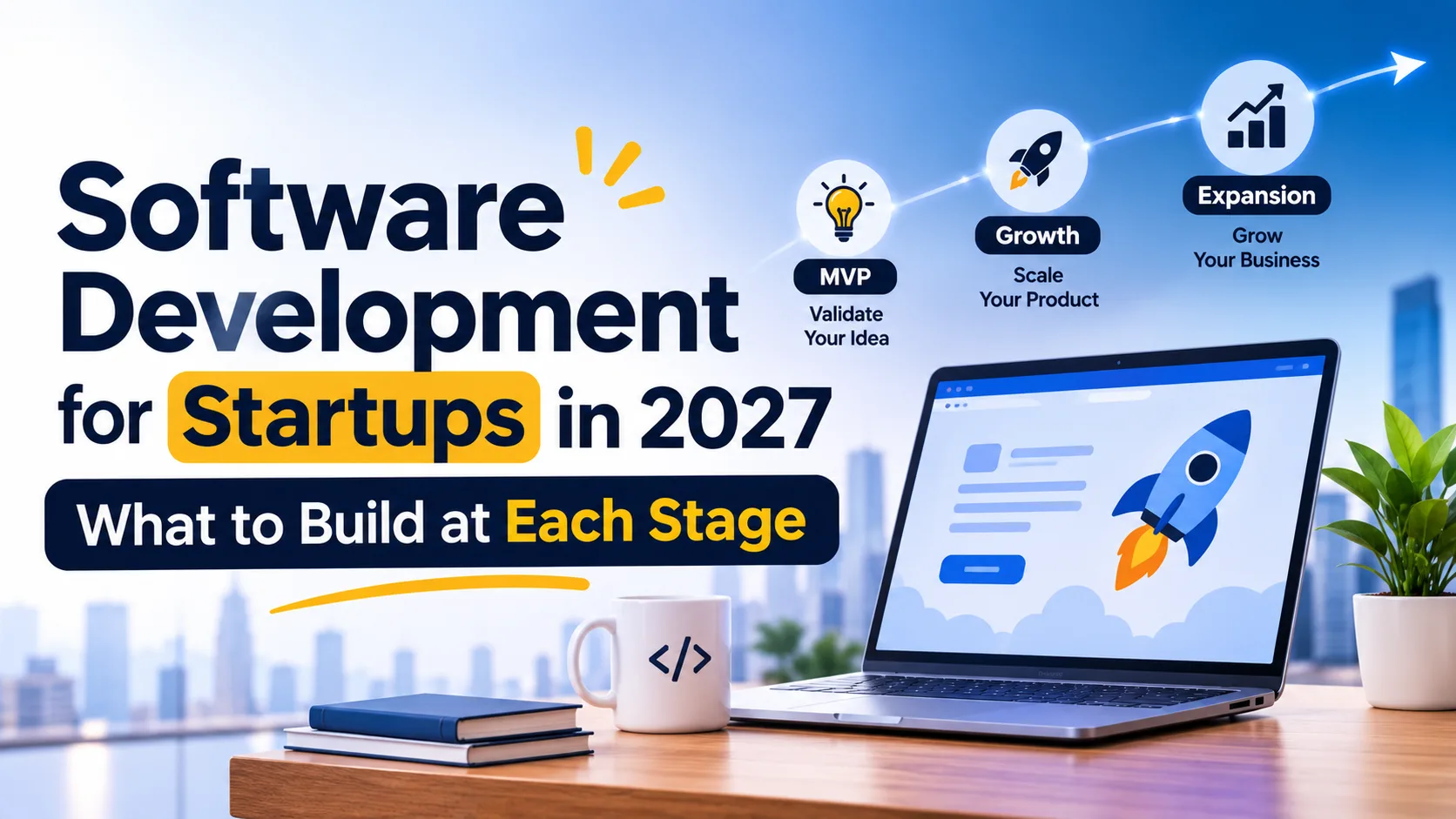
For a startup in the United States, building software in 2027 is no longer just about turning an idea into an application. Founders must think about customer expectations, AI capabilities, data security, development costs, and how quickly their product can adapt as the business grows.
The rise of AI is also changing how startups approach product development. According to the U.S. Chamber of Commerce's 2026 Empowering Small Business Report, 66% of surveyed small businesses now use AI, nearly three times the share reported in 2023. This growing adoption is creating opportunities for startups to build smarter products and improve internal operations.
However, investing in AI software development in USA does not mean adding a chatbot to every application. It means identifying where AI can solve a genuine problem and building technology around that need.
Here are seven practical software development priorities US startups should consider in 2027.
1. Start With a Problem, Not a Long Feature List
One common startup mistake is trying to launch with too many features. A product becomes expensive to develop and difficult to improve when the team has not validated its core purpose.
Start with a specific customer problem and build the smallest version that can test your assumption.
Focus on:
- Identifying one primary user problem.
- Interviewing potential customers before development.
- Creating wireframes or clickable prototypes.
- Building one essential workflow for the first release.
- Collecting feedback before expanding the product.
A focused MVP helps founders understand whether customers actually need the product before committing a large part of their budget.
2. Use AI Where It Creates Measurable Value
AI is becoming part of everyday business software, but startups should avoid implementing it simply to follow a trend.
Consider practical applications such as:
- AI-powered customer support and ticket classification.
- Document processing and information extraction.
- Personalized product recommendations.
- Predictive analytics for sales and inventory.
- Internal assistants that retrieve information from company data.
For many early-stage startups, using a hosted AI model through an API is a more practical starting point than training a custom model. It reduces initial infrastructure requirements and lets the team test the feature before making a larger investment.
The important question is simple: Does the AI feature save time, improve accuracy, or make the customer experience better?
3. Choose a Technology Stack That Can Grow With You
A startup does not need an unnecessarily complex architecture from day one. It needs technology that developers can maintain, update, and extend without rebuilding everything.
Common choices include:
- Frontend: React, Next.js, or Vue.
- Backend: Node.js, Python, or Java.
- Database: PostgreSQL or MongoDB, depending on data requirements.
- Cloud infrastructure: AWS, Microsoft Azure, or Google Cloud.
- Mobile development: React Native, Flutter, or native iOS and Android.
The right combination depends on the product, team expertise, integrations, and expected traffic. Avoid choosing a framework just because it is popular. Documentation, developer availability, and long-term maintenance matter just as much.
4. Treat Security as a Development Requirement
US startups often underestimate security until they approach enterprise customers or handle sensitive information.
Building security into the development process early is generally less disruptive than adding it after launch.
Important priorities include:
- Multi-factor authentication for sensitive accounts.
- Role-based access controls.
- Encryption for sensitive data.
- Secure API design and regular vulnerability testing.
- Backups, monitoring, and incident response planning.
- Privacy practices aligned with applicable federal and state requirements.
Startups handling healthcare information should also assess whether HIPAA obligations apply. Companies serving California residents may need to consider CCPA/CPRA requirements.
Security is not just a technical concern. It can influence customer trust, procurement decisions, and future fundraising discussions.
5. Plan Integrations Before Building Everything From Scratch
Most US businesses already use tools for payments, accounting, sales, communication, and customer management. A startup product becomes more useful when it fits into those existing workflows.
Depending on the audience, consider integrations with:
- Stripe for payment processing.
- Salesforce or HubSpot for CRM.
- QuickBooks for accounting workflows.
- Slack for team communication.
- Google Workspace or Microsoft 365 for productivity.
Using established services can reduce development time and avoid maintaining functionality that another platform already handles well.
Before integrating, review API limitations, pricing, data permissions, and vendor dependency.
6. Budget for Maintenance, Not Just the Initial Build
Software development costs do not end when an application goes live. Hosting, monitoring, security updates, bug fixes, third-party APIs, and new features all require ongoing investment.
A realistic startup budget should account for:
- Initial product design and development.
- Cloud hosting and infrastructure.
- Third-party subscriptions and API usage.
- Testing and security improvements.
- Ongoing maintenance and technical support.
Founders comparing software development services in USA should evaluate more than the initial project quote. Ask what is included, who owns the source code, how changes are priced, and what support is available after launch.
A lower upfront estimate may become expensive if the product is difficult to maintain or extend.
7. Choose a Development Partner Who Understands Startup Growth
The right development partner should understand that startups work with changing requirements, limited budgets, and tight timelines.
Before choosing a team, evaluate:
- Experience building MVPs and production-ready applications.
- Ability to explain technical decisions clearly.
- Transparent pricing and development milestones.
- Ownership of code, repositories, and cloud accounts.
- Post-launch support and scalability planning.
- Experience with relevant AI, security, and integration requirements.
For founders exploring bespoke software development services in USA, the goal should be to find a team that can build around the business model rather than push an unnecessarily complicated solution.
Final Thoughts
Successful startup software in 2027 will not necessarily have the most features or the newest technology. It will solve a clear problem, offer a reliable user experience, and adapt as the business grows.
For startups looking for an experienced development team, Apptunix offers custom software development, MVP development, web and mobile application development, and AI-powered solutions. Its role in a startup project should be to help translate business requirements into practical technology, without losing sight of budget, usability, and future growth.
The smartest investment is not building everything at once. It is building the right thing at the right time.