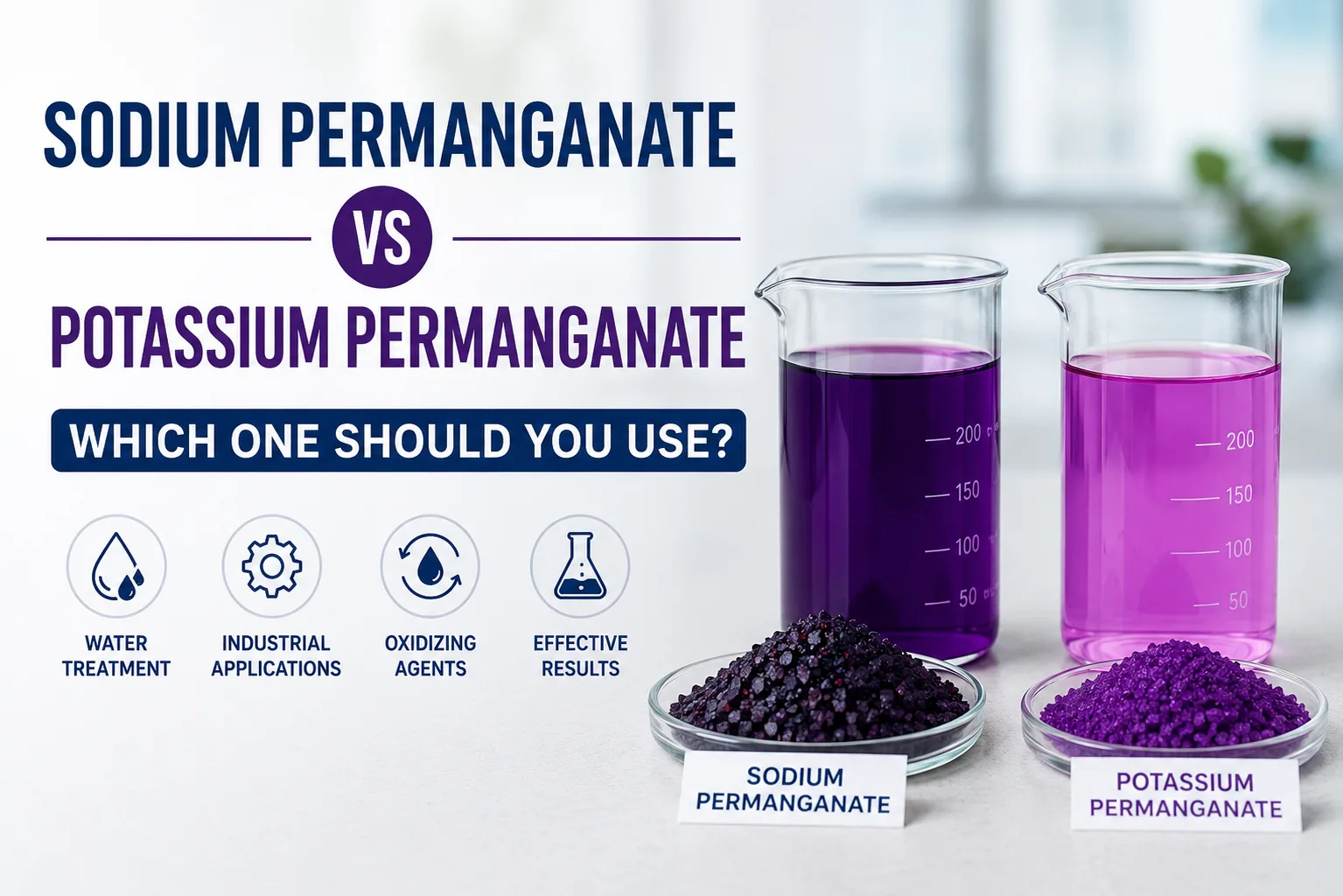
If you've been researching chemicals used for water purification, you've probably come across both sodium permanganate vs potassium permanganate. At first glance, they seem almost identical. Both are purple-colored oxidizers. Both are used to treat contaminated water. Both help tackle iron, manganese, odors, and certain organic pollutants.
Still, there are a few practical differences that make one a better fit than the other depending on the application. I've noticed that many people assume they're interchangeable in every situation. Not always. The choice often comes down to storage preferences, dosing requirements, and the type of treatment system being used.
What Is Sodium Permanganate?
Sodium permanganate is a powerful oxidizing chemical commonly supplied as a liquid solution. Because it arrives ready to use, operators don't need to dissolve crystals or prepare mixtures before feeding it into a treatment system.
It is widely used in environmental cleanup projects, municipal facilities, and remediation work where liquid chemical feed systems are already in place.
One thing many treatment professionals appreciate is the convenience. The chemical can often be pumped directly into the process, reducing preparation time.
What Is Potassium Permanganate?
Potassium permanganate is typically available as crystals, granules, or powder. It has been used for decades in water purification applications and remains one of the most recognized oxidation chemicals in the industry.
Before use, it is generally dissolved in water to create a solution that can be introduced into the treatment process. It is commonly found in municipal systems, industrial facilities, and private water treatment installations.
Its long history of use means many operators are already familiar with handling and dosing procedures.
Understanding the Role of Oxidation
Both chemicals belong to a group known as oxidizing agents for water treatment.
Oxidation is a process that changes dissolved contaminants into particles that can be removed more easily through filtration. This reaction helps improve water quality and supports the removal of substances that may cause staining, odor, discoloration, or operational issues.
Without oxidation, many contaminants would simply pass through standard filtration systems.
Sodium Permanganate vs Potassium Permanganate: Key Differences
Physical Form
The most obvious difference is the form in which they are supplied.
One is generally delivered as a liquid solution, while the other is commonly supplied in solid form. This affects transportation, storage, and how treatment operators prepare the chemical before use.
Facilities looking for ready-to-feed products often lean toward liquid formulations.
Solubility
Liquid permanganate products eliminate the need for mixing tanks and dissolution equipment.
Solid products require preparation before dosing. For some facilities, that extra step isn't a concern. For others, it may increase labor requirements.
Storage and Handling
Storage requirements vary depending on site conditions and available infrastructure.
Liquid systems may require dedicated storage tanks and transfer equipment. Solid products typically require dry storage conditions and proper handling procedures to prevent contamination.
The right choice often depends on the setup already available at the facility.
Water Treatment Applications
One of the most common uses for these chemicals is treating groundwater that contains elevated levels of iron and manganese.
Many facilities rely on sodium permanganate water treatment processes where automated liquid dosing systems are already installed. The liquid format can make chemical feeding relatively straightforward.
Meanwhile, potassium permanganate water treatment remains popular in applications where operators prefer preparing solutions on-site or where solid chemical storage is more practical.
Both approaches can be effective when managed correctly.
Iron and Manganese Removal
A major reason these chemicals are used is iron and manganese removal.
If you've ever noticed reddish stains on sinks, brown water from taps, or black deposits in plumbing fixtures, these minerals may be responsible.
Permanganates oxidize dissolved metals, converting them into particles that can then be captured by filtration systems. The result is often clearer water and reduced staining problems.
Groundwater Treatment Applications
In many parts of India, naturally occurring minerals affect groundwater quality.
For groundwater treatment, permanganates are frequently used to address contaminants before water enters distribution systems or industrial processes. The choice between sodium and potassium versions often depends on equipment design, operational preferences, and chemical logistics.
Water chemistry also plays an important role in selecting the most suitable treatment approach.
Industrial and Wastewater Applications
Permanganates are not limited to drinking water systems.
They are also used in industrial water treatment processes where oxidation is needed to address contaminants, odors, or specific treatment objectives.
In some facilities, wastewater treatment chemicals are selected based on reaction speed, ease of handling, and compatibility with existing treatment infrastructure.
Different industries may have different priorities, which is why no single chemical is automatically the right answer for every application.
Which One Should You Use?
There isn't a universal winner.
A facility already designed for liquid chemical feed systems may find sodium permanganate more convenient. Another operation with established dry chemical handling procedures may prefer potassium permanganate.
The decision often depends on:
- Treatment objectives
- Existing equipment
- Storage capabilities
- Site operations
- Water quality conditions
- Maintenance preferences
A proper water analysis and system evaluation usually provide the clearest answer.
Final Thoughts
The discussion around sodium permanganate versus potassium permanganate is less about which product is "better" and more about which one fits a particular application.
Both chemicals serve as effective oxidation tools and are widely used across water treatment industries. Understanding the differences in handling, storage, and operational requirements can make the selection process much easier.
In many cases, the best choice is simply the one that works most efficiently with the treatment system already in place.
FAQs
1. What is the difference between sodium permanganate and potassium permanganate?
The primary difference is their form. Sodium permanganate is generally supplied as a liquid solution, while potassium permanganate is commonly available as crystals, granules, or powder.
2. Which is better for water treatment, sodium permanganate or potassium permanganate?
Neither is universally better. The choice depends on system design, handling preferences, storage conditions, and treatment goals.
3. Can sodium permanganate replace potassium permanganate?
In many applications, yes. Still, compatibility with existing equipment and operational requirements should be evaluated before making changes.
4. Why are permanganates used in water treatment?
Permanganates act as oxidizers that help convert dissolved contaminants into filterable particles, improving water quality.
5. Are both chemicals effective for iron and manganese removal?
Yes. Both are widely used to oxidize iron and manganese before filtration.
6. Which permanganate is commonly used for groundwater treatment?
Both can be used successfully. The selection usually depends on the treatment system and operational preferences.
7. Is sodium permanganate easier to handle than potassium permanganate?
Some operators find liquid products easier because they eliminate the need for mixing. Others prefer solid products because of storage considerations.
8. Are permanganates used only in drinking water systems?
No. They are also used in wastewater treatment, environmental remediation projects, industrial processes, and other oxidation-based applications.