Quick Answers
Is SOC 2 required in Australia? No. It is driven by customer demand, not regulation.
How long does it take? About 6 to 8 weeks for a Type 1 with controls in place, and 9 to 12 months for a Type 2 from scratch.
Can we skip Type 1? Yes. Most companies can go directly to Type 2.
Does ISO 27001 help? Yes, significantly, because of the shared controls.
SOC 2 in One Minute
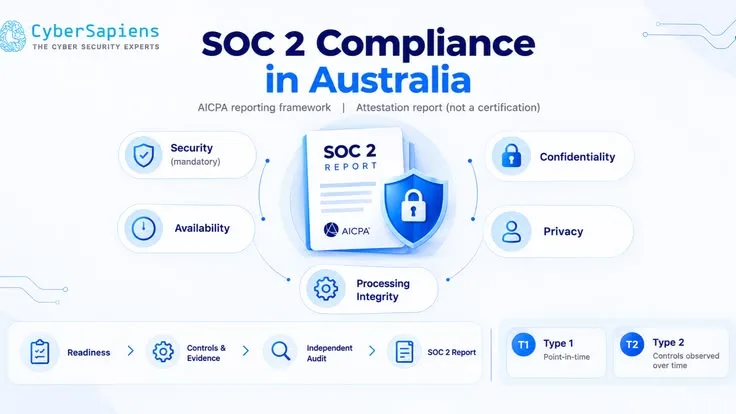
SOC 2 (System and Organization Controls 2) is a framework from the American Institute of CPAs (AICPA). An independent auditor examines how your company protects customer data and then issues a formal report. The assessment is based on five Trust Services Criteria: Security, Availability, Processing Integrity, Confidentiality and Privacy.
Security is the only mandatory criterion. Most first-time programmes start there and add others only when customers ask for them. Every extra criterion means more controls to build and more evidence for the auditor to test.
Five SOC 2 Myths Worth Dropping
Myth 1: "SOC 2 is a certificate."
In practice, almost everyone calls it a certification. Strictly speaking, though, SOC 2 is an attestation report: an auditor's opinion on your controls. This matters because only a genuine, licensed audit engagement can produce a report that enterprise buyers will accept.
Myth 2: "Australian law requires it."
It does not. No Australian regulator makes SOC 2 mandatory. The pressure is commercial, coming from enterprise customers, especially in the United States, who want proof before they trust a vendor with their data.
Myth 3: "You can get a Type 2 report in 45 days."
You cannot. Type 2 requires an observation window, usually 3 to 12 months, during which auditors see your controls operate. Evidence has to be gathered as it happens and cannot be recreated afterwards. A provider promising a 45-day Type 2 is either describing a Type 1 or overpromising.
Myth 4: "You must complete Type 1 before Type 2."
Not at all. Many companies go straight to Type 2. A Type 1 is simply useful when a deal is waiting and you need something sooner while your observation window runs.
Myth 5: "The audit fee is the whole cost."
The audit fee is often only around 30 to 40% of what a company spends in the first year. Readiness work, fixing gaps, tooling and your own team's time make up the rest. When comparing quotes, always ask what is included.
Type 1 and Type 2, Explained Simply
Think of Type 1 as a photograph and Type 2 as a video.
A Type 1 report looks at whether your controls are properly designed on a single date. With controls already in place, it typically takes around 6 to 8 weeks. Buyers generally treat it as a useful interim step.
A Type 2 report looks at whether your controls actually work over time, usually across 3 to 12 months. From a standing start, the whole journey commonly takes 9 to 12 months, and it often costs 25 to 50% more than Type 1. This is the report most enterprise procurement teams expect.
If an urgent deal is on the table, a Type 1 can act as a bridge. If you are building for long-term enterprise sales, plan for Type 2.
Do You Actually Need SOC 2?
You probably do if several of these are true for your business:
- A specific enterprise prospect has asked for a SOC 2 report
- You store, process or transmit customer data in the cloud
- You handle financial, health or other regulated data on behalf of customers
- You sell, or plan to sell, into North America
- Competitors in your space already hold a report
- Your sales team spends many hours on custom security questionnaires for each deal
That last point is easy to overlook. A current SOC 2 report can replace much of the questionnaire work and help shorten procurement cycles.
A Realistic SOC 2 Roadmap
Here is how a typical programme unfolds, with honest durations:
- Scope it (first few weeks). Decide which systems and which Trust Services Criteria are in scope. Starting with Security alone is a common choice.
- Readiness assessment (4 to 8 weeks). Map your existing controls against the criteria and identify gaps.
- Fix the gaps (1 to 4 months). Write policies, deploy tooling and put missing controls in place, including least-privilege access and role-based access control across your cloud environments.
- Observe (3 to 12 months, Type 2 only). Your controls run day to day and generate evidence. Six months is generally seen as the minimum most enterprise buyers accept.
- Audit and report (4 to 8 weeks). The auditor tests your evidence and issues the final report.
- Renew. SOC 2 is ongoing, so build evidence collection into normal operations rather than treating it as a one-off project.
What Will It Cost?
Costs depend heavily on scope, company size and how mature your security already is. As an indicative guide, market estimates for a first-year, all-in programme look like this:
- Early-stage startups (Security criteria only): roughly USD $20,000 to $50,000, with renewals around USD $10,000 to $30,000
- Small to mid-sized SaaS companies (20 to 50 staff, several criteria): roughly USD $60,000 to $150,000, with renewals around USD $25,000 to $50,000
- Large or complex enterprises: roughly USD $150,000 to $250,000 or more, with renewals around USD $40,000 to $100,000 or more
Local consultancy-plus-audit-partner models can come in lower. CyberSapiens, for instance, quotes AUD $8,000 to $20,000 for early-stage startups, AUD $12,000 to $30,000 for small to mid SaaS companies, and AUD $30,000 or more for large environments. These are indicative bands, not fixed quotes.
Four things move the price most:
- Who audits you. Big 4 firms often charge two to five times what specialist firms do for a comparable report.
- How many criteria are in scope. Security is required, and each addition adds effort.
- How long the observation window is. Longer windows mean more evidence to collect and test.
- What you already have. An existing ISO 27001 programme can cover a large part of the work.
Choosing How to Get Your Report
Australian companies generally have three routes:
- A Big 4 firm. This carries the strongest brand name and the highest cost. It suits large enterprises whose buyers specifically expect it.
- An overseas specialist auditor, engaged directly. Fees are usually lower, but you carry the readiness, remediation and evidence work yourself, often across time zones.
- A local consultancy working with an audit partner. A hands-on Australian team handles readiness, implementation and audit preparation, while an independent audit firm issues the attestation. For example, CyberSapiens works with Accorp Partners in this model. It tends to suit mid-market companies that want support without Big 4 pricing.
Before you commit, ask three questions: who actually issues the report, what exactly the quoted price covers, and who is responsible for collecting evidence.
Already Have ISO 27001?
Then you are ahead. ISO 27001 and SOC 2 share a commonly cited 60 to 70% of their controls, including access management, encryption, incident response and vendor risk. Your existing risk assessments, policies and evidence habits can be reused, leaving you to close only the real gaps.
If you will need both, building them together means one set of controls supports two credentials: the ISO 27001 certificate that European and APAC buyers often look for, and the SOC 2 report US buyers ask for.
A Note on HIPAA
Selling to US healthcare customers? SOC 2 and HIPAA are different things. HIPAA is a US law, and there is no official HIPAA certificate. SOC 2 is an independent audit report. HIPAA applies to your business only if you handle protected health information for a US covered entity, typically as a business associate, and a request to sign a Business Associate Agreement is the usual sign. Because the controls overlap, many companies build them once and map them to both.
Where to Start
The simplest first step is a readiness conversation: list what the customers who are asking actually need, review the controls you already have, and decide whether Type 1, Type 2 or both makes sense. From there, a clear scope and an honest timeline will tell you what is realistic, and a fixed-price quote will tell you what it costs.
CyberSapiens offers free SOC 2 consultations for Australian businesses, with a tailored fixed-price quote.
Figures in this article are indicative and vary with scope, company size and security maturity.