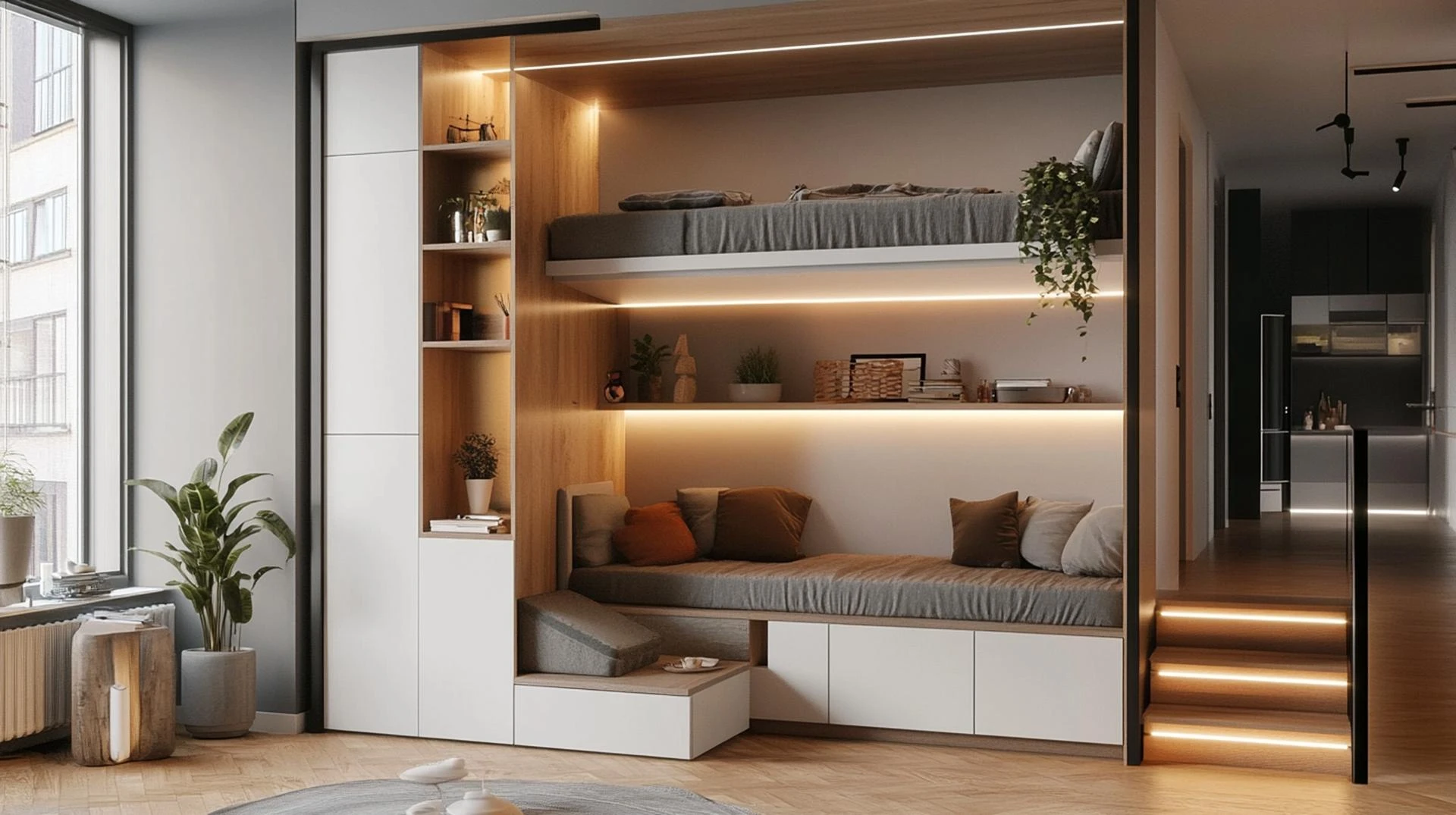
A homeowner's honest guide to why Indian apartments feel half their size - and what actually fixes it.
My cousin moved into her new 2BHK in Bengaluru last year. She'd spent months planning it -saved a Pinterest board with 400 pins, argued with her husband about curtain colours, the whole thing. Three weeks after moving in, she called me and said, "I don't understand. It felt so much bigger when it was empty."
I've heard some version of that line from almost every person I know who's moved into a flat in the last five years. The space looked fine on paper. It looked fine during the site visit. And then life moved in and somehow the rooms just… shrank.
Here's the thing nobody tells you when you're buying a flat: square footage is almost irrelevant. What you actually live in is the designed space -the walkable area, the breathing room, the way your eye travels across a room when you walk in. And in most Indian apartments, that designed space is being quietly stolen by one thing above everything else.
Storage. Specifically, wardrobes that were built without any real thought.
The Wardrobe Is Probably the Villain
Builder-grade wardrobes in India follow a formula: take a corner, fill it floor to ceiling, add two swing doors, put in one hanging rod, and call it done. The builder ticks the box. You get a wardrobe. And you also get a bedroom that feels like a very expensive closet.
Swing doors alone are brutal in a small room. You open one side and it eats 2 feet of your walkable floor. If the bed is close -and in most 2BHKs it has to be -you're doing a little sideways shuffle every morning just to get to your clothes. That shuffle is not a minor inconvenience. That shuffle is your brain registering, every single day, that this space is tight.
And that's before we even talk about what's inside the wardrobe. One hanging rod. Two shelves. That's basically the whole offer. So what actually happens? Clothes get folded and stacked until the stack falls. Shelves overflow. Stuff ends up on chairs. The floor. The bed. And now the entire room looks cluttered, not just the wardrobe.
If you're deep-diving into 2BHK interior design ideas and you haven't addressed the wardrobe layout first, you're essentially repainting a leaking wall. It'll look better temporarily. But the problem is still there.
What Sliding Doors Actually Change
The switch from swing to sliding wardrobe doors is probably the single highest-impact, lowest-effort change you can make in a bedroom. It doesn't just save floor space -it changes the entire rhythm of the room.
When you don't have to mentally budget for "door swing space," you can actually place furniture the way you want to. The bed can sit where the light is best, not where the wardrobe will allow. You get back 10 to 15 square feet of usable floor that was technically yours all along but practically unusable.
Add to that a wall-to-wall wardrobe design -the kind that spans the full width of the wall rather than sitting as a standalone unit -and something almost magical happens. The eye reads it as a wall, not as furniture. The room doesn't feel like it has an obstacle in it. It feels considered. And considered spaces feel bigger than cluttered ones, always.
The Living Room Is Carrying Too Much Weight
In Indian homes, the living room is expected to do everything. Host Diwali guests. Be the study when the kids need to focus. Serve as the Netflix room, the reading corner, the overflow dining area when too many people show up for lunch. It's a workhorse room dressed up like a showroom.
The mistake most people make -and I have made this mistake myself -is buying the sofa that looks best in the store. It's beautiful. It's grand. It fills the room like a centrepiece. And then it literally fills the room. There's nowhere to walk. Guests squeeze past each other. You stop having people over because it's just too cramped to host comfortably.
Scaled furniture changes everything here. A three-seater sofa with clean lines in a neutral fabric will make your living room feel twice as large as a plush seven-seater that looked incredible in the showroom. Pair it with a low-profile TV unit that has concealed storage inside, and suddenly you've got a room that breathes.
Mirrors help too -but only placed well. A full-length mirror on the wall opposite your main light source doubles the perceived light in the room. A mirror crammed into a random corner just reflects more clutter back at you.
Lighting Is Doing More Work Than You Realise
Most Indian flats have one overhead light per room. It's a design choice born from construction economics and it's quietly making your home feel smaller and flatter than it needs to.
Think about the last time you walked into a hotel room and thought it felt luxurious. Guaranteed there were at least three light sources working together -something overhead, something ambient near the bed or sofa, and something directional somewhere else. That layering creates depth. It makes the room feel like it has corners worth looking at.
At home, you can add a floor lamp, a few LED strips under a shelf or behind a cove, and suddenly the room has dimension it didn't have before. Warm white light (around 3000K if you're shopping for bulbs) in living spaces and bedrooms makes everything feel more inhabited, more intentional. It costs very little. The difference on the first night is immediate and somewhat emotional -it genuinely feels like coming home.
Why Getting This Right Early Matters More in Small Homes
I want to be honest about something: in a large home, bad design decisions are expensive but forgivable. There's room to course-correct, to shuffle things around, to add a piece here that compensates for a mistake there.
In a 2BHK flat, there's no margin. One wrong unit in the wrong spot and the whole room pays for it. That's why the homes that feel genuinely spacious and calm aren't the ones with the most square footage -they're the ones where every decision was made with the actual space in mind from the start.
This is where professional interior designers who understand Indian apartment living earn their fee in a way that's hard to explain until you've experienced it. They don't just make things pretty. They think spatially. They know that the depth of a wardrobe affects how wide the corridor feels. That a false ceiling dropped by 4 inches to hide a beam will make a bedroom feel claustrophobic. That a kitchen with the wrong layout will make cooking feel like a daily obstacle course.
Teams like Liva Kitchens and Interiors work specifically with homeowners who want to get this right -not just visually, but functionally -so the flat you live in five years from now still feels the way you hoped it would on day one.
Before You Buy Anything - Just Look
If there's one thing I'd say before you start any renovation or redesign, it's this: before you buy a single new piece of furniture or call a painter, walk slowly through your flat and notice what's actually bothering you.
Is it the wardrobe that needs two steps back to open? The kitchen where two people can't stand at the same time? The living room where the sofa pushes so close to the wall that guests sit in a single row like a waiting room? The bedroom where the light switch is behind the door because nobody thought about the swing direction?
Almost always, what feels like a "small flat problem" is actually a layout problem. And layout problems have solutions. They're not cheap or painless to fix, but they are fixable -and fixing them changes how you feel about your home every single day.
Your flat is the right size. It just hasn't been designed yet.
Thinking about redesigning your 2BHK with someone who actually gets Indian apartment life? Liva Kitchens and Interiors works across Bengaluru, Kochi, Palakkad, and Coimbatore -with a design process built around homes that feel right to live in, not just right to photograph