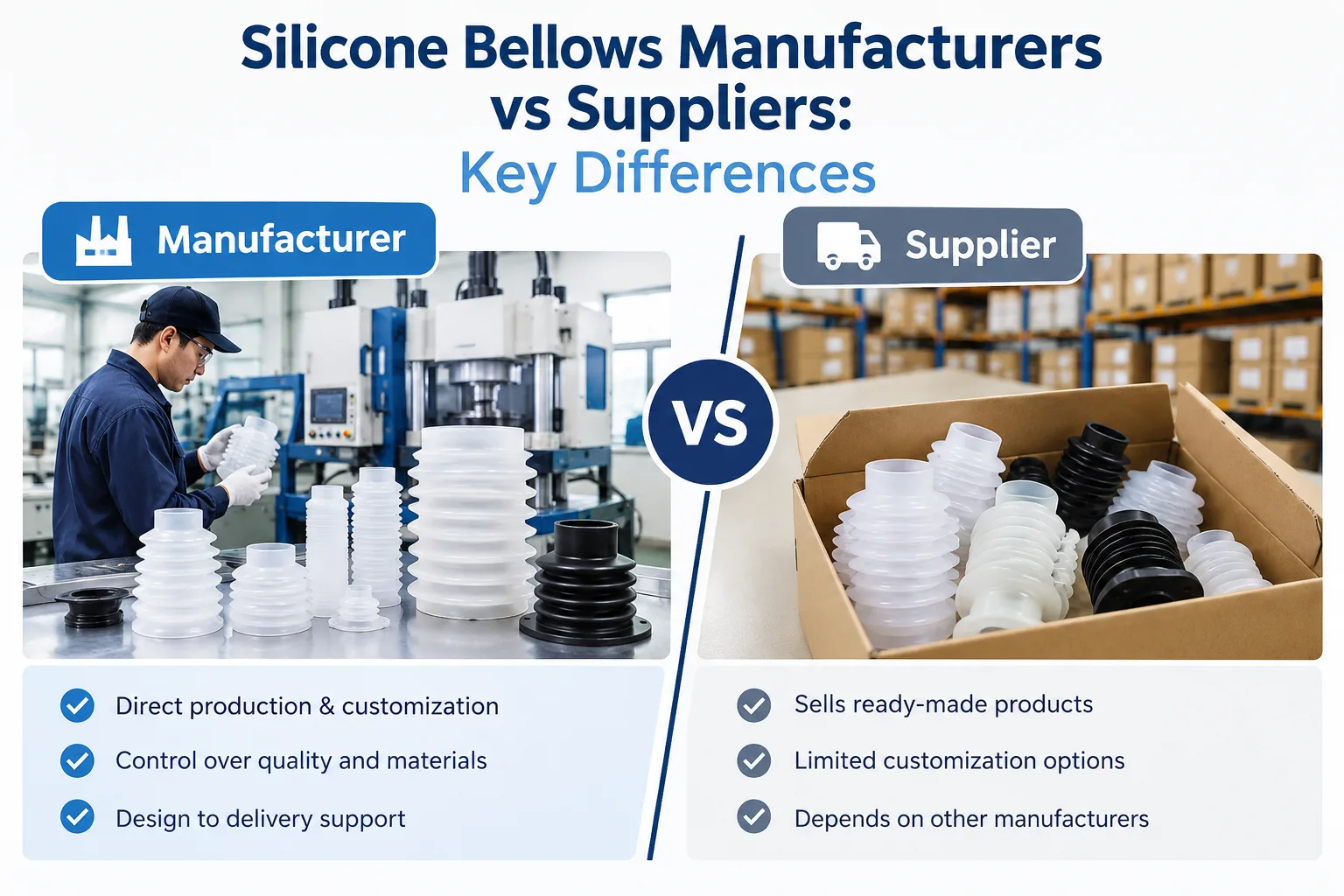
If you are buying a silicone rubber bellow for the first time, you will quickly notice that some companies call themselves manufacturers and others call themselves suppliers. They may look the same on a website, but the way they work is very different. Choosing the wrong one can mean delays, higher costs, or parts that do not fit your machine.
In this guide, we explain the real difference between silicone bellows manufacturers and suppliers in simple words, so you can pick the right partner for your project.
What Is a Silicone Rubber Bellow?
A silicone rubber bellow is a flexible, accordion-shaped cover. It protects moving parts like shafts, cylinders, and joints from dust, moisture, oil, and heat. Because it can stretch and compress, it moves with the machine without losing its seal.
Silicone is popular for this job because it handles very high and very low temperatures, resists ageing and UV light, and stays flexible for years. That is why you will find industrial silicone bellows in food processing, medical equipment, automotive systems, packaging machines, and robotics.
Who Are Silicone Bellows Manufacturers?
Silicone bellows manufacturers are companies that actually make the product. They own the moulds, machines, and raw materials, and they control every step: design, moulding, curing, trimming, and testing.
When you work with a manufacturer, you speak directly to the people who produce your part. If you need a change in size, wall thickness, or material grade, they can usually do it on their own floor without asking anyone else.
Who Are Suppliers?
A supplier, also called a trader or distributor, buys finished products from one or more factories and sells them to you. They may stock ready-made items and ship them quickly. They do not usually control how the product is made.
Suppliers are not bad. For a small, urgent, standard order, they can be very handy. But when your requirement is technical or specific, their limits start to show.
Key Differences Between Manufacturers and Suppliers
1. Customization
A manufacturer can build a bellow to your drawing or sample. You can choose the number of convolutions, the diameter, the length, the end-cuff style, and even the silicone grade.
A supplier mostly sells what is already available. If your machine needs a special size, they must go back to a factory and wait for a reply, which takes time and often changes the design along the way.
2. Pricing
Manufacturers sell directly, so there is no middleman margin. For medium and large orders, this usually means a better price per piece.
Suppliers add their own profit on top of the factory price. For a single piece or a tiny order, this difference may not matter much. For regular or bulk buying, it adds up fast.
3. Quality Control
A good silicone rubber bellows company checks quality at every stage: raw material, moulding, and final inspection. If a batch has a problem, they can trace it back and fix it.
With a supplier, you often do not know where the product came from. If a bellow cracks early, finding the cause is difficult, and the blame goes back and forth.
4. Technical Support
Manufacturers have engineers who understand materials and working conditions. They can tell you whether standard silicone is enough or whether you need a food-grade, high-temperature, or oil-resistant compound.
Suppliers can share a catalogue, but they rarely have deep product knowledge. Their advice may be limited to "this one is in stock."
5. Lead Time
This is where suppliers sometimes win. If they keep ready stock, they can ship within a day or two.
Manufacturers may need time to make a new mould or run a custom batch. However, once the mould exists, repeat orders are fast and consistent. For planned or recurring needs, a manufacturer is usually more reliable.
6. Minimum Order Quantity (MOQ)
Suppliers are more flexible with small quantities. Manufacturers often prefer a minimum order, especially for custom parts, because setting up production has a fixed cost. Many manufacturers do offer sample runs, so it is worth asking.
7. Long-Term Relationship
When you work with a manufacturer, you build a direct relationship. They keep your drawings, mould, and specifications on file, so every future order matches the first one. With a supplier, the source can change from one order to the next, and so can the quality.
Quick Comparison
FactorManufacturerSupplierCustomizationFull custom designLimited to available stockPrice (bulk)LowerHigherQuality controlDirect, traceableIndirectTechnical helpExpert guidanceBasic informationLead time (custom)Longer first orderNot suitableLead time (standard)Fast on repeat ordersFast if in stockMOQUsually higherUsually lowerWhen Should You Choose a Manufacturer?
A manufacturer is the better choice if:
- You need industrial silicone bellows made to a specific size or drawing
- Your machine works in extreme heat, cold, or a hygiene-sensitive area
- You plan to place regular or bulk orders
- You want consistent quality across batches
- You need certifications or material test reports
When Is a Supplier Enough?
A supplier can work well when:
- You need a standard bellow urgently
- Your quantity is very small
- You are replacing a common part with a known size
- Precision and special material properties are not critical
How to Check If a Company Is a Real Manufacturer
Many traders present themselves as factories, so check before you commit. Here are a few simple ways:
- Ask for factory photos or a video call. A real manufacturer will happily show their moulds and production line.
- Request material details. They should tell you the silicone grade, hardness (Shore A), and temperature range without confusion.
- Ask about tooling. Manufacturers can explain how they make or modify moulds.
- Look for sample support. A genuine silicone bellows manufacturer can make a sample from your drawing.
- Check their quality process. Ask what tests they run before shipping.
Why Experience Matters
Whether you buy from a manufacturer or a supplier, experience counts. A well-established silicone rubber bellows company understands how different industries use bellows and can guide you away from costly mistakes, like choosing a material that hardens in the cold or a wall thickness that tears under repeated movement.
If you want to see what a dedicated manufacturer offers, you can explore our silicone rubber bellows company page for custom options, materials, and applications.
Frequently Asked Questions
Silicone bellows manufacturers make the product in their own factory using their own moulds and machines. Suppliers buy finished bellows from factories and resell them. Manufacturers offer better customization, pricing on bulk orders, and quality control, while suppliers are useful for small, urgent, standard orders.
2. What is a silicone rubber bellow used for?A silicone rubber bellow is a flexible, accordion-shaped cover that protects moving parts like shafts, cylinders, and joints from dust, moisture, oil, and heat. It is widely used in food processing, medical devices, automotive systems, packaging machines, and robotics.
3. What are the advantages of industrial silicone bellows?Industrial silicone bellows handle a wide temperature range, resist ageing, UV light, and ozone, stay flexible for a long time, and can be made in food-grade or medical-grade material. This makes them a good choice for tough working environments and hygiene-sensitive industries.
4. How long do silicone rubber bellows last?Lifespan depends on temperature, movement frequency, and the chemicals they touch. With the right material and design, silicone bellows can last several years. Choosing the correct wall thickness and silicone grade from a reliable manufacturer makes a big difference.
5. Can silicone bellows be customized?Yes. A good silicone rubber bellows company can customize the diameter, length, number of convolutions, wall thickness, end-cuff style, colour, and silicone grade based on your drawing or sample.
6. What temperature can silicone bellows withstand?Standard silicone bellows generally work from about -50°C to 200°C. Special high-temperature grades can go higher. Always confirm the exact range with your manufacturer for your application.
7. How do I know if a company is a real silicone bellows manufacturer?Ask for factory photos or a video call, request material details like Shore A hardness and temperature range, ask about their tooling and mould-making process, and check if they can make a sample from your drawing. Genuine manufacturers answer these easily.
8. Is it cheaper to buy from a manufacturer or a supplier?For medium and bulk orders, buying directly from a manufacturer is usually cheaper because there is no middleman margin. For a single piece or a very small order, a supplier with ready stock can sometimes be more convenient.
Final Thoughts
Both manufacturers and suppliers have a place in the market. Suppliers are convenient for small, quick, standard purchases. But if you need a custom design, better pricing on volume, consistent quality, and real technical support, working directly with silicone bellows manufacturers is the smarter long-term choice.
Before you place your next order, think about your quantity, your timeline, and how specific your requirement is. Answering those three questions will tell you which route is right for you.
Need a custom silicone rubber bellow for your machine? Share your drawing or requirements with our team and get a quick quote.