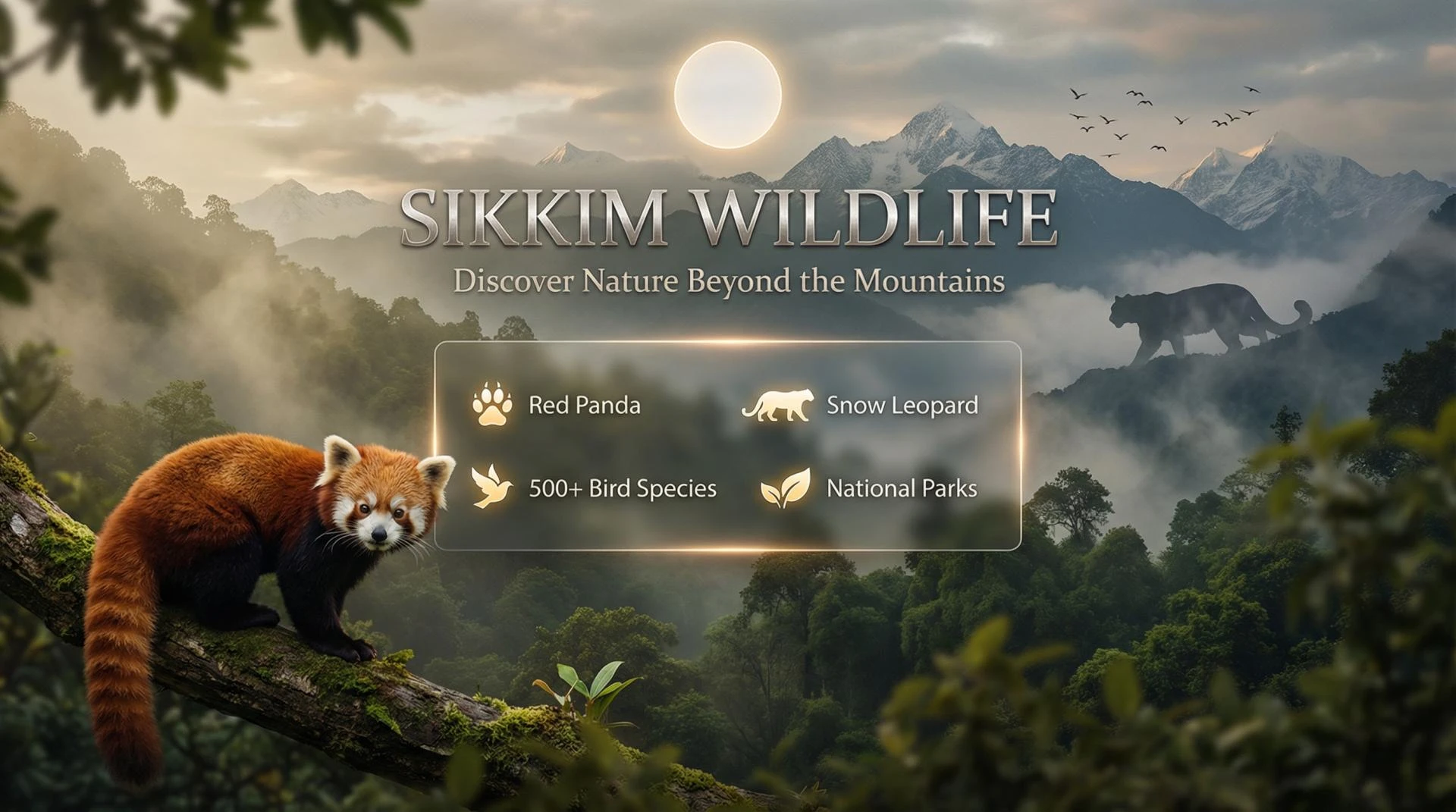
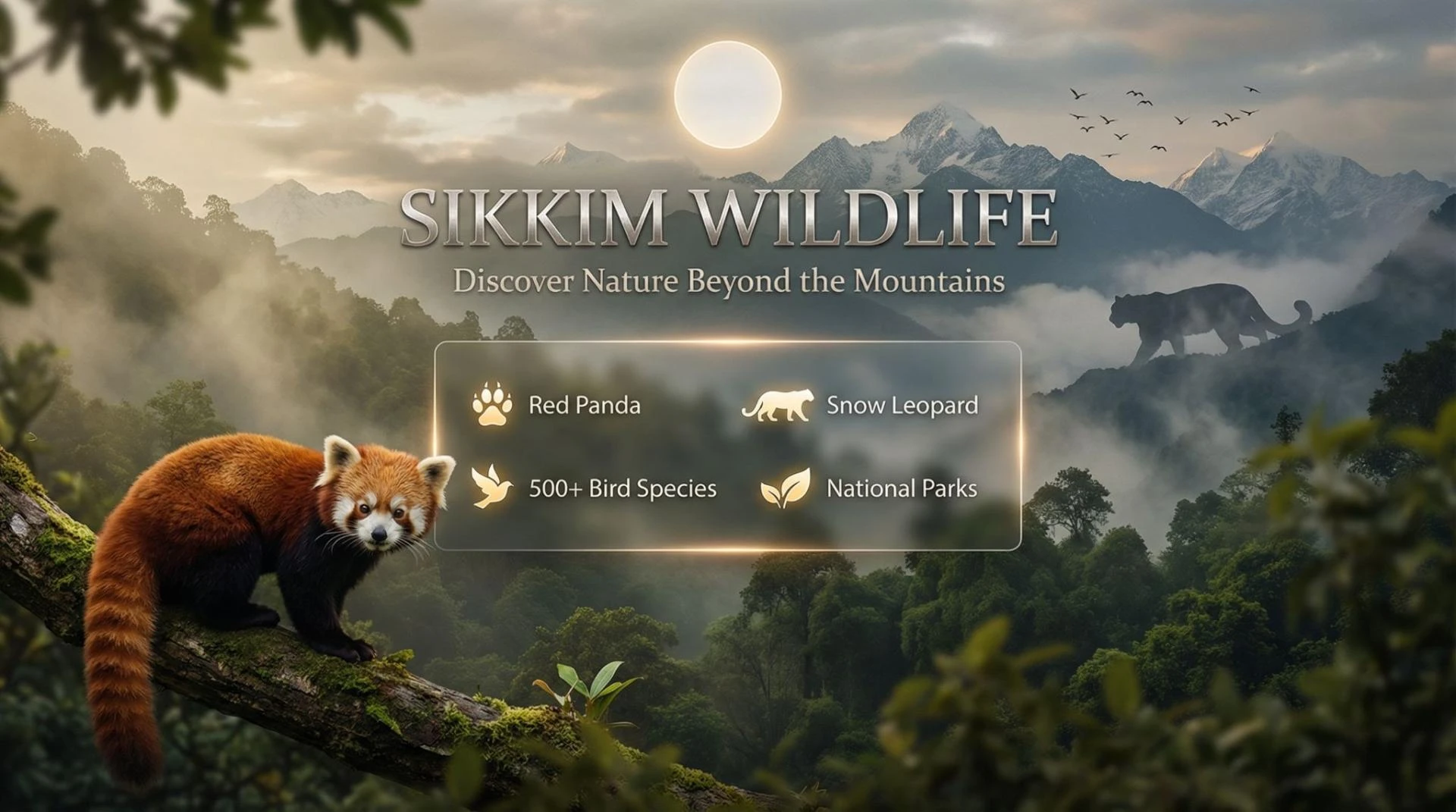
Sikkim has one of the highest concentrations of biodiversity per square kilometre of any state in India. Over 500 bird species. The red panda — the original panda, the one that predates the giant panda by naming rights and by evolutionary history — living in the rhododendron forests of the middle altitude. Snow leopards in the upper zones of khangchendzonga national park. Over 4,000 species of flowering plants including 36 species of rhododendron and 500 species of orchid. Himalayan black bears, blue sheep, musk deer, and Himalayan tahr sharing the high-altitude terrain. Call 📞 +91 77193 52120 and book your sikkim tour package — the wildlife dimension of Sikkim travel is available to every visitor who knows where to look and what time to be there.
This guide covers the wildlife and natural history of Sikkim — the animals worth specifically seeking, the birds that make serious birders plan dedicated trips, the protected areas and their different characteristics, and the practical advice that separates a traveller who sees wildlife from one who spends the same days in the same places and sees only landscape. Call 📞 +91 77193 52120 after reading for wildlife-specific itinerary additions to your sikkim holiday packages booking.
The Red Panda — Sikkim's Defining Animal
The red panda is Sikkim's state animal and genuinely its most charismatic wildlife encounter. Smaller than the giant panda with which it shares a name — raccoon-sized, russet-coloured, with a distinctive ringed tail — the red panda lives in the temperate forests between 6,000 and 12,000 feet altitude where bamboo grows alongside rhododendron and oak. Sikkim has one of the highest densities of wild red panda habitat in India.
Himalayan zoological park gangtok has the most reliable red panda viewing in the region — several individuals in large forested enclosures on the hillside, visible throughout the day but most active in the early morning and late afternoon when they come down to feed. The zoo is the right starting point for travellers who want to see red pandas with certainty — the wild population is real but sightings are not guaranteed on a standard north sikkim tour package schedule.
Wild red panda habitat in Sikkim is concentrated in the Barsey Rhododendron Sanctuary in West Sikkim — accessible from pelling tour package as a specific wildlife addition — and in the forest zones of khangchendzonga national park along the goechala trek and dzongri trek routes. The Tshoka to Dzongri section of the Goechala route passes through prime red panda forest and morning departures in October and November regularly produce sightings. Call 📞 +91 77193 52120 for wildlife-specific trekking itinerary additions.
The Snow Leopard — The Ghost of the High Himalaya
The snow leopard is the most mythologised animal in the Himalayan wildlife lexicon — grey-spotted, yellow-eyed, adapted to life above the treeline in some of the most inhospitable terrain in Asia. Sikkim's khangchendzonga national park has a resident snow leopard population in the upper alpine and sub-nival zones above 12,000 feet.
Seeing a snow leopard in the wild is genuinely possible in Sikkim — it is also genuinely uncommon on a standard tourist itinerary. Wildlife researchers and serious photographers who spend multiple days at high-altitude zones along the goechala trek package route report sightings at a rate that makes dedicated snow leopard expeditions worth mounting. The winter months — December to February — when the leopards move to lower altitudes following their prey are the most productive for sightings.
Darjeeling zoo has a small captive snow leopard population — the zoo is one of the few in India with a successful snow leopard breeding programme and the animals are visible in their hillside enclosure throughout visitor hours. This is not a substitute for a wild sighting but it gives a genuine sense of scale and form that photographs do not. Call 📞 +91 77193 52120 for wildlife-focused itinerary advice.
The Himalayan Black Bear and Other Large Mammals
The Himalayan black bear — medium-sized, glossy black with a white chest chevron — lives in the middle-altitude forests of Sikkim between 6,000 and 11,000 feet. Himalayan zoological park gangtok maintains a visible population in large forested enclosures. Wild sightings are possible but uncommon in the forest sections of the dzongri trek package route and in the Barsey Sanctuary area.
Blue sheep — locally called bharal — are a high-altitude grazing animal found above 12,000 feet in the open rocky terrain above the treeline. They are regularly visible on the Dzongri plateau and the higher sections of the goechala trek route — stocky, grey-brown, with backward-curving horns, moving in groups of 5 to 30 across the rocky slopes. They are generally unafraid of slow-moving trekking parties and close observation is possible.
Himalayan tahr — large wild goat with massive backward-sweeping horns — occupy similar terrain to blue sheep and are similarly visible on high-altitude trekking routes. The singalila ridge trek and sandakphu trek routes both pass through tahr habitat on the ridge sections.
Musk deer — small, hornless, with distinctive enlarged upper canines — live in the dense forest between 8,000 and 12,000 feet. Shy and primarily nocturnal, they are occasionally seen at dawn and dusk on trekking routes through the khangchendzonga national park middle forest zones. Call 📞 +91 77193 52120 for trekking itineraries with specific wildlife observation timing built in.
Flying squirrels — specifically the large Indian giant flying squirrel — are visible in the banjhakri waterfall gangtok forest and in the forest near rumtek monastery in the early evening hours when they emerge to glide between forest trees. Spotted at twilight, they are one of the most surprising wildlife encounters for travellers who are not expecting them.
The Birds — Why Sikkim Is a Serious Birding Destination
Sikkim bird watching tour is a dedicated activity for a growing number of travellers who come specifically for the bird list rather than the mountain views — though they generally get both simultaneously. Over 500 species are recorded for Sikkim and the surrounding Darjeeling Hills, including a significant number of Himalayan endemics and high-altitude specialists that are found nowhere outside the eastern Himalayan arc.
The Key Species
The Blood Pheasant is Sikkim's state bird — a striking red and green pheasant that lives in rhododendron and juniper forest between 11,000 and 14,500 feet. Most commonly seen on the goechala trek package route between Dzongri and Lamuney in the early morning hours when the birds feed along the trail edge. Groups of 5 to 15 individuals moving through the forest in single file are a regular sighting for dawn departures.
The Satyr Tragopan is one of the most visually dramatic pheasants in Asia — the male has an electric blue and red head pattern during breeding season in April and May that makes it one of the most photographed birds in the Himalaya. Found in the dense rhododendron forest between 8,000 and 12,000 feet, it is present on the sandakphu trek ridge route and in the varsey rhododendron sanctuary during the spring window.
The Fire-tailed Myzornis — a small flame-coloured sunbird-like species found in the high rhododendron forest — is one of the most-sought birds for serious tickers visiting Sikkim. Present at the forest-treeline transition zone between 9,000 and 12,000 feet, it is regularly found on the lower Goechala route and in the forest above yuksom tour.
The Himalayan Monal is the most spectacular pheasant in the region — iridescent green, blue, purple, and bronze plumage in the male, found above the treeline in the rocky terrain adjacent to high meadows. Regularly seen on the Dzongri plateau and on the singalila ridge trek at altitude. October and November sightings are most reliable as the birds move into more visible terrain before snow.
The Ward's Trogon is one of the most-prized birds in the Darjeeling Hills and Sikkim — a large, brilliantly coloured trogon found in the temperate forest between 6,000 and 9,000 feet. Rarely seen and always memorable when encountered. The forest roads above darjeeling tourism town and the lower sections of the goechala trek both fall within its range.
Darjeeling bird watching tours operate from early morning dawn walks on the forest roads above Tiger Hill — the most accessible birding location in the region, delivering 40 to 60 species on a good morning walk with a specialist guide who knows the call patterns. Call 📞 +91 77193 52120 to add the darjeeling bird watching dawn walk to your darjeeling tour plan.
The Protected Areas — Khangchendzonga and Singalila
Khangchendzonga National Park
Khangchendzonga national park is a UNESCO World Heritage Site and the largest protected area in Sikkim — covering the entire western and northern high-altitude terrain including the Kanchenjunga massif itself. The park encompasses everything from subtropical forest at 4,000 feet to glacier and permanent snowfield above 22,000 feet.
Entry into the park requires the standard inner line permit sikkim plus a specific national park trekking permit for the goechala trek package and dzongri trek package routes. A registered guide is mandatory within the park — this is a permit condition and serves the park's conservation objectives by ensuring visitor behaviour is monitored and routes are followed correctly. We arrange all permits and guide booking as part of every trekking package. Call 📞 +91 77193 52120 for park permit arrangements.
The biodiversity within Khangchendzonga is the richest of any area in the eastern Himalaya — the altitude gradient from subtropical to permanent ice produces every Himalayan habitat type within one protected area. The result is a wildlife list that includes species from tropical and subtropical birds at lower elevations, temperate forest specialists in the middle zones, high-altitude endemics at treeline, and the great open-country mammals of the alpine above.
Singalila National Park
Singalila national park covers the Singalila Ridge along the India-Nepal border — the trekking terrain of the sandakphu trek and singalila ridge trek. The park is West Bengal's only high-altitude national park and the conservation focus is the Himalayan mammal and bird community of the ridge environment.
Red panda, Himalayan black bear, leopard, serow — a goat-antelope relative — and the full array of high-altitude pheasants and raptors are recorded within the park. Entry requires the singalila national park permit plus a guide for trekking routes. All arranged through us as part of trekking bookings. Call 📞 +91 77193 52120 for permit and guide arrangements.
The Plant Life — Sikkim as a Botanical Destination
The botanical dimension of Sikkim travel is underappreciated by most visitors and genuinely extraordinary to anyone who knows what they are looking at. Over 4,000 species of flowering plants, 36 species of rhododendron ranging from 6-inch shrubs to 60-foot trees, 500 species of orchid, and the primula meadows that appear at high altitude in spring are all within the same landscape that contains the mountains and the monasteries.
The rhododendron tour sikkim in April specifically targets the Yumthang and varsey rhododendron sanctuary bloom windows — when the forest hillsides are covered simultaneously in 20 to 30 species at different altitudes creating a layered display of colour from valley to treeline. The flower tour yumthang is the most visited botanical spectacle in northeast India and it genuinely deserves every traveller it attracts during the two to three week peak window.
The khangchendzonga national park alpine meadows above 13,000 feet in June produce primula species — cushion-forming, flowering in pink, purple, yellow, and white — across the open slopes above the treeline in a display that mountain botanists specifically travel to Sikkim to witness. This is a less-visited botanical window than the April rhododendron but equally dramatic for those who know to look for it. Call 📞 +91 77193 52120 for botanical-interest itinerary additions to your north sikkim tour package or trekking booking.
Wildlife Practical Advice — Making the Most of the Natural History
The single most important practical principle for wildlife and bird watching in Sikkim is time of day. Dawn and the two hours after sunrise produce the majority of wildlife encounters across every habitat type. Animals that are invisible during the mid-morning and afternoon tourist rush are visible at 6am to 8am for anyone who planned the departure time correctly. The darjeeling sunrise tour to tiger hill darjeeling that starts at 4am is the correct departure time not just for the mountain view but because the birds are active on the roadside forest in the pre-dawn and the mammal activity peaks in the first hour of light.
Silence matters more than most travellers expect. A group of ten people talking at normal conversation volume produces no wildlife encounters. A group of two moving quietly along a forest trail produces sightings regularly. When we add sikkim bird watching tour and darjeeling bird watching to itineraries we brief every traveller specifically on this before the dawn walk.
A specialist wildlife guide — as distinct from a general trekking guide — makes a significant difference to the number and quality of encounters. A general guide shows you the trail. A wildlife guide shows you where to stop, what sound that was, why that branch is moving, what that shape is at the edge of the forest. We can connect you with specific specialist wildlife and birding guides for Sikkim and Darjeeling destinations. Call 📞 +91 77193 52120 for wildlife guide booking.
Browse sikkim travel guide, sikkim travel tips, north sikkim tour plan, and goechala trek package for wildlife-inclusive itinerary planning. Check sikkim april tour and sikkim october tour for the best wildlife windows. Review sikkim adventure tour options for trekking-based wildlife itineraries. Visit sikkimholidaypackages.com or call 📞 +91 77193 52120 — Sikkim's wildlife is waiting and the right guide makes all the difference. 📞 +91 77193 52120