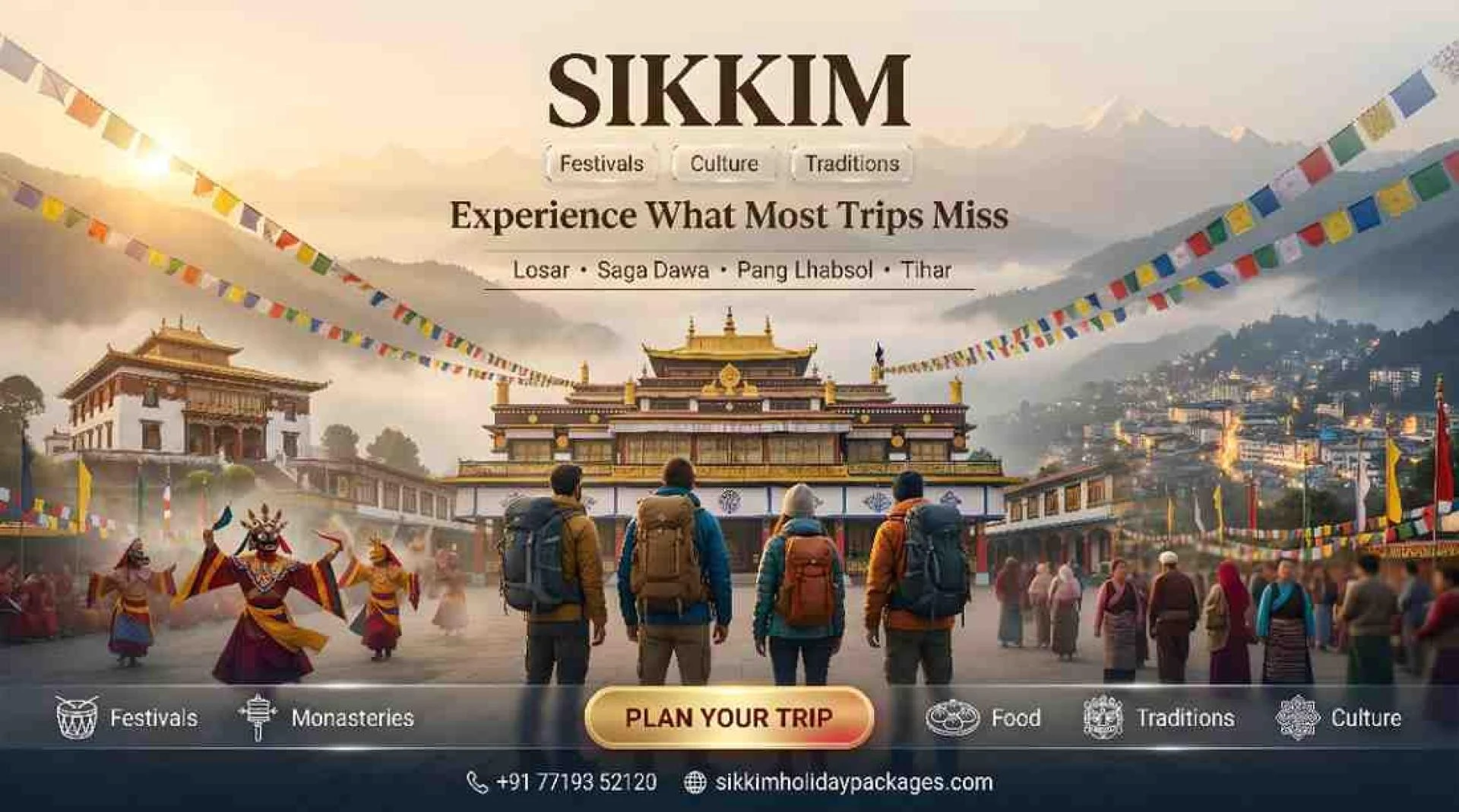
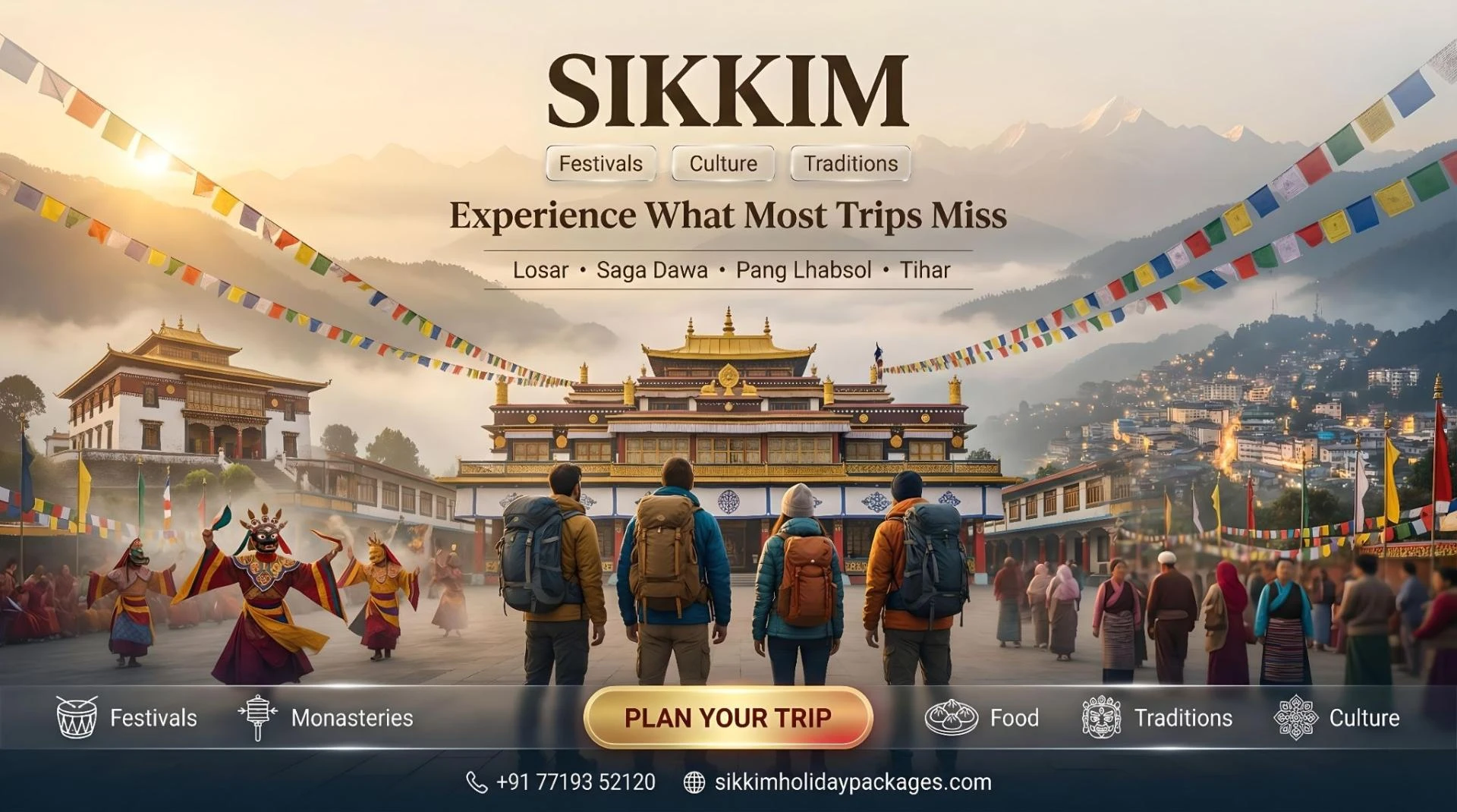
Most people who book sikkim tour packages think about mountains. What they discover when they arrive is that Sikkim has a cultural depth that the mountain photographs do not prepare you for — monastery courtyards where monks in masks perform dances that have been performed for three centuries, market mornings where Lepcha, Bhutia, and Nepali communities shop alongside each other in a multilingual mix that makes Gangtok feel genuinely unlike any other Indian city, festival calendars that shift with the lunar cycle and fill the streets with colour and sound in ways that scheduled tourist attractions simply cannot replicate. Call 📞 +91 77193 52120 and book your sikkim tour packages with the team that knows exactly when each festival falls and how to time your trip around the ones worth seeing.
This is the guide to Sikkim's culture and festivals that most travel websites do not write — not because the information does not exist but because it requires someone who actually knows the calendar, the communities, and the specific places where each tradition is most authentically experienced. Call 📞 +91 77193 52120 — our team has been planning sikkim tours and packages around these events for years and the timing advice we give is specific and accurate rather than generic.
Understanding Sikkim's Cultural Layers
Before the festivals make sense, the cultural structure of Sikkim needs to be understood. Sikkim is not one culture — it is at minimum four, living in close proximity and influencing each other continuously over centuries while maintaining distinct identities that show up in language, food, dress, architecture, and religious practice.
The Lepcha people are the indigenous community — the earliest inhabitants of Sikkim, with a unique language, a specific relationship with the landscape that is expressed in their festivals, and a tradition of forest knowledge that has made them the custodians of the high-altitude ecological zones of khangchendzonga national park for longer than written records exist.
The Bhutia people are of Tibetan origin — they arrived in Sikkim several centuries ago with the Buddhist religious tradition that built rumtek monastery, enchey monastery gangtok, and pemayangtse monastery pelling. The monastic festival calendar — the cham dances, the Losar celebrations, the Saga Dawa observances — is primarily a Bhutia tradition with roots in the Tibetan Buddhist practice that the Bhutia community brought across the Himalaya.
The Nepali community arrived progressively from the eighteenth century onward and now constitutes the majority population of Sikkim. The Nepali cultural contribution — the Dashain and Tihar festivals, the Nepali language that serves as the lingua franca of the state, the food traditions that produced the momos and thukpa culture of Gangtok — is the most widely visible layer of daily life in modern Sikkim.
The Tibetan refugee community, smaller but culturally significant, added another layer of Tibetan Buddhist practice, craft tradition, and food culture after 1959. Together these four communities have created something genuinely unusual in Indian cultural geography — a state where Buddhist monks, Hindu farmers, indigenous forest communities, and Tibetan refugees share a small geographical space with remarkable day-to-day harmony. Call 📞 +91 77193 52120 for the sikkim trip timing that puts you in the right place for the cultural experience you specifically want.
The Festival Calendar — Month by Month
Losar — The Tibetan New Year
Losar is the most important festival in the Bhutia and Tibetan Buddhist calendar — the new year celebration that falls in February or March depending on the lunar calendar year. In Sikkim, Losar transforms the monastery courtyards of rumtek monastery, enchey monastery gangtok, and pemayangtse monastery pelling into the settings for the most dramatic ritual performances in the state.
The cham dances — performed by trained monks in elaborate costumes and deity masks — are the centrepiece of the Losar celebration at each monastery. The dances are not performances in the theatrical sense — they are religious acts, the physical embodiment of particular Buddhist teachings and the ritual defeat of negative forces at the beginning of the new year. The masks are stored year-round and brought out for Losar — some of them are centuries old and the craftsmanship in the painted papier-mache faces and gilded headpieces is extraordinary.
What to see at Losar:
At do drul chorten gangtok the circumambulation circuit around the stupa runs continuously during Losar — monks and lay people spinning the 108 prayer wheels in an unbroken circuit from dawn. The smell of butter lamps, the sound of the drums from inside the monastery, and the colour of the festival dress worn by the Bhutia community make this the most sensory-rich experience in Gangtok travel.
At rumtek monastery the Losar cham dance is performed in the main courtyard over two days — the monastery's distance from Gangtok means fewer casual visitors and a more concentrated religious atmosphere than the city monastery celebrations.
Practical note: Losar falls on different dates each year according to the Tibetan lunar calendar. It is typically 4 to 8 weeks after Tibetan New Year is announced — call 📞 +91 77193 52120 in November or December of the previous year if you want to time a trip around Losar. We track the lunar calendar and confirm dates as soon as they are established.
Bumchu — The Sacred Water Festival
Bumchu is a festival unique to Sikkim that takes place at Tashiding Monastery in West Sikkim — one of the most sacred Tibetan Buddhist sites in the state, sitting on a hilltop above the Rathong River valley with views of the Kanchenjunga massif. The festival centres on a sacred sealed pot — the bumchu — that is opened once a year and the level of water inside is read as a prophecy for the coming year.
The journey to Tashiding for Bumchu — a 25-kilometre drive from pelling tour package base — produces one of the most atmospheric festival experiences in northeast India. The combination of the monastery setting, the sacred water ritual, and the pilgrims who arrive from across Sikkim and Bhutan specifically for this event creates something that feels genuinely irreplaceable. Call 📞 +91 77193 52120 for Bumchu date and access arrangements — the festival happens between late January and mid-February depending on the lunar calendar.
Saga Dawa — The Holiest Buddhist Month
Saga Dawa is the month-long observance of the Buddha's birth, enlightenment, and parinirvana — traditionally the holiest period in the Tibetan Buddhist calendar. In Sikkim, Saga Dawa transforms the monastery circuit in ways that persist throughout the entire month rather than concentrating on a single festival day.
During Saga Dawa the majority of the Buddhist community in Sikkim observes vegetarian eating — which means the restaurant menus in Gangtok shift significantly toward vegetable-based preparations that are among the most interesting cooking in the local food tradition. The monastery visits during Saga Dawa catch the institutions at their most actively religious — prayer sessions more frequent, butter lamps continuously lit, circumambulation circuits continuously populated.
The main public observance of Saga Dawa in Sikkim is the procession at do drul chorten gangtok on the full moon day — the fifteenth day of the fourth lunar month, typically falling in May or June. Thousands of people circumambulate the stupa from early morning, the drum and cymbal sessions inside the monastery run continuously, and the atmosphere of collective religious observance is unlike anything in the regular tourist season. Call 📞 +91 77193 52120 for Saga Dawa timing in your target travel year.
Pang Lhabsol — Kanchenjunga Worship
Pang Lhabsol is the festival that is most uniquely Sikkimese — with no close equivalent anywhere else in Indian cultural practice. It is the annual worship of Kanchenjunga as the guardian deity of Sikkim — the mountain not as a geological feature but as a divine protector of the kingdom and its people. The festival falls in August or September on the fifteenth day of the seventh lunar month.
The warrior dance — the main ritual performance of Pang Lhabsol — is performed by monks in warrior costumes with specific regalia representing the divine protector and his attendants. Pemayangtse monastery pelling is the primary venue and the combination of the dance in the monastery courtyard with the actual Kanchenjunga visible behind the building — on clear August days the mountain watches its own worship — produces an experience that travellers who encounter it by timing rather than planning consistently describe as the most unexpected and memorable of their sikkim trip.
Call 📞 +91 77193 52120 for Pang Lhabsol date confirmation — the lunar calendar date shifts each year and a call to us in June or July will give you the exact date for your target season. The north sikkim tour packages from gangtok in August can be combined with a Pang Lhabsol day at Pemayangtse for the right itinerary.
Tendong Lho Rum Faat — The Lepcha Harvest Festival
Tendong Lho Rum Faat is the most important festival of the indigenous Lepcha community — a harvest celebration and worship of Mount Tendong, a peak in South Sikkim sacred to the Lepcha as the place where their ancestors found refuge during a great flood. The festival falls on the eighth day of the eighth lunar month — typically August — and is a public holiday in Sikkim.
The Lepcha cultural performances during Tendong Lho Rum Faat — traditional music on the unique Lepcha instruments, the specific festival dress of the community, and the ritual offerings to the mountain — are the most authentic window into the indigenous culture of Sikkim available to outside visitors. Namchi in South Sikkim and Ravangla are the primary celebration centres. Call 📞 +91 77193 52120 for the sikkim tour packages timing that includes this festival.
Tihar — The Festival of Lights in Sikkim
Tihar is the Nepali community's equivalent of Diwali — a five-day festival of lights in October or November that in Sikkim has a specific character shaped by the Nepali mountain community's traditions rather than the plains Diwali format. The fifth day of Tihar — Bhai Tika — when sisters perform a protective ceremony for brothers — is the most visually distinctive element of the Sikkim Tihar observance.
Gangtok during Tihar is covered in oil lamps and string lights in a way that is genuinely beautiful from the viewpoints above the city — the tashi view point gangtok evening visit during Tihar shows the entire city valley lit from within in a way that the regular tourist season does not produce. The sel roti making that happens in every Nepali household during Tihar means the market has the specific smell of fried rice bread and the food stalls are at their most active. Call 📞 +91 77193 52120 for Tihar-timing sikkim tours and packages.
The Monastery Circuit — Understanding What You Are Seeing
Most visitors to Sikkim monastery sites treat them as architectural attractions — photograph the building, note the age, move to the next destination. The monasteries of Sikkim are religious institutions first and tourist attractions incidentally — understanding what is actually happening inside them transforms the experience from sightseeing into something more genuinely interesting.
Rumtek Monastery — The Largest and Most Significant
Rumtek monastery is the seat of the Karma Kagyu school of Tibetan Buddhism outside Tibet — one of the four main schools of Tibetan Buddhism and historically one of the most influential. The monastery was rebuilt in its current form in the 1960s by the sixteenth Karmapa, who fled Tibet after 1959 and established the seat of the lineage in Sikkim with the support of the Sikkim royal family.
The main prayer hall contains thankas — scroll paintings — of exceptional artistic and religious quality, golden statues of the Buddha in multiple manifestations, and the ritual objects of the Karma Kagyu practice. The stupa complex behind the main monastery contains the relics of the sixteenth Karmapa. The monastery museum displays ritual implements, royal gifts, and artefacts from the pre-1959 Tibetan period. Visiting Rumtek properly requires two to three hours — not thirty minutes. The detail in the iconography rewards attention. Call 📞 +91 77193 52120 for the gangtok tour packages itinerary that includes proper Rumtek time.
Enchey Monastery — The City Monastery
Enchey monastery gangtok sits on a ridge above the city — established in the 1840s on a site chosen by a Tantric master who tested the location through ritual practice. The monastery is small compared to Rumtek but more immediately atmospheric because of its position above the city and the prayer flags that line the approach path.
The morning prayer session at Enchey — beginning around 6am — is accessible to respectful visitors who arrive quietly and observe without disrupting the ceremony. The monks chant in unison to the accompaniment of drums, cymbals, and long horns — the sound carrying across the hillside in the pre-dawn quiet. This is one of the most powerful experiences available in Gangtok and it is available to anyone who sets an early alarm and arrives respectfully. Call 📞 +91 77193 52120 for the gangtok tour packages itinerary that includes the Enchey morning session.
Pemayangtse — The Sacred and the Scenic
Pemayangtse monastery pelling is the oldest functioning monastery in Sikkim and historically the most important — built by the first religious ruler of Sikkim and maintained by a lineage of monks who trace their descent from the monastery's founders. The main hall contains an extraordinary painted wooden model of Zangdog Palri — the heavenly palace of Guru Rinpoche — built over five years by a single monk and standing as the most remarkable piece of religious art in Sikkim.
The monastery is most powerful in the early morning — before the tourist groups from Pelling arrive and while the monks are completing the morning ritual schedule. The view from the monastery courtyard on clear mornings — Kanchenjunga directly in front, the monastery's golden roof in the foreground — is one of the defining images of Sikkim travel. Call 📞 +91 77193 52120 for the pelling tour package that includes early morning Pemayangtse access.
Traditional Crafts and Art — The Living Cultural Output
Sikkim's craft traditions are the visible output of its cultural layers — the thangka paintings of the Bhutia Buddhist tradition, the woven textiles of the Lepcha community, the woodcarving and metalwork of the monastery workshops, and the carpet weaving tradition that was established specifically to support Tibetan refugee craftspeople after 1959.
Thangka Painting
Thangka are Buddhist scroll paintings — complex compositions depicting deities, mandalas, and narrative scenes from Buddhist literature, painted in mineral pigments on cotton canvas and traditionally used as meditation supports and teaching tools. In Sikkim, thangka painting is a living craft tradition — not a heritage activity preserved for tourists but a genuine religious art practice continued by trained painters who study for years under master teachers.
The directorate of handicrafts gangtok is the best place to see genuine thangka painting in process and to buy work directly from verified craftspeople at fair prices. The paintings available range from small pieces at ₹2,000 to ₹5,000 to large elaborate compositions at ₹50,000 and above. Call 📞 +91 77193 52120 for the gangtok tour packages itinerary that includes the handicrafts directorate visit.
Lepcha Weaving
The Lepcha community weaves a distinctive fabric — dumra — in geometric patterns using traditional back-strap looms. The patterns are specific to lineage and region within the Lepcha community and the knowledge of pattern and technique is passed within families. Dumra fabric and garments made from it are available at the Gangtok market and from specific craft producers in the Dzongu region of North Sikkim — the Lepcha heartland.
Carpet Weaving
The carpet weaving tradition in Sikkim was established by Tibetan refugee craftspeople and continues as both a cultural preservation project and a commercial enterprise. The sikkim government museum in Gangtok displays examples of traditional carpet patterns alongside historical artefacts. Working carpet weaving cooperatives in Gangtok are open to visitors by arrangement. Call 📞 +91 77193 52120 for craft-focused itinerary additions to your sikkim tours and packages booking.
The Food Culture — Cultural Identity on a Plate
Sikkim's food culture is the most direct and accessible entry point into the cultural landscape for most visitors — the flavours tell the community story in the same way the festivals and the architecture do.
Momos gangtok are the Tibetan-Bhutia contribution — the dumpling tradition that spread from Tibet through the Himalayan communities and became the defining street food of the entire eastern Himalayan region. Thukpa gangtok is the same tradition — Tibetan noodle soup adapted with local ingredients over generations of mountain cooking.
Gundruk — fermented leafy greens — and sinki — fermented radish — are the Lepcha and Nepali contribution — preservation techniques from the pre-refrigeration era that produce flavours genuinely unavailable anywhere outside the communities that developed them. The sel roti of the Nepali festival tradition — fried rice bread that appears at every major celebration — is the food equivalent of a cultural marker, appearing at Tihar, at Losar, at weddings and birthdays, always signalling a moment of communal significance.
Tongba — the millet beer served in traditional wooden vessels — is the Nepali and Limbu community's contribution to the drinking culture of Sikkim and Darjeeling — a slow, warming, communal drink that belongs to the same tradition as the butter tea of the Tibetan community and the tea culture of the darjeeling tea garden tour tradition in the hills below.
The gangtok food tour and sikkim local food tour that we arrange as package additions cover all of these traditions in a structured way — not a restaurant tour but a street and market walk that goes to where each food tradition is made and eaten by the community it belongs to. Call 📞 +91 77193 52120 to add the food tour to your sikkim trip booking.
Practical Cultural Travel Advice — Getting It Right
Monastery visits require specific behaviour that is worth knowing before arrival rather than learning by making mistakes in a sacred space. Remove footwear at the entrance to every prayer hall — the sign will be there but the practice is consistent across all monasteries in Sikkim. Walk clockwise around stupas and mani walls — this is the Buddhist circumambulation direction and walking counter-clockwise is inauspicious in the religious context. Ask before photographing monks or religious ceremonies — many are willing, some are not, and asking is respectful rather than intrusive. Keep voices low inside prayer halls regardless of whether a ceremony is in progress. Modest dress is appropriate at all monastery visits — shoulders and knees covered as a minimum.
Festival timing is the most valuable practical information we can provide and it requires a call rather than a website check — the lunar calendar dates for Losar, Saga Dawa, Pang Lhabsol, and Tendong Lho Rum Faat shift by several weeks between years and the dates for any given year are confirmed several months ahead. We track all of these. Call 📞 +91 77193 52120 and give us your target travel window — we will tell you exactly which festivals fall within it and how to position your itinerary to catch the ones you want.
Browse sikkim tours and packages for the full range of itinerary options. Check north sikkim tour packages from gangtok for North Sikkim monastery circuit planning. Review gangtok tour packages for city monastery itinerary options. Visit sikkimholidaypackages.com or call 📞 +91 77193 52120 — the cultural dimension of Sikkim is available to every traveller who knows where to look and when to be there. 📞 +91 77193 52120