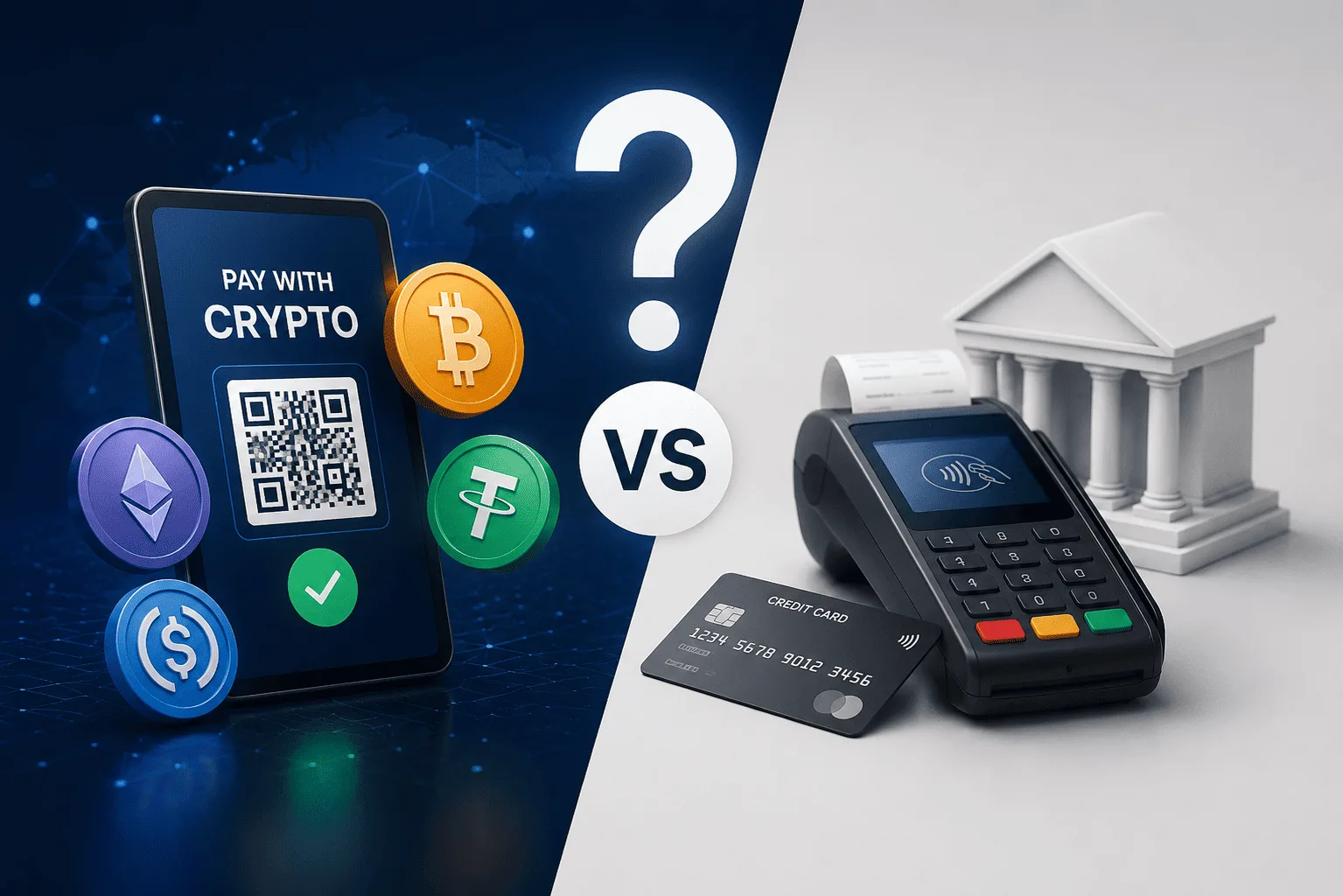
This is a fair question, and there is no single right answer for every business. Traditional payment methods have decades of trust behind them. Accepting crypto payments are newer, but they solve real problems that traditional methods still struggle with. The right choice depends on how your business operates, who your customers are, and what problems you are actually trying to solve.
Let us look at both sides honestly, so you can decide what makes sense for your business.
The Case for Traditional Payment Methods
Traditional payments did not become the default by accident. They offer real advantages that are worth acknowledging.
Familiarity. Most customers already know how to pay with a card or bank transfer, which means there is no learning curve at checkout.
Buyer protection. Cards often come with dispute and refund processes that customers trust, especially for larger purchases.
Stable value. A card payment does not fluctuate in value. What a customer pays is exactly what the business receives, in a currency everyone understands.
Wide acceptance. Traditional payment methods work almost everywhere, without needing customers to set up anything new.
For a small, local business with mostly domestic customers and low transaction volume, traditional payments may already work just fine.
The Case for Crypto Payments
At the same time, crypto payments solve problems that have never fully gone away with traditional methods.
Lower fees. Card processing fees can add up quickly, especially for international transactions. Crypto payments often cost less to process.
Faster settlement. Bank transfers, especially across borders, can take days. Crypto transactions are usually confirmed within minutes.
Less chargeback fraud. A confirmed crypto transaction cannot be reversed, which reduces a common type of fraud that affects online businesses.
Global reach. Crypto does not depend on local banking systems, which makes it easier to accept payments from customers anywhere in the world.
A crypto payment gateway like Oppi Payment is built specifically to make these benefits accessible, without requiring a business to understand the technical side of blockchain payments.
It Does Not Have to Be One or the Other
Here is the part that often gets missed. Most businesses are not actually choosing between crypto and traditional payments. They are choosing whether to offer crypto in addition to what they already have.
Adding a crypto payment gateway does not mean removing your existing card or bank payment options. It simply gives customers one more way to pay, while your business keeps everything that already works. This lowers the risk of trying it, since you are not betting your entire payment system on something new.
When Traditional Payments Might Be Enough
Crypto is not automatically the right move for every business. It may make sense to stick with traditional methods for now if your business fits most of the following.
- You sell almost entirely to local, domestic customers
- Your transaction volume is low
- Your customers have not asked about crypto
- You do not deal with cross-border fees or slow international transfers
There is nothing wrong with waiting until crypto adoption grows further in your specific market.
When Crypto Payments Make a Strong Case
On the other hand, crypto payments tend to make the most sense when your business faces one or more of these situations.
- You sell to customers in multiple countries
- International card fees are cutting into your margins
- You want faster access to funds instead of waiting on bank transfers
- You run an ecommerce store, freelance business, or platform where fees and delays are already a known pain point
- You operate an online marketplace with sellers spread across different regions
If any of these sound familiar, it is worth reading more about the benefits of using a crypto payment gateway.
For Businesses That Want More Control
Some businesses want crypto payments built directly into their existing systems, rather than using a standard checkout page. A crypto payment API allows developers to connect crypto payments into a website, app, or internal billing system, so the payment experience can be fully customized instead of relying on a one size fits all solution.
If you manage a multi-seller platform business, our guide on a crypto payment gateway for online marketplaces goes into more detail on that specific use case.
How to Decide
If you are still unsure, ask yourself a few honest questions.
- Do I lose money or time to international payment fees and delays right now?
- Have customers asked about paying with crypto?
- Would faster access to funds meaningfully help my business?
- Am I comfortable adding one more payment option without removing what already works?
If you answered yes to two or more of these, testing a crypto payment gateway alongside your current setup is a low-risk way to find out if it fits your business.
Frequently Asked Questions
Is crypto safer than traditional payments?
It depends on the type of risk. Crypto reduces certain risks, like chargeback fraud, but businesses should still choose a trusted, secure provider either way.
Will I lose money to price swings if I accept crypto?
Not necessarily. Many gateways offer automatic conversion to your local currency, which removes most of the price risk.
Do I have to choose only one payment method?
No. Most businesses keep their existing payment methods and simply add crypto as an additional option.
Is crypto only useful for tech companies?
No. Businesses in ecommerce, services, freelancing, and marketplaces are all finding practical uses for crypto payments today.
Final Thoughts
There is no universal right answer to this question. Traditional payments remain reliable and familiar, while crypto payments solve real problems around fees, speed, and global reach. For many businesses, the smartest move is not choosing one over the other, but adding crypto as an extra option and letting the results speak for themselves.