A person sees a photo of a rescued dog on Instagram.
They click through to an animal shelter's website.
They read the dog's story. They see the shelter's work. They want to help.
Then they have a question.
"Where will my donation actually go?"
If they can't find the answer quickly, that moment of connection can disappear.
This is why shelter donor engagement in Canada is about much more than asking people to donate.
It is about building trust, telling better stories, showing impact, and giving supporters more reasons to stay connected with your shelter.
Canadian animal welfare organizations are already part of a strong charitable giving landscape. CanadaHelps reported that donations to animal welfare charities increased by 13% in 2025, reaching $35.7 million through its platform.
The opportunity now is not simply to find more donors.
It is to build stronger relationships with the people who already care.
What Is Shelter Donor Engagement?
Shelter donor engagement is everything an animal shelter does to build and maintain a relationship with its supporters.
That can include:
- Thank-you messages after a donation
- Updates about rescued animals
- Stories showing how donations create impact
- Email newsletters
- Social media conversations
- Monthly giving programs
- Fundraising campaigns
- Volunteer opportunities
- Adoption stories
- Personalized donor communication
The goal is simple:
Don't let the relationship end after the donation.
A donor who gives $25 today could become a monthly supporter, volunteer, fundraiser, foster parent, or long-term advocate for the shelter.
Why Donor Engagement Matters for Canadian Animal Shelters
Animal shelters need ongoing support.
Food, veterinary care, medications, shelter operations, transportation, foster programs, and emergency rescues all require resources.
A one-time donation helps.
But a supporter who stays connected can create much more long-term value.
This is why donor engagement should start before someone gives and continue after they click the donation button.
CanadaHelps also highlights personalized communication, donor segmentation, giving history, and engagement levels as useful parts of donor engagement strategies.
For shelters, that can be as simple as understanding the difference between:
- A first-time donor
- A monthly donor
- A previous donor who hasn't given recently
- A volunteer who also donates
- A major supporter
- Someone who regularly shares shelter content
Each person has a different relationship with your organization.
Your communication should reflect that.
Start With the Animal, Not the Donation
This is one of the biggest lessons for animal shelters.
People don't always connect with a fundraising goal first.
They connect with a story.
A dog named Charlie who arrived scared and underweight.
A senior cat who had been waiting for months.
A rescued puppy who finally found a foster family.
A story gives people something they can understand and remember.
Then you can connect that story to the need.
Instead of:
"Please donate to support our shelter."
Try something more specific:
"When Charlie arrived, he needed veterinary care, nutritious food, and a safe place to recover. Your support helped give him all three."
The donation request becomes part of the story rather than the entire story.
CanadaHelps recommends using real stories, showing tangible impact, and connecting emotionally with supporters when developing fundraising messages.
Show Donors What Their Support Makes Possible
One of the simplest ways to improve shelter donor engagement is to answer one question:
"What did my support actually do?"
Don't make donors guess.
Show them.
For example:
Your support helped provide:
- Veterinary treatment for rescued animals
- Food and daily care
- Emergency medical support
- Foster supplies
- Spay and neuter services
- Safe temporary shelter
- Transportation for animals in need
The exact impact will depend on your shelter and its programs.
The important part is making that impact visible.
A donor should be able to look at your website or receive an update and understand that their contribution became something real.
Don't Stop Communicating After the Donation
This is where many organizations miss an opportunity.
Someone donates.
They receive an automated receipt.
And that's it.
The relationship becomes quiet.
Instead, think about what happens next.
A simple follow-up could say:
"Thank you for helping animals like Charlie. Here's what happened after his rescue."
Then share the update.
Maybe Charlie recovered.
Maybe he found a foster home.
Maybe he was adopted.
Maybe he still needs support.
The outcome doesn't always have to be perfect.
People appreciate honesty.
They want to know what their support made possible and what still needs to be done.
Make Monthly Giving Part of the Conversation
Monthly giving can give shelters a more predictable source of support.
It also creates an ongoing relationship with donors.
Instead of asking only:
"Will you donate today?"
you can also ask:
"Would you consider becoming a monthly supporter?"
The message should focus on consistency rather than simply a larger donation.
For example:
"A small monthly gift can help us plan ahead and continue caring for animals who need us throughout the year."
Canadian giving platforms actively promote monthly donations as a way for supporters to create ongoing impact.
The important thing is not to make every communication about upgrading someone's donation.
Sometimes the best engagement is simply saying thank you.
Give Donors More Ways to Stay Involved
Not everyone is ready to donate every time you ask.
That's okay.
Someone might not have money to give this month.
But they might be able to:
- Share an adoption post
- Volunteer
- Foster an animal
- Attend an event
- Sign up for your newsletter
- Follow your social channels
- Fundraise for your shelter
- Tell a friend about an animal
- Advocate for animal welfare
Engagement doesn't always have a dollar value.
Someone who shares your story today could become a donor tomorrow.
A recent CanadaHelps success story for Northern Lights Wildlife Society also highlights the value of building engagement with younger audiences who may contribute through advocacy, social sharing, and community participation before becoming future donors.
Your Website Can Be Part of Donor Engagement
Your website isn't just where people click "Donate."
It can answer questions, tell stories, build trust, and help visitors understand your mission.
Imagine a visitor asking:
"How does my donation help animals?"
Instead of making them search through several pages, they could get a clear answer immediately.
Or:
"Do you have monthly giving?"
"Can I donate in memory of someone?"
"What animals are currently waiting for adoption?"
"How can I help if I can't donate?"
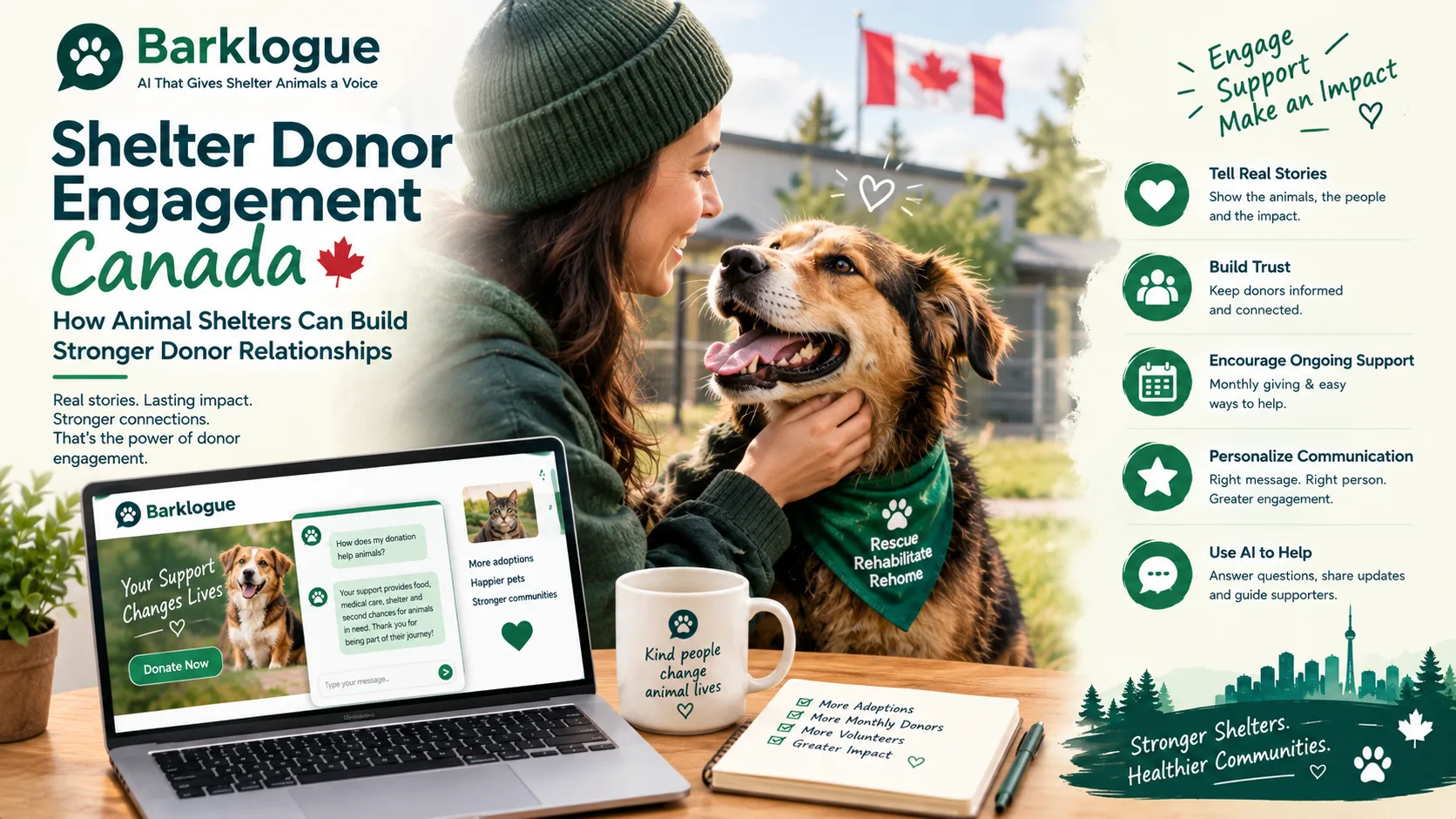
This is where an AI chatbot can become useful.
An AI chatbot for your website can help visitors find information, understand your programs, explore animal stories, and discover ways to support the shelter.
It doesn't replace your fundraising team.
It makes your website more conversational.
How AI Can Support Shelter Donor Engagement in Canada
AI can help shelters make their websites more helpful without adding another full-time person to answer basic questions.
For example, a visitor could ask:
"I want to help but can't adopt. What can I do?"
The chatbot could explain options such as fostering, volunteering, donating, or sharing adoption profiles.
Another visitor might ask:
"Where does my donation go?"
The chatbot could provide information based on the shelter's approved content.
Someone else might ask:
"Can I make a monthly donation?"
The chatbot could guide them toward the appropriate giving page.
The important part is that the AI should work from accurate shelter information.
It shouldn't invent statistics, make unsupported claims, or answer questions outside its knowledge.
When something requires a human, it should guide the visitor to the shelter team.
Personalize the Donor Experience
Not every supporter should receive exactly the same message.
Think about the relationship.
A first-time donor may need a warm introduction to your organization.
A monthly donor may appreciate regular impact updates.
A long-time supporter may want to hear about bigger projects.
A volunteer who also donates may appreciate stories showing how their time and money work together.
Personalization doesn't have to be complicated.
Even acknowledging someone's previous relationship with your organization can make communication feel more genuine.
Make Your Impact Easy to Understand
Your shelter may do incredible work.
But if visitors can't understand it, they may not realize how much their support matters.
Instead of putting all your impact information into one large report, bring it into your everyday communication.
Show:
Before:
"Vet care is one of our biggest expenses."
Better:
"After arriving with an injured leg, Luna needed treatment before she could begin her adoption journey."
Specific stories make abstract needs easier to understand.
The same principle applies to your website, emails, social posts, and fundraising campaigns.
A Simple Shelter Donor Engagement Plan
If your team wants to improve donor engagement without creating a complicated strategy, start here.
1. Tell One Animal Story Every Week
Choose one animal and tell the story honestly.
2. Show One Clear Impact
Connect support to something tangible.
3. Thank Donors
Don't wait until the next fundraising campaign.
4. Offer Different Ways to Help
Donation isn't the only form of support.
5. Ask for Monthly Support
Give people an easy way to stay involved.
6. Make Your Website Conversational
Help visitors get answers without making them search through every page.
7. Follow Up
Keep supporters updated after they give.
Small improvements repeated consistently can create a much stronger donor relationship.
The Future of Shelter Donor Engagement in Canada
The future isn't about sending more fundraising emails or adding more "Donate Now" buttons.
It's about creating better conversations.
People want to understand where their support goes.
They want to see impact.
They want to feel connected to the animals and the people doing the work.
And they increasingly expect digital experiences to be simple and responsive.
For Canadian shelters, that creates an opportunity.
Your website can tell stories.
Your social channels can start conversations.
Your email can build relationships.
And AI can help make information available when your team isn't online.
The technology is useful.
But the story is still human.
How BarkLogue Can Help
At BarkLogue, the idea is simple: give shelter animals a stronger voice while helping shelters create better conversations with the people who care about them.
An AI-powered experience can help visitors learn about animals, understand shelter programs, discover ways to help, and find answers without waiting for office hours.
For shelters focused on adoption, fundraising, fostering, volunteering, and community engagement, that can turn a static website into a more helpful part of the donor relationship.
You can also explore BarkLogue's AI chatbot for animal rescue shelters to see how this approach can support shelter communication.
Final Thoughts
Strong shelter donor engagement in Canada doesn't start with asking for more money.
It starts with building trust.
Tell people what is happening.
Show them the animals behind the mission.
Explain where their support goes.
Thank them when they help.
And give them simple ways to stay involved.
A donor shouldn't feel like someone who completed a transaction.
They should feel like part of the shelter's story.
Because when people feel connected to the work, they have more reasons to keep showing up for the animals who need them.