
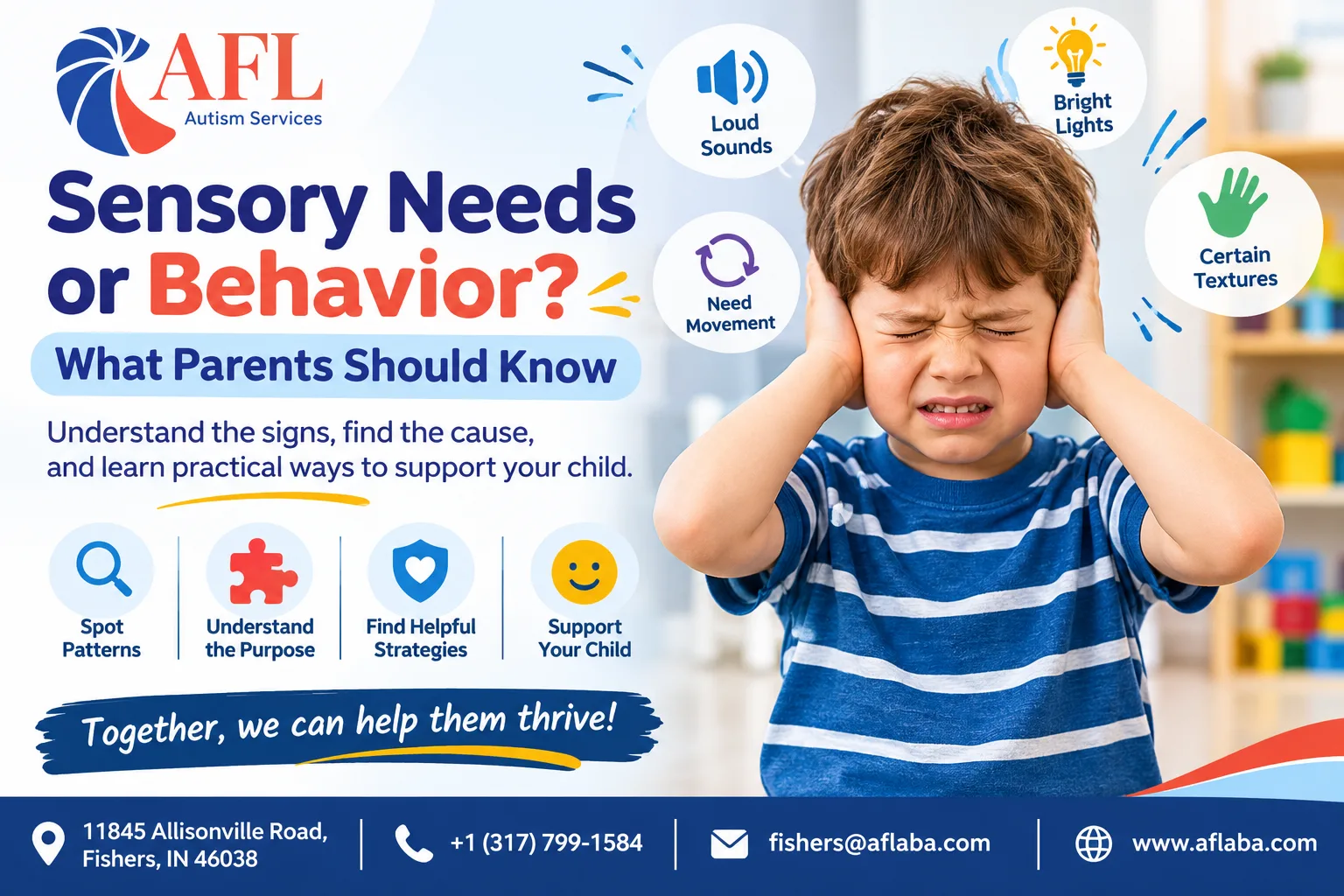
Your child covers their ears and screams in the grocery store. They refuse to wear socks. They spin in circles for long stretches, or crash into the couch over and over. Is this a sensory need? Is it a behavior? Is it both?
These questions come up for almost every parent of a child with autism. The CDC lists unusual reactions to the way things sound, smell, taste, look or feel, as well as flapping hands, rocking or spinning, among characteristics common in autism. Understanding what drives a behavior helps you respond in a way that actually helps. This guide explains sensory differences, how they connect to behavior, and practical ways to support your child.
What are sensory differences?
We all take in information through our senses: sight, sound, touch, taste, smell, movement and body position. Many children with autism experience these senses differently.
Over-responsive (more sensitive)
Some children find certain sensations too strong. Everyday sounds may feel painfully loud, clothing tags may feel unbearable, or bright lights may be overwhelming. A child may cover their ears, avoid certain textures or melt down in busy places.
Under-responsive (less sensitive)
Other children seem to need more input to notice a sensation. They may not react to their name, may not notice pain as much, or may seek strong input like spinning, jumping or chewing.
Sensory seeking
Some children actively look for certain sensations, like rocking, bouncing, touching textures, or watching spinning objects.
Most children have a mix. A child may be very sensitive to sound but seek strong movement.
How sensory needs connect to behavior
In ABA, behavior is understood by looking at what happens before it (the trigger) and after it (the result). Many behaviors fall into a few broad purposes:
- Getting something, like a toy or food.
- Getting attention.
- Escaping or avoiding something, like a hard task or an uncomfortable situation.
- Sensory input, where the behavior itself feels good or calming.
Sensory differences can show up in several of these. A child who screams in a loud store may be trying to escape overwhelming noise. A child who rocks may be getting calming movement input. A child who refuses to brush their teeth may be avoiding an uncomfortable feeling.
Understanding the purpose matters because the right response depends on it.
How to figure out what is going on
Watch for patterns
Keep a simple log for a week or two:
- Before: Where were you? What was happening? Was it loud, bright, crowded? Was your child asked to do something?
- Behavior: What exactly did your child do?
- After: What happened next? Did your child leave the situation? Get a toy? Calm down on their own?
Patterns often emerge. If screaming happens mostly in loud places and stops when you leave, noise may be a factor.
Ask your child's team
A BCBA can conduct a functional assessment to understand why a behavior happens. An occupational therapist can assess sensory processing. These professionals together can give a fuller picture.
Practical ways to help with sensory needs
For sound sensitivity
- Noise-reducing headphones in loud places.
- Warn your child before loud noises, like the vacuum or a hand dryer.
- Plan outings for quieter times.
For touch sensitivity
- Tagless, soft clothing.
- Let your child choose textures they tolerate.
- Gradually introduce new textures in small, playful steps.
For visual sensitivity
- Sunglasses or a hat in bright places.
- Reduce clutter in your child's main spaces.
- Dim lighting at home when possible.
For movement seeking
- Build in movement breaks: jumping, swinging, dancing.
- A small trampoline or a safe space for active play.
- Heavy work activities, like carrying groceries or pushing a laundry basket.
For oral seeking
- Safe chew toys, if appropriate.
- Crunchy or chewy snacks, as advised by your child's doctor or therapist.
A calm-down space
Many families create a small calm-down space at home: a corner with soft pillows, dim light, headphones and a few favorite calming items. Teach your child to use it when they feel overwhelmed, and practice going there when they are calm. Over time, many children learn to ask for or go to their calm space on their own.
A "sensory diet" in everyday life
Some occupational therapists talk about a sensory diet, which is a planned set of sensory activities spread through the day to help a child stay regulated. It does not involve food. It might include jumping on a trampoline before school, carrying heavy books to the car, a quiet break after lunch and a warm bath before bed. If your child sees an occupational therapist, ask whether a sensory plan would help and how it fits with your child's ABA goals.
Two examples of the same behavior
To see why understanding the cause matters, consider two children who both scream at the grocery store.
Child A screams as soon as you walk through the doors. The lights are bright, the music is loud and the carts are clanging. When you leave, the screaming stops. For this child, the store's sensory environment may be the main trigger. Headphones, quieter shopping times and gradual practice may help.
Child B is calm until you walk past the candy aisle. They scream when you say no to candy, and the screaming stops if they get a treat. For this child, the behavior may be about getting a wanted item. Teaching them to ask, setting clear rules before the trip and not giving candy after screaming may help.
The behavior looks the same, but the best response is very different. This is why careful observation is so important.
When sensory behavior is unsafe
Some sensory-driven behaviors, like head banging or running into the street, are unsafe. These need a careful plan. Talk to your BCBA and pediatrician right away. The goal is to keep your child safe while finding safer ways to meet the same need.
How ABA helps
ABA does not ignore sensory needs. A BCBA looks at why a behavior happens and builds a plan that respects your child's needs while teaching new skills. That might include:
- Teaching your child to ask for a break or headphones.
- Building tolerance to sounds or textures step by step.
- Providing safe ways to get sensory input.
- Reducing behaviors that are unsafe or get in the way of learning.
Our clinic-based ABA therapy and in-home ABA therapy both include this kind of individualized planning. For sensory-friendly activity ideas, see our post on sensory-friendly activities and crafts for kids with autism, and for more on how ABA approaches behavior, read how ABA therapy improves behavior, communication and skills.
Working with occupational therapy
The CDC notes that occupational therapy can include sensory integration therapy to help improve responses to sensory input that may be restrictive or overwhelming. Many children benefit from both ABA and occupational therapy. Ask your pediatrician whether an OT evaluation makes sense for your child, and share findings with your BCBA so everyone works together.
Talk to Our Fishers Team
Families in Fishers and Hamilton County who want to understand their child's behavior better can contact our Fishers clinic.
Adapt For Life – Fishers
- Address: 11845 Allisonville Road, Fishers, IN 46038
- Phone: +1 (317) 799-1584
- Email: [email protected]
- Location page: ABA therapy in Fishers
- Main helpline: +1 (502) 965-1116
Ready to take the next step? Get started today and our team will walk you through intake, insurance and scheduling.
Frequently Asked Questions
How do I know if my child's behavior is sensory?
Look for patterns: when, where and what happens before and after. A BCBA and occupational therapist can help you understand the cause.
Should I stop my child from stimming?
Many stimming behaviors are harmless and help children regulate. Talk to your BCBA if a behavior is unsafe or gets in the way of learning.
What is a calm-down space?
A quiet, comfortable area with calming items where your child can go when overwhelmed.
Can ABA help with sensory issues?
ABA can teach skills like asking for breaks, build tolerance step by step and provide safe alternatives, often alongside occupational therapy.
Who can help in Fishers, IN?
Contact our Fishers clinic to talk about your child's needs.
References
- Centers for Disease Control and Prevention: Signs and Symptoms of Autism Spectrum Disorder
- Centers for Disease Control and Prevention: Treatment and Intervention for Autism Spectrum Disorder
- Behavior Analyst Certification Board: About Behavior Analysis