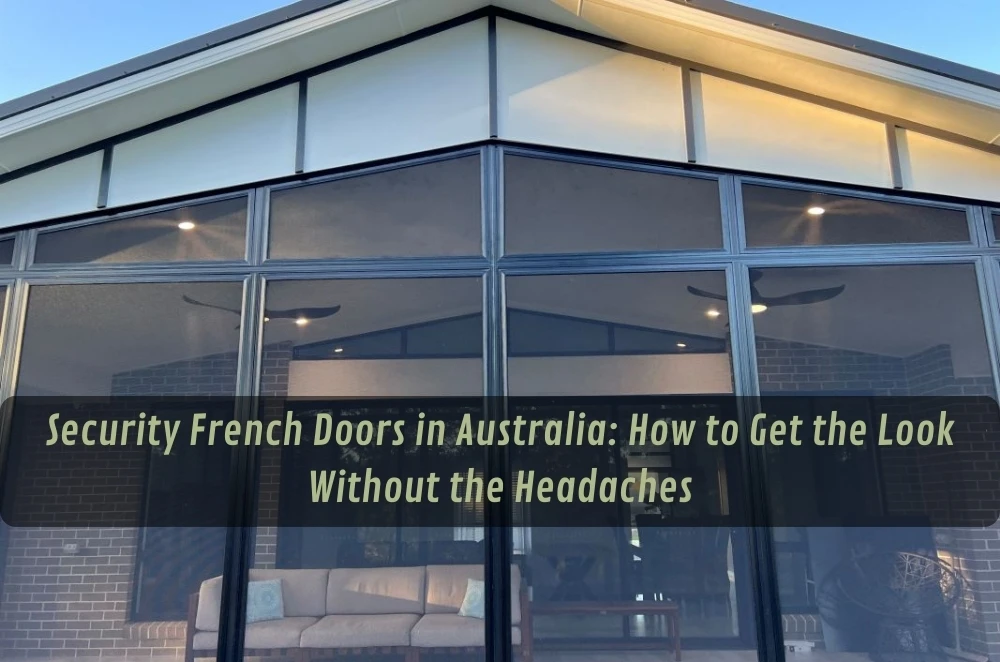
French doors are brilliant for light and indoor–outdoor flow, but they’re also one of the easiest entries to get wrong when security screens are added after the fact.
The goal is a pair of doors that feel smooth and predictable every day, not something that only works when it’s handled gently.
Why double doors behave differently
A single hinged security door has one hinge line, one latch path, and one set of tolerances to manage.
French doors introduce a second hinge line and a meeting point, which means small alignment issues are amplified.
One leaf is usually “active” (the one used most often), while the other is “inactive” (secured in place until both doors are needed), and that choice drives hardware, latching sequence, and how the pair wears over time.
If the opening is slightly out of square, a double set will reveal it fast through rubbing, uneven gaps, or a latch that feels fine one day and temperamental the next.
What actually makes a security French door setup work
Think of a French door security screen setup as a system: frames, hinges, fixings, lock hardware, and the condition of the surrounding opening all matter.
The frame is the unsung hero. If it isn’t anchored into solid structure and held square, the entire assembly can flex under everyday use, and that flex shows up as misalignment at the meeting stile where two leaves have to agree with each other.
Hinges matter more than people expect because double doors are often heavier and used in a way that creates side-load: kids pushing, guests leaning, pets bouncing off the mesh, or someone trying to close two leaves at once with a foot.
Locking is also about repeatability. If the locking sequence is fiddly, people default to half-latching or “I’ll lock it later”, and that’s where security intent quietly evaporates.
Australian conditions add another layer. UV, heat, rain, and coastal salt can punish finishes and hardware, so corrosion resistance and a realistic cleaning routine should be treated as part of the buying decision rather than “maintenance we’ll get to someday”.
Common mistakes
People buy on looks first, then try to bolt security screens onto an opening that was never checked for square or structural soundness.
They don’t decide which leaf is active, so the household or staff end up with an annoying routine that changes from person to person.
They underestimate how much thresholds and floor levels affect double doors, then wonder why one leaf drags and the meeting edge starts to shift.
They focus on the screen panel itself and forget the frame anchoring and fixings that stop movement over time.
They accept “it’s normal for double doors to be fussy”, when most fussiness is a symptom of alignment or hardware choices that weren’t matched to real use.
Decision factors to choose the right approach
Start with how the entry is used on a normal week. A set of doors that opens 30 times a day for entertaining, kids, deliveries, or staff movements needs smooth operation and intuitive latching more than it needs complexity.
Next, assess the opening honestly. If there are signs of movement (swollen timber, hairline cracks, old repairs, uneven gaps), address the structure first so the new system isn’t trying to compensate for a drifting foundation.
Then choose a daily workflow and design for human behaviour. If the routine requires a specific order of operations that people won’t follow, it will fail in practice even if it’s “secure on paper”.
Consider who uses the doors. Older relatives, small kids, casual staff, and frequent guests will all expose whether the handle height, latch feel, and closing force are genuinely user-friendly.
Plan for seasonal changes. Heat and humidity can change how components feel and how timber openings behave, so a setup that’s borderline fiddly in mild weather can become a daily frustration in summer.
If you want to sanity-check common configurations before committing, Australian security screens designed for double French doors is a practical reference point.
Finally, treat installation quality as a core decision factor, not a line item. Correct fixing into solid structure, accurate hinge alignment, and properly set strikes are what turn “double doors” into “doors that just work”.
Operator Experience Moment
When double security doors get called “finicky”, the root cause is often a few millimetres of mismatch at the meeting line.
That tiny mismatch makes people push harder, slam, or pull the leaf into the latch, and those habits accelerate hinge wear and loosen fixings.
The best installs feel boring: one smooth close, one clean latch, and the doors stay consistent week after week.
Simple first-actions plan for the next 7–14 days
Day 1–2: Write down the real use case (main entry, patio access, alfresco connection, staff access) and who uses it most, because that determines the right locking and closing feel.
Day 3–4: Inspect the opening for clues: does anything stick, rub, rattle, or show uneven gaps? Take photos of both hinge sides, the meeting edge, and the threshold so comparisons are grounded in reality.
Day 5–7: Decide which leaf should be active and what “easy” means in your household or premises (one-handed locking, minimal closing force, fast exit path). If pets or kids are involved, note the behaviours that stress the door (pushing, slamming, leaning).
Day 8–10: Shortlist two or three configurations and ask for itemised inclusions: frame type, hinge specifications, locking approach, closer options, finish, and what happens if the opening needs adjustment to get everything square.
Day 11–14: Confirm a maintenance routine you will actually follow, then plan the install so the doors can be tested properly after fitting (latch feel, meeting line, closer tension, and any rubbing). For the first month, do a weekly check for minor changes so small adjustments don’t become chronic issues.
Local SMB mini-walkthrough
Hospitality venues: prioritise smooth flow, quick latching, and hardware that doesn’t fight customers during peak periods.
Showrooms and studios: visibility matters, but frequent opens make hinge quality and alignment non-negotiable.
Allied health: quieter closing and easy operation reduce friction for staff and patients across long days.
Light industrial: dust and vibration make sturdy fixings and reliable latching more important than fancy add-ons.
Strata-managed premises: clarify who maintains it, how keys are controlled, and how repairs get approved.
Regional sites: consider service availability and choose a setup that’s straightforward to adjust and maintain.
Practical Opinions
Prioritise consistent closing over extra complexity.
Choose a locking routine people will follow without shortcuts.
If the opening isn’t square, fix that before upgrading anything.
Key Takeaways
- Double doors magnify small alignment issues, so the opening condition and installation precision matter more than most people expect.
- The most effective setup is the one that closes and latches correctly every time, even when people are rushing.
- Frame anchoring, hinge quality, and strike alignment are the usual difference between “great on day one” and “annoying by month three”.
- In Australian conditions, hardware durability and a realistic maintenance routine are part of performance, not optional extras.
Common questions we hear from Australian businesses
Q1: Are security screens on French doors harder to live with than a single door?
Usually they’re only harder when the closing sequence is awkward or the meeting line isn’t set perfectly from the start. A practical next step is to test the routine repeatedly (open/close 10–15 times) and make sure the latch engages cleanly without needing a shove. In many Australian venues with indoor–outdoor movement, usability is what prevents doors being propped or left half-latched.
Q2: Do both leaves need to lock, or can one leaf be “fixed” most of the time?
It depends on how the entry is used and whether the inactive leaf needs to stay secured for stability and consistent alignment. The next step is to map “normal days” versus “event days” and choose hardware that supports both without staff or family having to guess the right sequence. In most Australian retail and hospitality settings, a simple everyday mode reduces workarounds during busy periods.
Q3: What maintenance should be expected for double security door screens?
In most cases, light regular cleaning plus quick inspections for hinge looseness and latch drift will prevent bigger issues later. The next step is to set a monthly reminder to check screw tightness, latch feel, and any rubbing at the meeting edge, then fix small changes early. In coastal Australian locations, salt and wind-blown grit can accelerate wear, so consistency matters more than occasional “big cleans”.
Q4: What’s the biggest red flag when quoting or comparing options?
Usually it’s when the opening condition is ignored, because out-of-square frames and uneven thresholds are the hidden drivers of ongoing adjustment. A practical next step is to insist on measurements that include diagonals and to confirm what rectification is included if the doorway needs squaring or repairs. In a lot of Australian older housing and mixed-use stock, the door opening itself is the variable that decides whether double doors stay aligned.