
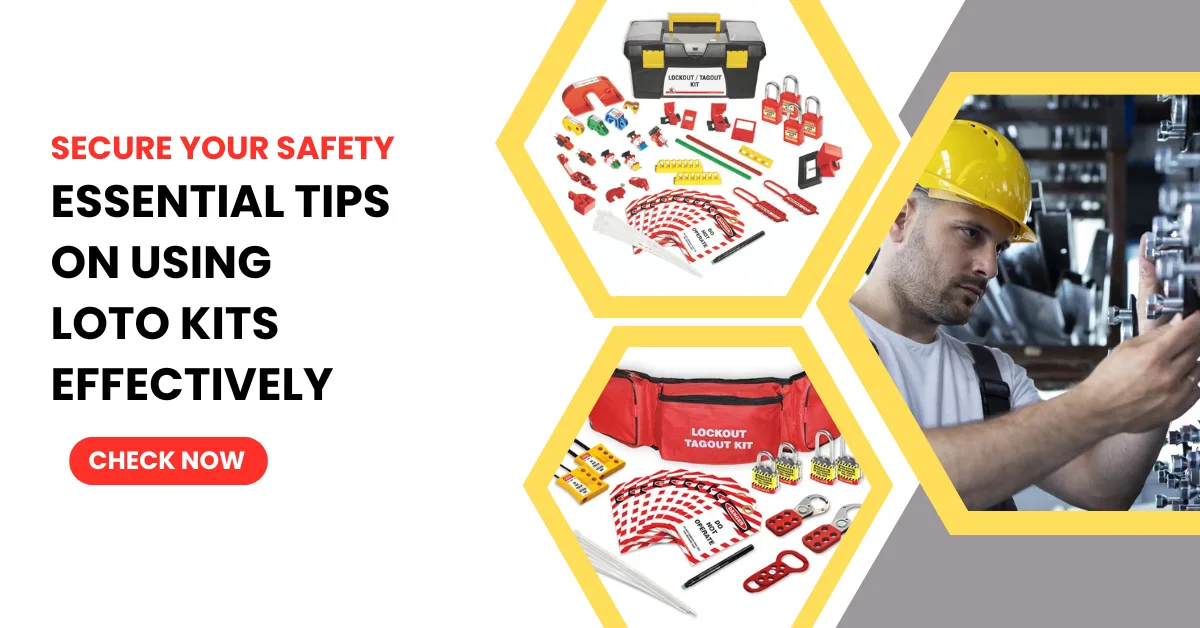
If there is one thing I’ve learned, it is that safety isn't just about having the right gear; it’s about the discipline of the process. A Lockout Tagout kit is often the most vital piece of equipment in a facility, yet it is frequently treated as a "grab-and-go" afterthought.
To truly secure your safety and ensure your team returns home in the same condition they arrived, you must move beyond simply owning a kit. You must master the effectiveness of your lockout protocol. Here are the essential, battle-tested tips for maximizing the utility of your LOTO kits.
1. Make the Kit "Location-Aware"
The biggest killer of LOTO compliance is distance. If a technician has to walk three floors to get the right lockout device, they will eventually be tempted to bypass the procedure for "just a quick adjustment."
Pro Tip: Do not rely on one "central" kit for the entire building. Portable kits could be one of the best ideas to take on ground zero. If a specific production line has complex electrical and hydraulic components, a dedicated, wall-mounted, or mobile kit should be permanently stationed within a 30-second walk of that equipment. Proximity is the silent partner of compliance.
2. Prioritize "First-Out" Accessibility
An effective LOTO kit is organized like an emergency room cart. When seconds matter, you shouldn't be digging through a pile of tags to find a padlock.
- Standardize the Layout: Every kit in your facility should have the same internal layout. Whether it’s in the maintenance shop or on the production floor, a technician should know exactly where the hasps are, where the tags are, and where the specialized circuit breaker locks are located.
- Inventory Audits: Perform a "Kit Audit" every month. It is incredibly common to find kits missing their most critical components because someone borrowed a tag or a hasp and forgot to return it. A missing tool is a breach in your safety perimeter.
3. The "Two-Step" Verification Method
Many technicians fall into the trap of assuming that because they have a kit, they are safe. However, a kit is only a tool; the process is the safety. Never perform a lockout without the Two-Step Verification:
- Visual Confirmation: Look at the lockout device after you’ve applied it. Tug on the padlock. Ensure the breaker is truly in the "OFF" position before the lock is snapped shut.
- The "Try-Out" Test: This is the most forgotten step. Once the energy is locked out, you must attempt to restart the machine. If the machine breathes, starts, or moves, your LOTO procedure failed, even if the padlock is on correctly. Always confirm the "Zero Energy State" before placing a hand on a machine.
4. Customize Kits for Specific Trades
While "Generalist" kits are great, they are often bulky and filled with tools that certain teams will never use. Efficiency breeds adoption.
- For the Electrical Team: Their kits should be dense with non-conductive (dielectric) padlocks, specialized "pin-in" breaker locks, and plug covers.
- For the Mechanical Team: Focus on heavy-duty ball valve covers, gate valve lockouts, and versatile cable lockouts for irregular plumbing.
When you give a worker a kit that is too heavy or filled with irrelevant gear, they will stop carrying it. When you give them a customised LOTO kit, they will treat it like their most prized tool.
5. Don’t Forget the "Human Factor" in Tags
Tags are not just bureaucratic paper; they are the primary communication tool between shifts. If a machine is locked out, the tag must clearly state:
- Who applied the lock.
- When it was applied.
- What specific task is being performed.
If you are handing off a job to a different shift, do not simply leave the lock. Replace the tag to reflect the new primary technician. This creates a chain of custody that ensures accountability is never lost in the chaos of a shift change.
Final Thoughts: Safety as a Culture, Not a Checklist
Using an LOTO kit effectively is about removing the friction between a worker and a safe decision. When you provide high-quality kits, maintain them rigorously, and train your team to treat every lockout as a "Try-Out" necessity rather than a bureaucratic chore, you change the atmosphere of the plant floor.
You aren't just complying with standards; you are creating a workspace where safety is the baseline, not the exception. Treat your LOTO kit with the respect it deserves - it is, quite literally, the most important bag in the building.