
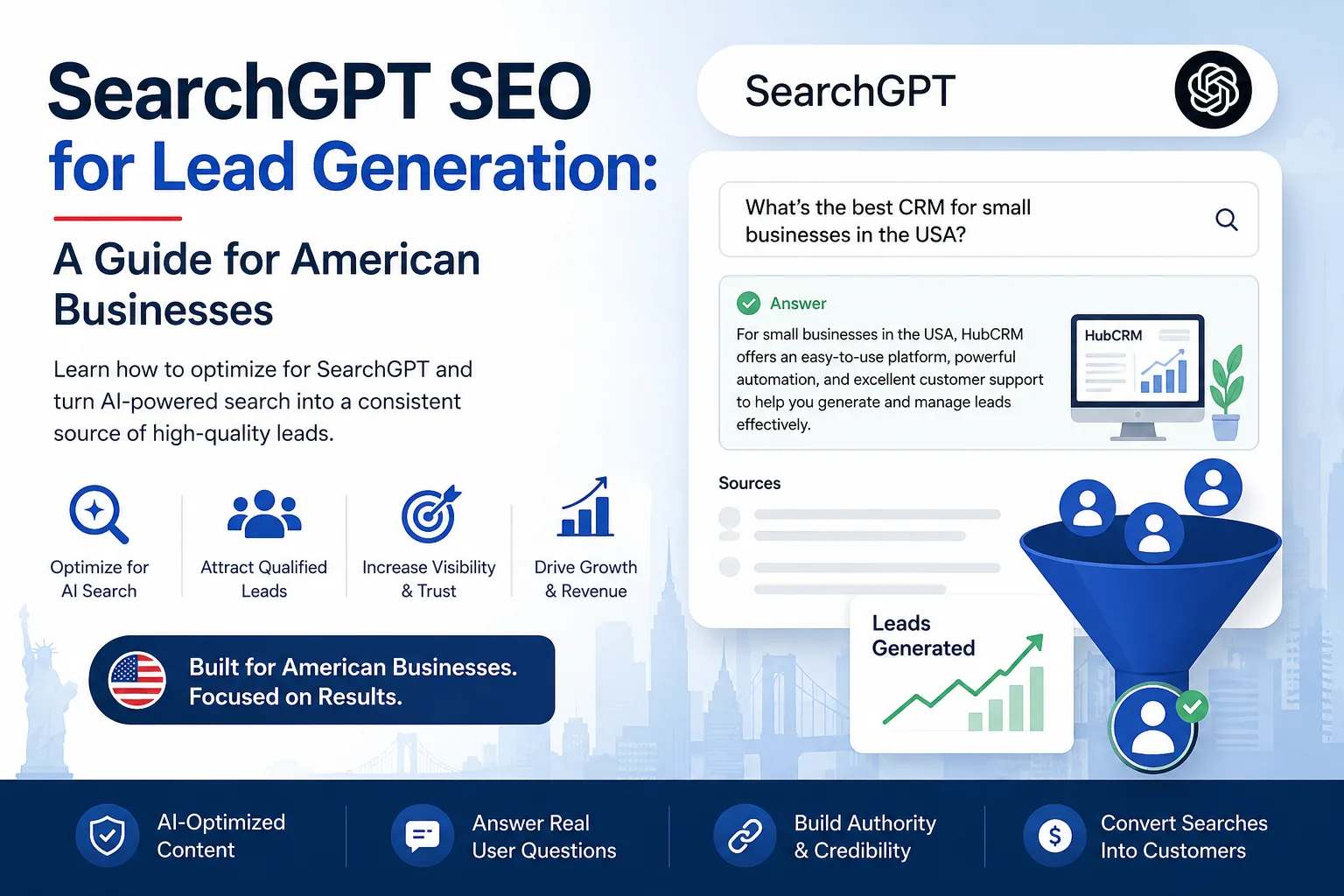
American businesses have spent years mastering Google. They understand keyword rankings, domain authority, and the mechanics of organic traffic. Then SearchGPT arrived, and the rules changed in ways that most businesses have not yet fully processed. The channel is new. The behavior of users on it is different. And the businesses that figure out how to generate leads through it first will have a significant advantage over competitors still thinking only in terms of traditional search.
This guide explains what SearchGPT SEO actually involves, how it differs from conventional search optimization, and what American businesses need to do to make it a consistent lead generation channel in 2026.
Understanding What SearchGPT Is and Why It Changes Lead Generation
SearchGPT is OpenAI's AI-powered search product. Unlike traditional search engines that return a list of links and let the user choose where to go, SearchGPT generates a synthesized answer and pulls from sources it deems credible, authoritative, and well-structured. The user gets a direct response. The sources that contributed to that response receive attribution, sometimes with links, sometimes without.
For lead generation, this creates a fundamentally different dynamic. In traditional Google search, a business competes for a click by ranking on the first page. In SearchGPT, a business competes to be cited as a source within the answer itself. If your business appears in a SearchGPT response for a high-intent commercial query, the buyer sees your brand and in many cases follows through to your site with a level of trust already established. If you do not appear, you are invisible in that channel entirely.
The impact of SearchGPT on SEO is not a future consideration. It is happening now. American businesses that sell services, professional expertise, software, or high-consideration products are already seeing shifts in their traffic patterns as more buyers use AI-powered search for research before making a purchase decision.
How SearchGPT Decides Which Sources to Cite
Understanding how SearchGPT selects its sources is the foundation of any effective SearchGPT SEO strategy. The system is trained on large volumes of web content and fine-tuned to prioritize sources that demonstrate credibility, clarity, and genuine expertise on the topic being queried.
Several factors consistently influence citation selection. Original, well-researched content that goes beyond what is commonly available performs better than thin or derivative material. Structured writing that presents information in a clear, logical sequence is easier for AI systems to extract from and reference accurately. Sources with strong topical authority, meaning a coherent body of content focused on a specific subject area rather than scattered topics, are treated as more reliable.
Trust signals matter enormously. An organization's About page, the credentials of the people behind the content, verifiable business information, and the reputation of the domain all contribute to how SearchGPT evaluates a source. This aligns directly with the E-E-A-T framework that Google has promoted through its Search Quality Evaluator Guidelines. Experience, Expertise, Authoritativeness, and Trust are not just Google concepts. They are the foundation of how AI-powered search systems assess content quality across the board.
What American Businesses Need to Do Differently
The businesses generating leads through SearchGPT are not necessarily the ones with the highest domain authority or the largest content libraries. They are the ones who have structured their content to answer real questions with genuine depth and clear attribution.
For lead generation specifically, the optimization strategy needs to focus on the types of queries that buyers ask at different stages of their decision-making process. Early-stage queries are informational: how does this type of service work, what should I look for in a provider, what are the common mistakes businesses make. Mid-stage queries are evaluative: what separates good providers from bad ones, what does pricing typically look like, what results should I expect. Late-stage queries are transactional: who are the leading providers in this category, which agency has experience in my industry, how do I get started.
A SearchGPT SEO strategy maps content to all three stages. Each piece of content needs to be genuinely useful at its intended stage, not a thin placeholder designed primarily to capture a keyword. AI-powered search systems are trained to distinguish between content that actually helps and content that merely appears to. The difference between the two is the difference between being cited and being ignored.
Structured data implementation has become more important in the context of AI search than it ever was in traditional SEO. Schema markup helps AI systems correctly identify the nature of a business, the services it offers, the location it operates from, and the credibility indicators that support citation. Service schema, organization schema, FAQ schema, and review schema all contribute to how accurately and how often a business surfaces in AI-generated answers.
Internal linking and topical architecture also play a different role in SearchGPT SEO than they do in traditional search. A tightly organized content structure where related topics are clearly connected signals topical completeness. AI systems that identify a domain as comprehensively covering a subject area are more likely to pull from that domain across a range of related queries rather than treating each piece of content in isolation.
The Role of a Digital Marketing Agency in SearchGPT Lead Generation
Most American businesses do not have the internal resources to build and execute a SearchGPT SEO strategy from scratch. The research required to understand how AI systems are responding to queries in a specific industry, the content architecture needed to support consistent citation, and the technical implementation of structured data require specialized knowledge that has only recently emerged as a distinct discipline.
Partnering with a digital marketing agency that understands both traditional SEO and the evolving dynamics of AI-powered search is the fastest path to consistent lead generation through SearchGPT. The best seo agency for this work is one that has already invested in understanding how generative search systems evaluate content and can apply that knowledge to specific business categories and buyer journeys.
SEO Discovery has been at the forefront of AI-powered search optimization since generative search platforms began reshaping how buyers discover businesses. Our team works with American businesses across multiple industries to build SearchGPT SEO strategies that generate qualified leads, not just impressions. Contact us today to get a clear assessment of how your business currently appears in AI search responses and what it would take to make that channel a consistent source of new business.
The impact of SearchGPT on SEO will only grow as more American consumers adopt AI-powered search as their default way of finding providers and solutions. The businesses that build credibility with these systems now are the ones that will generate leads from them at scale in the years ahead. Waiting for the channel to mature before investing in it means watching competitors establish authority that becomes progressively harder to displace.