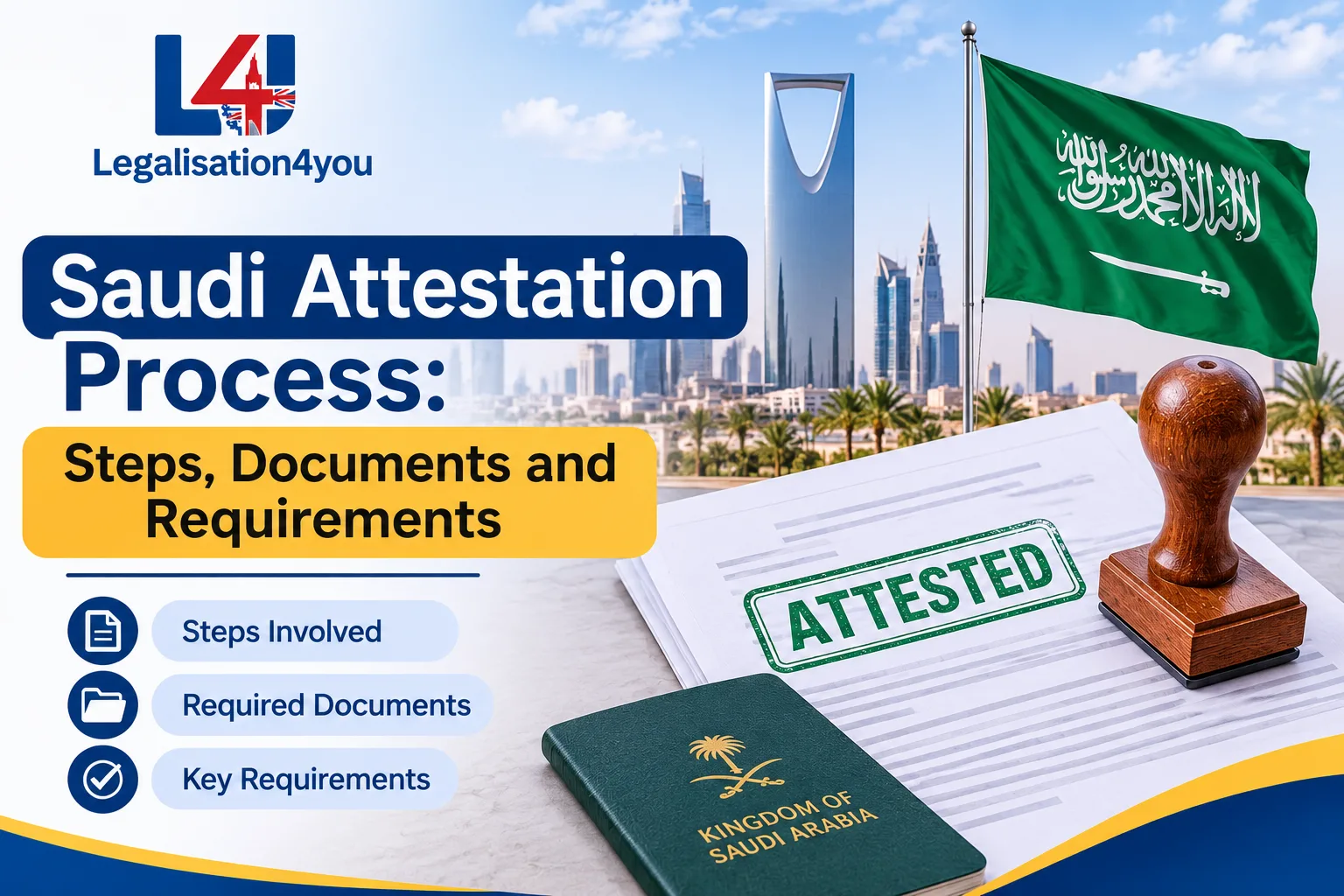
When you need to use UK-issued documents in Saudi Arabia, it is important to make sure they are properly authenticated before submitting them to the relevant organisation. Whether you are moving to Saudi Arabia for employment, applying for a family visa, continuing your education or handling business activities, your documents may need an official apostille or additional certification.
The Saudi attestation process helps confirm that a document is genuine and that the signature, seal or stamp on it can be recognised by the receiving authority. However, the exact requirements depend on the type of document and the organisation requesting it.
Understanding the process before you apply can help you avoid unnecessary delays, additional costs and document rejection. This guide explains the main steps, documents and requirements involved when preparing UK documents for use in Saudi Arabia.
What Is Saudi Attestation?
Saudi attestation refers to the process of authenticating documents so they can be accepted by authorities, employers, universities, government departments or other organisations in Saudi Arabia.
For UK-issued public documents, the FCDO apostille is generally the main legalisation step. The UK Legalisation Office checks whether the signature, seal or stamp on a document matches its records. If the document meets the requirements, an apostille is attached to confirm its authenticity.
GOV.UK+1
Saudi Arabia joined the Hague Apostille Convention, which came into force for the Kingdom on 7 December 2022. This means an apostille can replace the traditional chain of legalisation for public documents covered by the Convention.
Authority+1
However, an apostille does not automatically mean every document will be accepted for every purpose. The organisation receiving the document may have additional requirements, such as a particular document format, translation or supporting evidence.
Which Documents May Require Saudi Attestation?
The documents you need to prepare will depend on why you are using them in Saudi Arabia. Different authorities may ask for different types of evidence.
Here are some common document categories.
1. Educational Documents
People travelling to Saudi Arabia for employment, higher education or professional registration may need to submit their academic qualifications.
Examples include:
- Degree certificates
- Diploma certificates
- University transcripts
- Professional qualification certificates
- School certificates
- Training certificates
Educational documents may need checks by the relevant educational institution or authority before they can be submitted for apostille. Some receiving organisations may also request verification through a Saudi educational authority or Cultural Mission.
It is important to confirm the requirements before starting the Saudi attestation process, particularly if your documents are needed for a job application or professional registration.
2. Personal Documents
Personal certificates are often required for family, residency, marriage or other administrative matters.
Common examples include:
- Birth certificates
- Marriage certificates
- Death certificates
- Divorce documents
- Police clearance certificates
- Affidavits
- Powers of attorney
Some documents, such as birth and marriage certificates issued by the General Register Office, can be submitted for a paper-based apostille if they meet the FCDO requirements. They are not eligible for an e-Apostille.
3. Commercial Documents
Businesses working with Saudi companies, suppliers or government organisations may need to authenticate commercial paperwork.
These documents can include:
- Certificates of incorporation
- Memorandum and Articles of Association
- Certificates of good standing
- Commercial invoices
- Certificates of origin
- Company agreements
- Board resolutions
- Business powers of attorney
Commercial documents may have additional requirements depending on their purpose and the organisation receiving them. For example, certain trade documents may need verification or certification by a relevant chamber of commerce before further processing.
4. Legal Documents
Legal documents may be required for property matters, business transactions, court proceedings or authorising another person to act on your behalf.
Examples include:
- Affidavits
- Powers of attorney
- Court orders
- Declarations
- Contracts and agreements
- Legal authorisation letters
Documents that contain a private signature may need to be notarised or certified by an appropriate professional before the FCDO can issue an apostille.
Saudi Attestation Process: Step-by-Step Guide
The process depends on the document type and its existing certification. However, the following steps provide a useful overview for people preparing UK documents for use in Saudi Arabia.
Step 1: Identify the Document Requirements
Before applying, find out exactly what the receiving organisation in Saudi Arabia expects.
For example, an employer may request an apostilled degree certificate, while a government department may ask for an official birth or marriage certificate. A business partner may require an apostilled agreement or company document.
Ask the recipient to confirm:
- Whether an original document is required.
- Whether an apostille is sufficient.
- Whether solicitor or notary certification is needed.
- Whether an Arabic translation is required.
- Whether additional supporting documents must be provided.
This first step is important because not all documents follow the same route.
Step 2: Check Whether Certification Is Required
Once you understand the requirements, check whether your document can be submitted directly to the FCDO or needs an additional certification first.
Government-issued documents, such as certain registry certificates, may be eligible for direct legalisation if their signatures or seals can be verified.
Private documents, copies and some academic documents may need certification by a UK solicitor or notary public before they can be submitted.
For example, a solicitor or notary may need to certify a copy of a passport, witness a signature or authenticate a declaration. The appropriate route depends on the document and the purpose for which it will be used.
Choosing the correct certification route can make the Saudi attestation process more straightforward.
Step 3: Arrange the FCDO Apostille
The next step for eligible UK documents is to apply for an apostille through the Foreign, Commonwealth & Development Office (FCDO).
The Legalisation Office checks the signature, seal or stamp on the document against its records. If everything is in order, it attaches an apostille certificate.
You can apply online for a paper-based apostille or an e-Apostille, depending on the document and the recipient's requirements. Some documents, including birth, marriage and death certificates, are not eligible for an e-Apostille.
The apostille confirms the authenticity of the relevant signature, seal or stamp. It does not verify the contents of the document itself.
Step 4: Check Whether Additional Attestation Is Needed
Saudi Arabia's membership of the Hague Apostille Convention means that an additional embassy legalisation stage is generally not required for public documents covered by the Convention when the apostille is accepted.
However, you should not assume that the same requirements apply to every document or situation.
Private documents may need appropriate certification before the apostille. Commercial documents may also have specific trade or recipient requirements. Always check with the Saudi organisation requesting the document before arranging extra stamps or paying for additional services.
This is particularly important when handling business paperwork, educational qualifications or documents for employment.
Step 5: Arrange Translation If Required
Some organisations in Saudi Arabia may ask for documents in Arabic. If your document is issued in English, you may need to arrange an Arabic translation.
Translation requirements can vary. The receiving organisation may specify whether the translation must be completed by an approved translator or follow a particular certification process.
Before arranging translation, confirm whether the recipient wants the original document and apostille translated together or only the original certificate.
Providing a correctly prepared translation can help avoid confusion when the document is reviewed.
Step 6: Submit the Documents to the Receiving Organisation
After completing the required legalisation and any additional preparation, you can submit your documents to the relevant organisation in Saudi Arabia.
Depending on the recipient, you may need to provide:
- The original apostilled document.
- A certified copy.
- An Arabic translation.
- A copy of your passport or identification.
- Additional application forms or supporting evidence.
Keep copies of all documents and proof of submission. If the organisation requests further information, having these records available can make it easier to respond.
Important Requirements for Saudi Attestation
Before sending your documents for processing, there are several important requirements to consider.
Ensure Your Documents Are Genuine
Documents should be genuine and issued by the appropriate authority. The FCDO cannot legalise a document if it cannot verify the relevant signature, seal or stamp.
If you have an older certificate, check whether it is still accepted by the organisation requesting it.
Check the Document Format
The receiving organisation may require an original document rather than a photocopy. Some documents may need to be issued recently or presented in a particular format.
For example, if you are submitting a birth certificate, check whether the recipient accepts the certificate you currently hold or requires a replacement official copy.
Verify Names and Personal Details
Make sure the names, dates of birth and other personal details are consistent across your documents.
Differences in spelling between a passport, degree certificate or marriage certificate may lead to questions from the receiving organisation.
If you notice an error, find out whether it needs to be corrected before applying for legalisation.
Check Translation Requirements
Do not arrange a translation without checking the recipient's instructions. Some organisations accept English documents, while others may request Arabic translations completed according to their own standards.
Confirm the Complete Legalisation Route
The most important requirement is to confirm the full process before submitting your documents. Some documents may need direct FCDO legalisation, while others require solicitor or notary certification first.
The correct Saudi attestation route should be based on the document type and the requirements of the organisation receiving it.
How Long Does Saudi Attestation Take?
The processing time depends on the document, the certification required and the FCDO service selected.
According to GOV.UK, the standard paper-based apostille service usually takes up to 25 working days, plus postage or courier time. The e-Apostille service can take up to two working days. Next-day and restricted urgent paper services are available only to registered businesses and have their own eligibility conditions.
However, these are FCDO service estimates rather than a guarantee of the complete time needed for your document.
If your paperwork needs solicitor or notary certification, translation or additional checks, you should allow extra time. Educational documents may also require verification by the relevant institution or authority.
It is sensible to begin the process well before your planned travel date, employment start date or application deadline.
What Is the Cost of Saudi Attestation?
The total cost depends on the document type and the services required.
For reference, the FCDO currently lists the following fees for its UK legalisation services:
FCDO serviceListed feeStandard paper-based apostille£45Next-day paper-based service for registered businesses£40e-Apostille£35Restricted urgent service for registered businesses£100Courier or postage charges may also apply to paper-based applications. These are FCDO fees and do not include any additional solicitor, notary, translation or service-provider charges.
GOV.UK
Before proceeding, check the latest FCDO fees and confirm whether your document needs any additional preparation.
Common Mistakes to Avoid During Saudi Attestation
Even a small mistake can delay the legalisation process. Here are some common issues to avoid.
1. Not checking the recipient's requirements
Do not assume that every organisation follows the same document requirements. Confirm whether an apostille, translation or additional certification is needed.
2. Sending an incorrect document
Make sure you have the correct original certificate or official copy before applying.
3. Ignoring spelling differences
Check that names and personal information match across your documents and identification.
4. Arranging unnecessary certification
Not every document needs a solicitor, notary or embassy stamp. Confirm the required route before paying for additional services.
5. Leaving the application until the last minute
Allow enough time for document checks, apostille processing, delivery and any translation requirements.
6. Choosing the wrong apostille format
Some documents are not eligible for an e-Apostille. Check the FCDO guidance and the recipient's preference before applying.
How to Choose a Reliable Saudi Attestation Service
Choosing a suitable document legalisation provider can make the process easier, particularly if you are dealing with several documents or have a deadline.
Before selecting a provider, consider the following points:
- Experience: Choose a provider familiar with UK document legalisation and Saudi Arabia's requirements.
- Clear guidance: The provider should explain which steps your document needs before processing begins.
- Transparent pricing: Ask for a clear breakdown of apostille, certification, translation and handling charges.
- Processing information: Check the expected turnaround time and whether delays are possible.
- Secure handling: Make sure your original documents are handled carefully and returned using a suitable delivery service.
- Customer support: Choose a service that can answer questions and provide updates during the process.
A reliable provider should help you understand the correct route rather than automatically adding unnecessary services.
Get Help with Saudi Attestation from Legalisation4you
Preparing UK documents for use in Saudi Arabia can involve several steps, depending on the document type and the requirements of the receiving organisation. Understanding the correct process before you apply can help prevent unnecessary delays and extra expenses.
Legalisation4you provides UK document legalisation support, including FCDO apostille services and guidance on the certification route required for different documents. Whether you need to prepare an educational certificate, personal document or commercial paperwork, getting the requirements checked in advance can make the process easier to manage.
Visit to learn more about document legalisation services. You can also contact the team to discuss your document type, destination and required timescale before starting your application.
Frequently Asked Questions (FAQs)
1. What is Saudi attestation?
Saudi attestation is the process of authenticating documents so they can be used in Saudi Arabia. For eligible UK public documents, this generally involves obtaining an FCDO apostille.
2. Is an apostille required for documents used in Saudi Arabia?
An apostille is generally used to authenticate eligible UK public documents for use in Saudi Arabia under the Hague Apostille Convention. Always confirm the requirements with the organisation receiving your document.
3. Which documents can be submitted for Saudi attestation?
Common documents include birth certificates, marriage certificates, degree certificates, academic transcripts, police certificates, powers of attorney and commercial documents. The required preparation depends on the document type.
4. Do educational certificates need additional verification?
Some educational certificates may need verification by the issuing institution or another relevant authority before they can be submitted for an apostille. Requirements can vary according to the qualification and its intended use.
5. How long does Saudi attestation take in the UK?
The time depends on the document and the services required. The FCDO's standard paper-based apostille service usually takes up to 25 working days, while its e-Apostille service can take up to two working days. Additional checks and delivery can increase the overall time.
6. Do I need to translate my documents into Arabic?
Not in every case. Some Saudi organisations accept English documents, while others request Arabic translations. Check the recipient's requirements before arranging translation.
7. Can I get a birth certificate apostilled for Saudi Arabia?
Yes, an eligible UK birth certificate can generally be submitted for a paper-based FCDO apostille. Birth certificates issued by the General Register Office are not eligible for an e-Apostille.
8. Do commercial documents require additional certification?
Some commercial documents may need verification or certification by a relevant chamber of commerce or another organisation, depending on their purpose and the recipient's requirements. Check the required route before submitting them.
9. Can I apply for an apostille myself?
Yes. You can apply directly through the official GOV.UK Legalisation Office service if your document meets the requirements. You can also use a document legalisation provider for assistance with checking and arranging the process.
10. What happens if my document is rejected?
If a document cannot be legalised, the FCDO may be unable to issue an apostille. You should check the reason for rejection, correct any missing or incorrect information and confirm whether additional certification is required before applying again.