
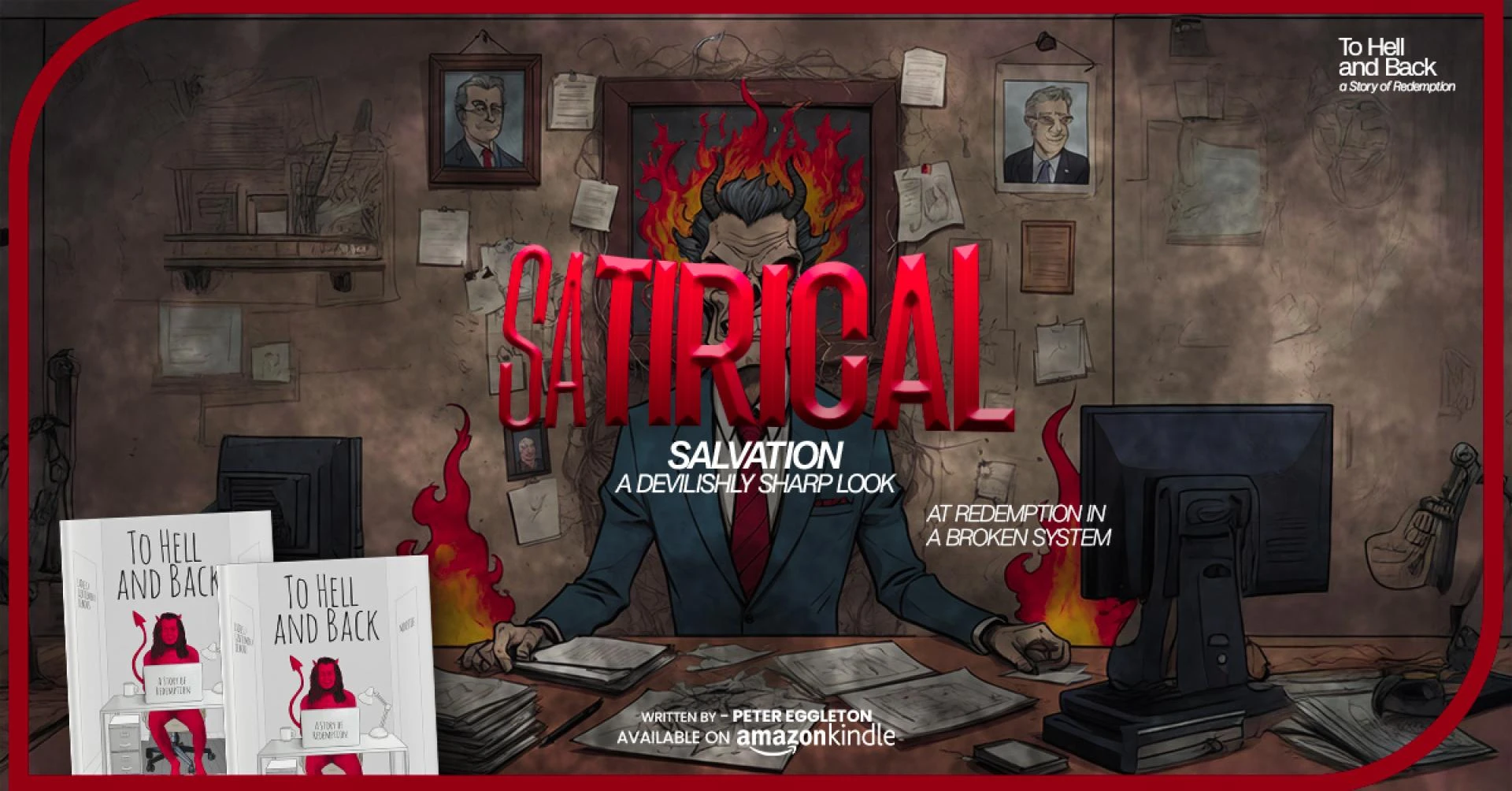
Peter Eggleton’s To Hell and Back is not your ordinary tale of sin and salvation. It’s a wickedly sharp, politically-charged satire that sets fire to modern bureaucracy and corporate greed—all while dragging readers, laughing and cringing, through the depths of Hell itself. But don’t be fooled: beneath the irreverent comedy is a profound commentary on morality, power, and the fragility of the human soul.
At the center of this infernal circus is Samantha, an unlikely anti-heroine who lands herself in Hell after a petty outburst—and finds the place surprisingly familiar. In Eggleton’s Hell, the punishment isn’t just fire and brimstone. It’s paperwork. It’s customer service queues. It’s broken systems, nonsensical job roles, and endless red tape. Sound familiar? It should. The brilliance of To Hell and Back lies in its ability to mirror our modern world, with just enough exaggeration to provoke laughter—until the realization hits: it’s not that far from reality.
Bureaucracy Has Never Been So Brutal—or So Funny
Eggleton’s depiction of Hell’s infrastructure is as absurd as it is painfully accurate. From “Satancare” (Hell’s healthcare plan) that endlessly restores the bodies of the damned just so they can be tortured again, to customer service lines that resemble the worst of automated tech support, the novel skewers every inefficiency we’ve come to accept. Satan, portrayed with equal parts charm and corporate cynicism, delivers monologues that would be hilarious if they weren’t so disturbingly plausible.
This isn't just a jab at religion or mythology—it’s an indictment of systemic failure. Through Samantha’s bewildered eyes, we explore a world where people pay with their souls for wealth and power, and the “employees” of Hell are overworked, underpaid, and riddled with burnout. Sound like a familiar industry?
Samantha’s Journey: From Carelessness to Compassion
While the world of To Hell and Back is rich with twisted humor, it’s Samantha’s arc that gives the book its emotional weight. Initially self-centered and morally ambiguous, her exposure to Hell’s injustices—particularly through her interaction with Abdul, a tragic yet endearing figure—sparks a transformation. She begins to see beyond herself, to care, and ultimately to act. This development is subtle yet powerful, and it's Eggleton’s way of reminding us that redemption is rooted in empathy.
Abdul, a former harem slave turned demon-punisher, embodies the book’s moral contradictions. He committed terrible acts in life, but did so from a place of heartbreak and betrayal. In Hell, he’s not a villain—he’s a cog in a monstrous machine. His humanity contrasts sharply with the soulless customers, who sold their integrity for temporary gain. The juxtaposition is stark, and it forces readers to question where the true sin lies.
A Satirical Masterpiece with a Conscience
What makes To Hell and Back more than just a clever satire is its depth. Eggleton doesn’t preach, but he does provoke thought. He ridicules the systems that devalue human life, all while weaving in sharp insights about the nature of good, evil, and everything in between. Even the character of Satan is complex—world-weary, cynical, and disturbingly relatable.
This is a book for readers who enjoy dark humor with substance. Fans of The Good Place, Catch-22, or even 1984 will find themselves right at home. Eggleton’s Hell is horrifying because it’s recognizable, and hilarious because it’s true.
In the end, To Hell and Back is about more than damnation. It’s about the small choices that define us, the systems that fail us, and the possibility of transformation—even in the most unlikely places. Samantha’s journey is one of reluctant growth, and her glimpses of compassion serve as a reminder that redemption isn’t about piety—it’s about perspective.
Amazon Link: To Hell and Back