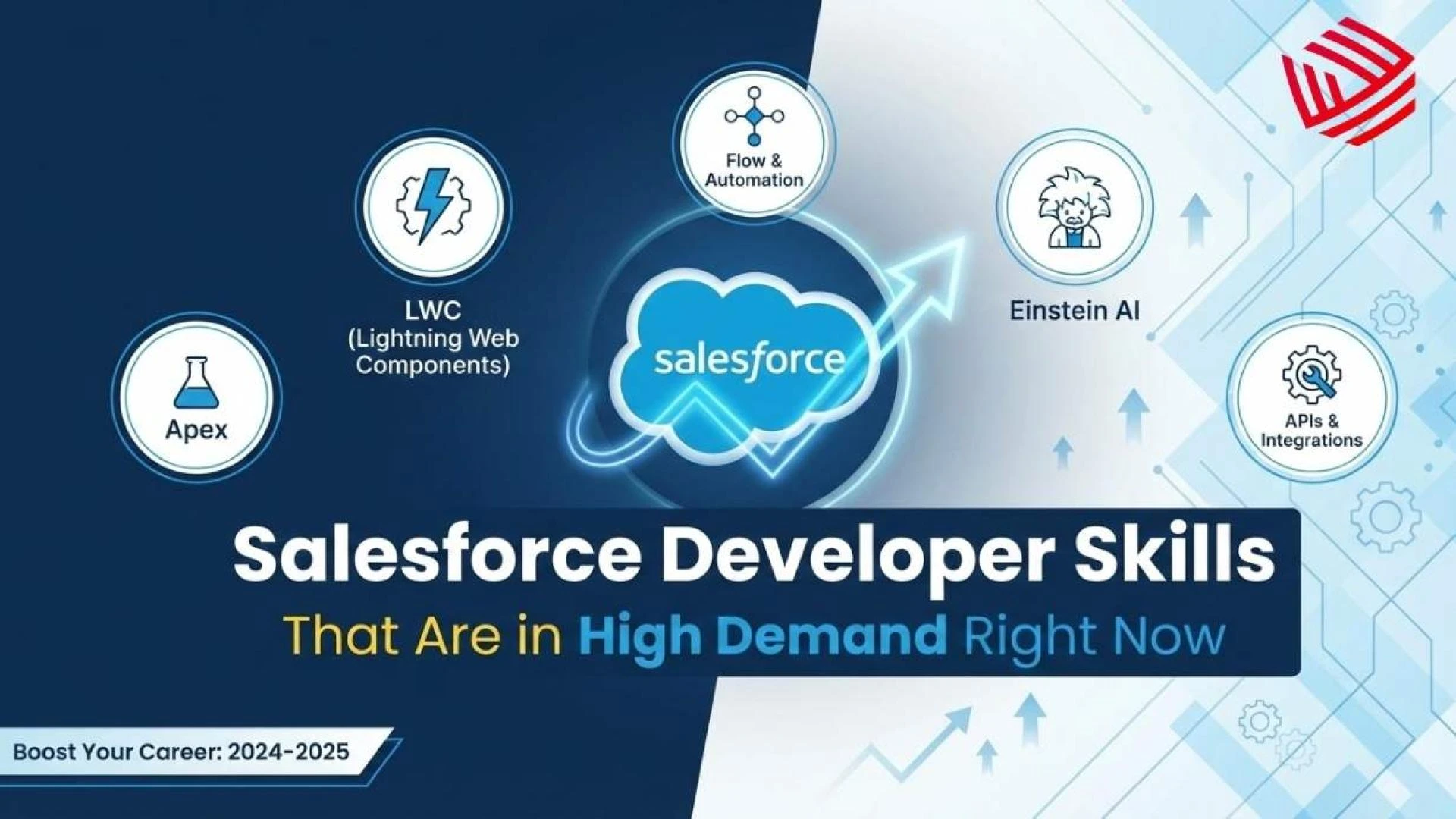
A few years ago, being a Salesforce developer mainly meant knowing Apex, triggers, and a bit of Visualforce. That is no longer enough.
In 2026, Salesforce sits at the center of business operations. It connects sales, marketing, support, finance, analytics, and external systems. Companies no longer want “someone who knows Salesforce.” They want developers who can build reliable, scalable, and business-ready solutions.
I’ve worked closely with Salesforce teams—startups, mid-sized companies, and enterprises. One thing is clear: the skills in demand today are very different from what certifications alone teach.
This blog breaks down, in simple and honest language, the Salesforce developer skills that are in high demand right now. Not buzzwords. Not theory. Real skills that companies are actively paying for.
If you’re:
- A Salesforce developer planning your career
- A fresher trying to enter the ecosystem
- A business leader hiring Salesforce talent
this guide will help you understand what truly matters in today’s Salesforce job market.
Why “knowing Salesforce” is no longer enough
Salesforce has grown into a massive platform. With that growth comes complexity.
Businesses expect Salesforce developers to:
- Understand business processes, not just code
- Build solutions that scale
- Avoid breaking existing systems
- Communicate clearly with non-technical teams
As a result, demand has shifted from narrow technical skills to well-rounded, real-world capability.
Let’s explore the skills that actually make a Salesforce developer valuable right now.
Strong understanding of Salesforce core architecture
Before any advanced skill, companies expect developers to deeply understand how Salesforce works internally.
This includes:
- Standard objects and their purpose
- Data relationships
- Record access and sharing models
- How transactions are processed
Why this skill is in high demand
Many Salesforce problems happen because developers build without understanding the platform’s foundation.
For example:
- Poor data model design leads to slow reports
- Incorrect sharing logic causes security issues
- Bad transaction design hits governor limits
Developers who understand Salesforce architecture make fewer mistakes and build systems that last longer.
This skill doesn’t sound exciting, but it separates beginners from professionals.
Apex development with scalability in mind
Apex is still a core skill—but how it’s written matters more than ever.
In 2026, companies are not looking for developers who can “write Apex.” They want developers who can write safe, scalable Apex.
What scalable Apex really means
Scalable Apex code:
- Works for one record and thousands
- Avoids unnecessary database calls
- Handles errors gracefully
- Is easy to test and maintain
Many real-world Salesforce systems break during:
- Data imports
- Integrations
- Automation-heavy processes
Developers who understand bulk processing and clean architecture are in very high demand.
Salesforce Flow expertise (beyond basic automation)
Flow has become one of the most important Salesforce tools—and also one of the most dangerous when misused.
Companies now expect Salesforce developers to:
- Design structured, readable flows
- Decide when Flow is better than Apex
- Avoid automation conflicts
- Build flows that can evolve over time
Why Flow skills matter so much now
Businesses want faster changes without redeploying code. Flow makes this possible—but only when designed properly.
Poorly built flows:
- Slow down transactions
- Cause unpredictable behavior
- Are hard to debug
Developers who can build clean, modular, and scalable flows are in constant demand.
Lightning Web Components (LWC) for real user experiences
User expectations have changed.
Salesforce users now expect:
- Faster interfaces
- Cleaner layouts
- App-like experiences
Lightning Web Components are the standard way to deliver this.
What companies expect from LWC developers
It’s not about flashy UI. It’s about:
- Building efficient components
- Handling data properly
- Respecting Salesforce security
- Creating maintainable front-end code
Developers who understand both LWC and backend logic are especially valuable, because they can own complete features instead of small pieces.
Integration skills with real-world systems
Modern Salesforce does not live in isolation.
It connects with:
- ERP systems
- Marketing platforms
- Payment gateways
- Data warehouses
- Mobile and web apps
Why integration skills are in high demand
Businesses rely on data moving smoothly between systems. When integrations fail, operations stop.
Salesforce developers are expected to understand:
- REST and SOAP APIs
- Authentication methods
- Asynchronous processing
- Error handling and retries
Even basic integration knowledge makes a developer far more valuable than someone limited to internal Salesforce features.
Understanding Salesforce security and data protection
Security is no longer an afterthought.
With regulations, audits, and growing data sensitivity, companies want developers who build security into the solution, not add it later.
Key security-related skills in demand
Salesforce developers are expected to understand:
- Profiles vs permission sets
- Record-level access
- Field-level security
- Secure Apex coding practices
Developers who ignore security create risks that businesses cannot afford.
This skill is especially valuable in industries like finance, healthcare, and enterprise SaaS.
Data modeling skills that support growth
Data volume grows fast in Salesforce.
Developers who know how to:
- Design clean object models
- Avoid unnecessary custom objects
- Create efficient relationships
help companies avoid performance and reporting issues later.
Why this skill is underrated but critical
Bad data models are expensive to fix.
Good Salesforce developers think ahead:
- How will this data be reported?
- Will this object grow to millions of records?
- Will future teams understand this design?
Companies value developers who design for tomorrow, not just today.
Debugging and problem-solving ability
One of the biggest differences between average and high-demand Salesforce developers is problem-solving skill.
Salesforce systems are complex. Issues often involve:
- Multiple automations
- Integrations
- User permissions
- Data conditions
Developers who can:
- Trace issues logically
- Use debug logs effectively
- Identify root causes
save companies time, money, and frustration.
This skill cannot be memorized—it comes from experience and curiosity.
Deployment and change management understanding
As Salesforce orgs grow, uncontrolled changes become risky.
High-demand Salesforce developers understand:
- Sandboxes
- Change sets
- CI/CD pipelines
- Version control basics
They know how to:
- Test changes safely
- Avoid breaking production
- Coordinate releases
This skill is critical in multi-developer teams and enterprise environments.
Ability to translate business needs into technical solutions
This is one of the most important—and most overlooked—skills.
Salesforce developers are not just builders. They are problem solvers.
What this looks like in real projects
A business user says:
“We want faster lead assignment.”
A high-demand Salesforce developer asks:
- What defines “fast”?
- Are there regional rules?
- How will this scale?
- What happens when data is missing?
Then they design a solution that fits both business and platform realities.
Developers who can communicate clearly with non-technical stakeholders are extremely valuable.
Knowledge of Salesforce clouds and ecosystems
Companies no longer use Salesforce as just a Sales tool.
They expect developers to understand:
- Sales Cloud
- Service Cloud
- Experience Cloud
- Industry-specific solutions
Even surface-level familiarity with multiple clouds increases demand, because developers can adapt faster across projects.
Testing mindset, not just test classes
Salesforce requires test coverage—but good developers go beyond minimum percentages.
They:
- Test edge cases
- Think about failure scenarios
- Protect critical business logic
This mindset helps prevent production issues and builds trust with stakeholders.
Documentation and maintainability awareness
In 2026, Salesforce teams change frequently.
High-demand developers:
- Write readable code
- Document complex logic
- Use clear naming conventions
This reduces dependency on individuals and supports long-term system health.
Businesses notice this—even if they don’t say it directly.
Soft skills that make Salesforce developers irreplaceable
Technical skills open doors. Soft skills keep them open.
The most in-demand Salesforce developers:
- Communicate clearly
- Ask good questions
- Accept feedback
- Take ownership
They don’t just “complete tasks.” They help teams succeed.
What skills are losing demand?
Not every skill is growing in value.
Some things matter less now:
- Visualforce-only development
- Over-customization without structure
- One-tool-only automation knowledge
- Ignoring scalability and limits
Developers who don’t update their skill set risk being left behind.
How Salesforce developers can build these skills practically
You don’t need to learn everything at once.
Start by:
- Deepening core platform knowledge
- Building small, real projects
- Studying existing orgs
- Learning from mistakes
Experience, not certificates, creates demand.
Final thoughts: High-demand Salesforce developers think beyond code
In 2026, the Salesforce developers in highest demand are not the ones who know the most features.
They are the ones who:
- Understand business context
- Respect the platform’s limits
- Build clean, scalable solutions
- Communicate effectively
Salesforce will keep evolving. Developers who focus on fundamentals, problem-solving, and growth mindset will always stay relevant.