
Introduction
Today, eCommerce is no longer optional for businesses. Customers expect seamless shopping experiences across websites, mobile devices, social media, and physical stores. To meet these expectations, companies need powerful digital commerce platforms that can manage multiple channels and deliver personalised experiences.
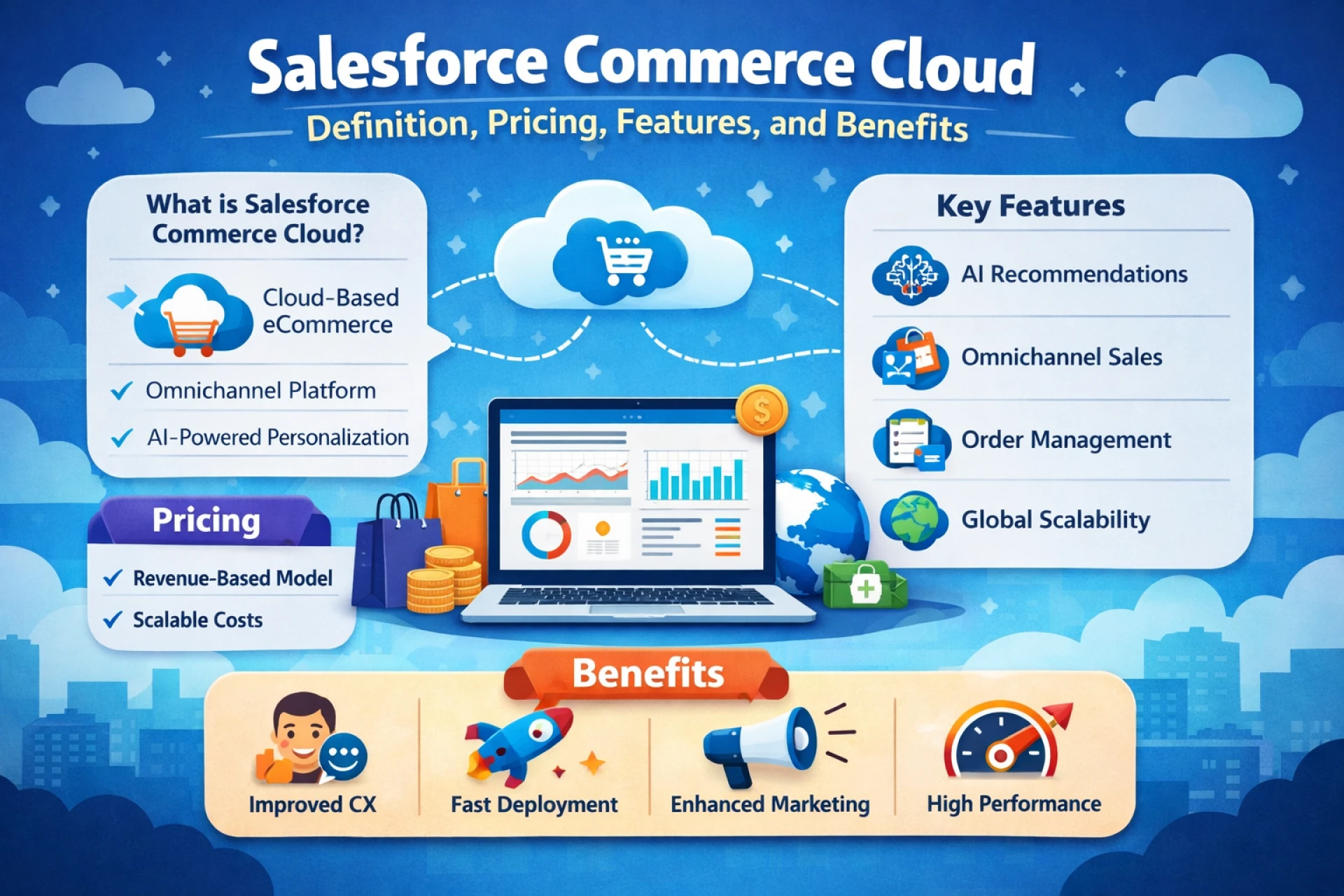
Salesforce Commerce Cloud is a leading cloud-based eCommerce platform designed to help businesses build scalable online stores and provide unified shopping experiences. It enables brands to manage products, customers, marketing campaigns, and sales operations from a single platform.
Many global brands rely on Salesforce Commerce Cloud to improve customer engagement, personalise shopping journeys, and increase online revenue.
In this guide, we will explain the definition, pricing model, features, and benefits of Salesforce Commerce Cloud, helping you understand whether it is the right platform for your business.
What Is Salesforce Commerce Cloud?
Salesforce Commerce Cloud is a cloud-based Software-as-a-Service (SaaS) platform that helps businesses create, manage, and optimise digital commerce experiences across multiple channels.
The platform allows businesses to:
- Launch online storefronts
- Manage product catalogues and inventory
- Deliver personalised shopping experiences
- Integrate marketing, CRM, and analytics tools
Salesforce Commerce Cloud is part of the larger ecosystem of Salesforce, which provides solutions for customer relationship management, marketing automation, and analytics.
Evolution of Salesforce Commerce Cloud
The platform was originally developed by Demandware, a leading eCommerce technology provider.
In 2016, Salesforce acquired Demandware and transformed the technology into Salesforce Commerce Cloud. The acquisition helped Salesforce expand its digital commerce capabilities and integrate them with CRM and marketing tools.
Today, the platform supports global brands in delivering personalised and omnichannel commerce experiences.
Salesforce Commerce Cloud mainly offers two solutions for businesses.
B2C Commerce Cloud
B2C Commerce is designed for businesses that sell directly to individual consumers.
Key capabilities include:
- Personalised product recommendations
- Marketing automation
- Multiple storefront templates
- Social commerce integrations
It uses AI technology such as Salesforce Einstein to analyse customer behaviour and provide intelligent product recommendations.
B2B Commerce Cloud
B2B Commerce is built for businesses that sell products to other companies.
This solution supports:
- Bulk ordering
- Custom pricing models
- Negotiated contracts
- Complex product catalogues
It helps wholesalers and manufacturers streamline their online ordering processes.
Salesforce Commerce Cloud uses a revenue-based pricing model, meaning the platform charges businesses based on a percentage of their total sales.
Typical Pricing Structure
- B2C Commerce: around 1–3% of Gross Merchandise Value (GMV)
- B2B Commerce: around 1–2% of GMV
Instead of paying a large upfront license fee, businesses pay a percentage of the revenue generated through the platform.
Factors Affecting Pricing
The cost of Salesforce Commerce Cloud depends on several factors:
- Business size and annual revenue
- Store complexity and customisation
- Integration with third-party systems
- Implementation and consulting services
- Ongoing support and maintenance
Because of this flexible pricing model, Salesforce Commerce Cloud is commonly used by mid-size and enterprise-level retailers.
Salesforce Commerce Cloud provides powerful tools to manage digital commerce operations.
AI-Powered Personalisation
The platform uses AI to analyse customer behaviour and deliver personalised product recommendations, search results, and targeted offers.
This helps businesses increase customer engagement and improve conversion rates.
Omnichannel Commerce
One of the strongest features of Salesforce Commerce Cloud is its ability to connect multiple sales channels.
Businesses can sell through:
- Online stores
- Mobile apps
- Social media platforms
- Physical retail stores
This ensures customers receive a consistent experience across all touchpoints.
Advanced Marketing and Merchandising Tools
Salesforce Commerce Cloud includes built-in marketing tools that help businesses manage promotions, campaigns, and personalised offers.
These tools allow marketers to run A/B tests, analyse campaign performance, and optimise customer journeys.
Mobile-First Experience
With mobile commerce rapidly growing, Salesforce Commerce Cloud ensures that online stores are fully optimised for smartphones and tablets.
The platform supports responsive design and mobile payment options like digital wallets, enabling a seamless checkout experience.
Global Localisation
Businesses operating in multiple countries can easily manage localisation features such as:
- Multiple languages
- Different currencies
- Regional tax rules
- Local marketing campaigns
This helps brands expand globally while adapting to local market requirements.
Scalability and Performance
Salesforce Commerce Cloud is built on a cloud infrastructure that allows businesses to scale easily as traffic and sales grow.
The platform can handle high traffic loads during seasonal sales events without affecting performance.
AI-Driven Customer Insights
The platform provides detailed insights into customer behaviour, allowing businesses to understand purchasing patterns and deliver personalised offers.
Improved Customer Experience
Features like personalised recommendations, advanced search, and targeted promotions help businesses create engaging shopping experiences.
Faster Time to Market
Salesforce Commerce Cloud includes ready-to-use templates and tools that help businesses launch online stores quickly.
Increased Marketing Efficiency
The platform integrates marketing, commerce, and customer data, allowing businesses to run more effective campaigns.
Lower Maintenance Effort
Since Salesforce Commerce Cloud is a SaaS platform, businesses do not need to manage servers, upgrades, or infrastructure.
Salesforce automatically handles updates, security patches, and performance improvements.
Salesforce Commerce Cloud is not a standalone platform. It is part of the broader Salesforce ecosystem that includes CRM, marketing automation, and analytics tools.
This integration allows businesses to:
- Track customer interactions across channels
- Personalise marketing campaigns
- Analyse customer data in real time
- Deliver consistent customer experiences
By combining commerce with CRM and marketing tools, businesses can build stronger customer relationships and improve lifetime value.
ConclusionSalesforce Commerce Cloud is a powerful platform that helps businesses create scalable and personalised digital commerce experiences.
With features such as AI-driven personalisation, omnichannel commerce, advanced marketing tools, and global scalability, it provides everything businesses need to grow their online presence.
For companies looking to deliver seamless customer experiences and expand their digital commerce capabilities, Salesforce Commerce Cloud is one of the most reliable solutions available today.