Real-world assets (RWAs) include assets that exist outside the native crypto ecosystem, such as real estate, government bonds, commodities, private credit, equities, art, and intellectual property. RWA tokenization is the process of representing ownership, economic rights, or claims related to these assets through blockchain-based tokens.
The concept is attracting attention because blockchain can introduce programmable ownership, faster settlement, fractionalization, and new ways of connecting traditional financial assets with digital markets. However, tokenization does not automatically remove the legal, regulatory, custody, or market risks associated with the underlying asset.
What Is RWA Tokenization?
RWA tokenization converts rights or economic interests associated with an off-chain asset into digital tokens recorded on a blockchain. For example, a token could represent an interest in a real estate investment, a government bond, a commodity, or a fund.
An important point is that the token is not necessarily the physical asset itself. Instead, it can represent a legal claim, ownership interest, or economic right connected to that asset. The relationship between the token and the underlying asset depends on legal agreements, custody arrangements, and the structure of the issuing entity.
How Does RWA Tokenization Work?
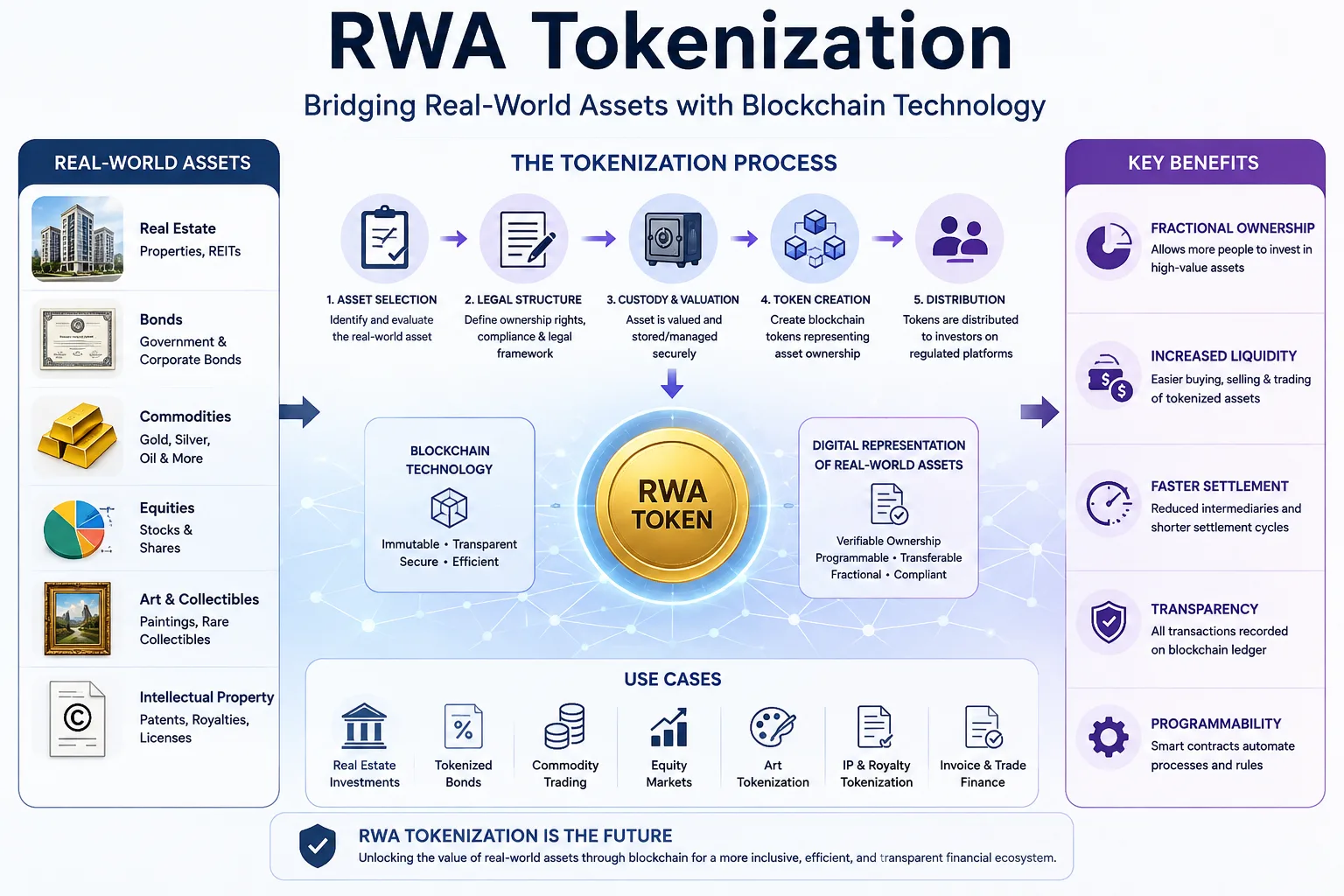
A typical tokenization process involves several stages:
1. Selecting the Asset
The process starts by checking an asset suitable for tokenization. It could be property, bonds, commodities, private credit, intellectual property, or another asset with identifiable economic value.
2. Establishing Legal Ownership
The issuer needs to determine how token holders will receive rights to the underlying asset. Legal structures and contracts are important because blockchain records alone do not establish every type of ownership right.
3. Valuation and Custody
The underlying asset generally needs to be valued and securely held or otherwise controlled. For physical assets, custodians may play an important role in maintaining the connection between the real-world asset and its digital representation.
4. Creating the Token
The asset or associated rights are represented through blockchain tokens. Smart contracts can define how tokens are issued, transferred, restricted, or redeemed.
5. Distribution and Management
Eligible participants can acquire the tokens according to the project's legal and regulatory framework. Depending on the structure, smart contracts may automate payments, transfers, compliance checks, or other processes.
What Assets Can Be Tokenized?
The range of potential RWAs is broad. Common categories include:
- Real estate
- Government bonds and Treasury products
- Corporate bonds
- Private credit
- Commodities such as gold
- Investment funds
- Equities
- Art and collectibles
- Intellectual property
- Trade finance and invoices
Ethereum's educational resources similarly identify real estate, gold, stocks, government debt, intellectual property, machinery, and collectibles among potential real-world assets.
Benefits of RWA Tokenization
Fractional Ownership
Tokenization can divide an economic interest in an asset into smaller units. This may make certain high-value assets easier to access, depending on the applicable legal and regulatory requirements.
Improved Liquidity
Some traditionally illiquid assets can potentially become easier to transfer through tokenized markets. However, tokenization alone does not guarantee liquidity; active buyers, sellers, suitable infrastructure, and regulatory access are still required.
Faster Settlement
Blockchain-based settlement can reduce some of the manual reconciliation and intermediary processes found in traditional transactions. Programmable transactions can potentially allow settlement and other financial operations to occur more efficiently.
Transparency
Blockchain networks can provide a shared transaction history. Depending on the network and privacy design, participants may be able to verify token movements and other information more easily.
Programmability
Smart contracts can add rules and automation to tokenized assets. For example, a token can be designed with transfer restrictions or automated payment logic.
Why Learn About RWA Tokenization?
RWA tokenization sits at the intersection of blockchain, finance, technology, regulation, and digital assets. Professionals who understand these different components can better evaluate how tokenized markets are designed and operated.
A structured RWA Course can help learners build knowledge from the fundamentals of blockchain and tokenization to asset categories, smart contracts, custody, compliance, and risk management. Current RWA learning programs commonly cover tokenization fundamentals, the tokenization lifecycle, smart contracts, asset categories, security, custody, and regulatory considerations.
For beginners, the learning journey can start with blockchain fundamentals and gradually move toward token standards, smart contracts, legal structures, asset valuation, and real-world case studies.
Frequently Asked Questions
1. What is RWA tokenization?
RWA tokenization is the process of representing ownership, economic rights, or claims related to real-world assets through blockchain-based tokens.
2. What does RWA stand for?
RWA stands for Real-World Assets. These are assets or financial instruments that exist outside the native crypto ecosystem.
3. Which assets can be tokenized?
Potential assets include real estate, bonds, commodities, private credit, equities, investment funds, intellectual property, art, and other assets.
4. Is an RWA token the same as the physical asset?
Not necessarily. The token generally represents a legal claim, ownership interest, or economic right connected to an underlying asset.
5. What are the main benefits of tokenization?
Potential benefits include fractionalization, improved transferability, faster settlement, transparency, and programmability.
6. Does tokenization guarantee liquidity?
No. Tokenization can make an asset easier to transfer, but actual liquidity depends on market participation, infrastructure, regulations, and demand.
7. What role do smart contracts play?
Smart contracts can automate rules governing token issuance, transfers, payments, compliance conditions, and other processes.
8. What are the main risks of RWA tokenization?
Key risks include regulatory uncertainty, legal enforceability, custody, smart contract vulnerabilities, liquidity limitations, and data or oracle risks.
9. Who should take an RWA Course?
Blockchain professionals, developers, finance professionals, entrepreneurs, investors, compliance specialists, and anyone interested in tokenized financial markets can benefit from structured RWA education.
10. Is RWA tokenization the same as cryptocurrency?
No. Cryptocurrencies such as Bitcoin and Ether are native digital assets, while RWA tokens represent claims or interests connected to assets that exist outside the blockchain.
Conclusion
RWA tokenization is creating a bridge between traditional assets and blockchain-based financial infrastructure. By representing real-world assets through digital tokens, organizations can explore fractional ownership, programmable transactions, improved settlement, and new market structures.
At the same time, successful tokenization requires much more than putting an asset on a blockchain. Legal rights, regulation, custody, smart-contract security, valuation, and liquidity must all be addressed.
For anyone looking to understand this evolving field, an RWA Course can provide a structured foundation for learning how real-world assets are tokenized, managed, and integrated with blockchain ecosystems.