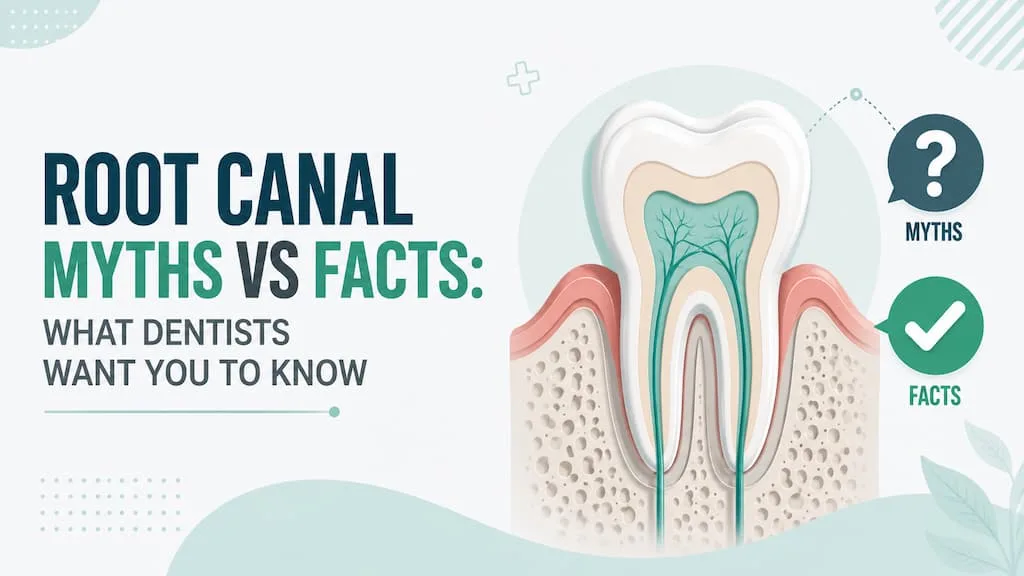
Root Canal Myths vs Facts: What Dentists Actually Want You to Know
The short version: A root canal relieves toothache rather than causing it, is completed in a single 30 to 60 minute visit for most teeth, and costs a fraction of replacing the tooth later. The idea that it causes chronic illness comes from research abandoned nearly a century ago.
Few medical procedures carry as much dread as the root canal. Mention one at a dinner table and somebody will wince. Yet ask anyone who has actually had one recently and the usual response is a shrug: it was fine, and the pain they walked in with was gone by evening.
That gap between reputation and reality costs people teeth. Patients delay treatment for months, the infection spreads, and a tooth that could have been saved ends up extracted. Here are the ten beliefs that come up most often, and what the evidence actually says.
Myth 1: A root canal is one of the most painful things you can go through
The reality is closer to the opposite. The pain people associate with root canals is the pain that sends them to the dentist in the first place, caused by an inflamed or dying nerve inside the tooth. The procedure removes that tissue, which is why most patients report relief the same day.
The treatment itself is carried out under local anaesthesia. The tooth is numb throughout. You feel pressure and vibration, not pain. Studies comparing patient-reported discomfort have found modern root canal treatment ranks similarly to having a routine filling placed.
Where the reputation comes from is history. Before effective local anaesthetics, rotary instruments and modern disinfection, root canals genuinely were an ordeal. That was several decades ago, and the reputation has simply outlived the procedure.
Myth 2: Pulling the tooth is cheaper and simpler
Cheaper on the day, considerably more expensive over the following year. An extraction leaves a gap, and that gap does not stay neutral. Adjacent teeth drift, the opposing tooth over-erupts, the bite changes, and the jawbone in that area begins to resorb.
Replacing the tooth is where the cost appears. In India, root canal treatment typically runs between INR 5,000 and INR 7,000 per tooth, with a protective crown starting around INR 9,500. A dental implant to replace an extracted tooth runs INR 35,000 to INR 45,000.
RouteTypical costVisitsOutcomeRoot canal plus crownINR 15,000 to INR 25,0001 to 3Natural tooth kept, bite unchangedExtraction aloneINR 1,000 onward1Gap, drifting teeth, bone loss over timeExtraction plus implantINR 36,000 to INR 46,0003 to 5 over several monthsFunction restored, higher cost and longer timelineFigures are indicative Indian metro pricing and vary by city, clinic and tooth.
Myth 3: Root canals cause cancer and chronic disease
This one deserves a direct answer, because it circulates widely online and frightens people out of necessary treatment.
The claim traces back to research by Weston Price in the 1910s and 1920s, built on what was then called focal infection theory. His methodology was later examined and found to be seriously flawed: uncontrolled experiments, contaminated samples, and results that could not be reproduced. The theory was abandoned by the mainstream dental and medical community decades ago.
The American Association of Endodontists and the American Dental Association both state plainly that no valid scientific evidence links root canal treatment to disease elsewhere in the body. Larger epidemiological studies have found no such association.
What is true is that no root canal eliminates every last bacterium, which is why a well-fitted crown, good hygiene and periodic checkups matter. That is a maintenance point, not a cancer risk.
Myth 4: It takes three or four appointments
It used to. Rotary instruments and electronic apex locators changed that. Most teeth are now completed in a single visit of roughly 30 to 60 minutes.
Multiple appointments are still needed sometimes, usually where there is heavy active infection that needs medication between visits, or where a molar has unusually curved or numerous canals. A dentist can usually tell you which applies after the X-ray, before starting.
Myth 5: The pain went away, so the problem resolved itself
This is the belief that costs the most teeth.
When a severe toothache stops on its own, it usually means the nerve inside the tooth has died. The pain signal stopped because the tissue sending it is no longer alive. The bacteria are still there, still multiplying, and now they have an unobstructed route through the root tip into the surrounding bone.
What follows is often a period of deceptive quiet, then swelling, an abscess, or a tooth that has become unsalvageable. Sudden relief from a serious toothache is a reason to see a dentist promptly, not a reason to cancel the appointment.
Myth 6: A crown afterwards is the dentist upselling
A tooth that has had a root canal has lost its internal blood supply and a significant amount of structure. It becomes noticeably more brittle, and chewing forces on back teeth are substantial.
Research on long-term outcomes consistently shows that root canal treated back teeth restored with a crown survive far longer than those left with only a filling. An unprotected molar frequently fractures within a few years, sometimes below the gum line, at which point the tooth cannot be saved and the money spent on the root canal is lost with it.
Front teeth are the exception. They take less force and can sometimes be closed with a well-sealed filling.
Myth 7: Treated teeth only last a few years anyway
Reported success rates for root canal treatment sit above 90 percent. A treated and properly crowned tooth commonly lasts 10 to 15 years, and frequently a lifetime.
When these teeth do fail, the cause is usually one of three things: no crown was placed, a new cavity developed at the crown margin, or gum disease undermined the supporting bone. All three are largely preventable with routine care.
Myth 8: You cannot have a root canal while pregnant
You can, and leaving a dental infection untreated during pregnancy carries its own risks. The second trimester is generally considered the most comfortable window for non-urgent dental work.
Dental X-rays with a lead apron and thyroid collar deliver an extremely low dose, and local anaesthetics used in dentistry are considered safe in pregnancy. Tell your dentist you are pregnant and how far along, so medication choices can be adjusted. An untreated abscess is the greater hazard.
Myth 9: Root canals are an older person's problem
Age has little to do with it. The two triggers are deep decay and trauma, and trauma skews young. A knock to a front tooth during sport in your teens can kill the nerve, sometimes with no symptoms for years until the tooth darkens or an abscess appears.
Children with developing permanent teeth may need a modified procedure that allows the root to continue forming. It is a different technique, not an argument for waiting.
Myth 10: Once it is crowned, that tooth is finished with
The crown itself cannot decay. The natural tooth structure underneath it can, particularly at the margin where crown meets tooth.
Because the nerve has been removed, a new cavity in that tooth will not hurt. It progresses silently and is often found on a routine X-ray rather than through symptoms. Flossing around crown margins and keeping up six-monthly checkups is what protects the work already done.
Signs you should actually get checked
Root canal treatment is not the answer to every toothache. These are the signs that warrant an examination:
- Lingering sensitivity to hot or cold that continues well after the stimulus is removed
- Pain when biting or applying pressure to a specific tooth
- A pimple-like swelling on the gum near a tooth, which may drain and recur
- A single tooth darkening compared with its neighbours
- Facial or gum swelling around one area
- Deep decay or a visible crack in a tooth
- Pain that wakes you at night or worsens when lying down
An X-ray settles the question quickly. Not every one of these means a root canal, but each of them means something is happening that will not resolve on its own.
What actually happens during the procedure
- The tooth and surrounding tissue are numbed and tested before anything begins
- A rubber dam isolates the tooth, keeping the working area clean and dry
- A small access opening is made through the biting surface
- Infected pulp tissue is removed and the canals are cleaned, shaped and disinfected
- An apex locator confirms the working length so the canal is filled to the correct point
- Canals are sealed with a biocompatible filling material
- The access opening is closed, and a crown is fitted at this or a follow-up visit
Mild soreness for a day or two afterwards is normal, and responds to ordinary painkillers. Pain that increases after the third day is worth a phone call.
The takeaway
Almost every myth on this list pushes in the same direction: wait, or pull the tooth. Both are usually the more expensive choice.
A natural tooth, even a treated one, does a job no replacement fully matches. It maintains the bone around it, keeps neighbouring teeth in position, and preserves a bite that took years to settle. If a dentist has told you a tooth can be saved, that recommendation is usually worth taking seriously, and it is always reasonable to ask for a second opinion before agreeing to an extraction.
About the author: Dr. Sanket Chakraverty, BDS, MDS, practises at Teeth Care Multispeciality Dental Clinic, a multispeciality dental group with five branches across Kolkata. The clinic's endodontists have completed over 8,500 root canal procedures. More on their approach to root canal treatment in Kolkata.
This article is for general information and does not replace an examination by a qualified dentist. If you have tooth pain or swelling, see a dental professional.