A few years ago, designing a data center cooling system was relatively predictable.
You knew the load, you planned airflow, you installed cooling, and the system held up.
That equation is changing.
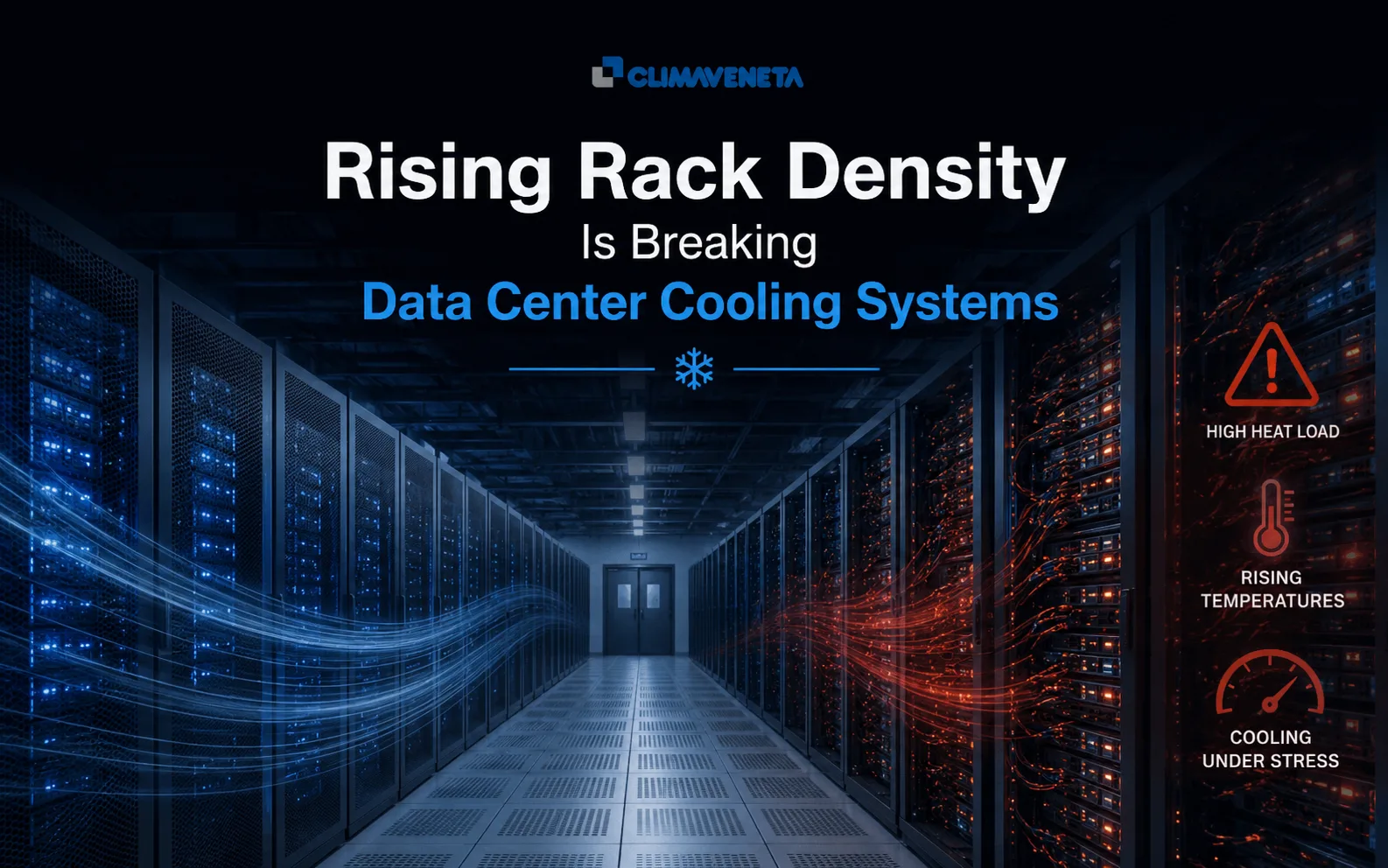
Today, the same rack footprint is expected to handle far more compute power than it was originally designed for. AI workloads, high-performance computing, and cloud expansion are pushing rack densities to levels that traditional data center cooling system were never built to manage.
And the result is starting to show; not as a complete failure, but as growing inefficiencies, hotspots, and rising operational costs.
What Changed: The Shift in Rack Density
Earlier data centers typically operated at 4–8 kW per rack.
Today, it’s not unusual to see:
- 15–25 kW racks in enterprise setups
- 30 kW and beyond in AI and hyperscale environments
The physical space hasn’t changed.
But the heat being generated within that space has increased dramatically.
This creates a fundamental imbalance:
more heat, but the same cooling approach.
Why Traditional Data Center Cooling Systems Struggle
Traditional data center cooling system—especially air-based setups—were designed around uniform, predictable heat loads.
Rising density breaks that assumption.
1. Air Has Its Limits
Air is not the most efficient medium for carrying heat. As density increases:
- More airflow is required
- Higher fan speeds increase energy consumption
- Cooling becomes uneven
At high densities, simply pushing more cold air is no longer enough.
2. Hotspots Become Inevitable
With uneven workloads across racks:
- Some racks generate significantly more heat
- Cooling distribution becomes inconsistent
Even if the overall room temperature looks controlled, localized overheating starts to occur.
3. Overcooling as a Safety Response
To avoid overheating, many facilities compensate by:
- Lowering overall temperature
- Increasing cooling output
This leads to:
- Wasted energy
- Higher operational costs
- Reduced system efficiency
Cooling the entire room more is often used to fix a localized problem.
4. Airflow Management Breaks Down
Traditional airflow strategies—like hot aisle and cold aisle containment—start losing effectiveness when:
- Rack density varies widely
- Layouts weren’t designed for high loads
- Air leakage and mixing occur
The system still runs, but not optimally.
The Business Impact
This isn’t just a technical issue—it directly affects operations.
Higher Energy Costs
A data center cooling system consumes more power trying to keep up with rising heat loads.
Reduced Equipment Lifespan
Consistent exposure to higher temperatures stresses servers and infrastructure.
Downtime Risk
If hotspots aren’t managed, systems may throttle or shut down.
Scalability Constraints
Adding more racks becomes difficult without redesigning the data center cooling system.
Why This Problem Is Growing, Not Slowing
The drivers behind rising rack density are only accelerating:
- AI and machine learning workloads
- Increased data processing demands
- Edge and hyperscale expansion
This means data center cooling systems are not just under pressure today—they will be under even more pressure tomorrow.
What Needs to Change in Cooling Strategy
Solving this isn’t about adding more cooling—it’s about changing how cooling is approached.
Move from Room Cooling to Targeted Cooling
Instead of cooling the entire space:
- Focus on high-density zones
- Use precision cooling where it’s needed most
Adopt Scalable Cooling Architectures
Data center cooling systems should grow with the data center:
- Modular designs
- Flexible deployment
- Load-based scaling
Improve Monitoring and Control
Real-time visibility is no longer optional:
- Track temperature at rack level
- Use predictive alerts
- Adjust cooling dynamically
Rethink Cooling Methods
At higher densities, alternatives become necessary:
- In-row cooling
- Liquid cooling for extreme loads
- Hybrid systems combining multiple approaches
The Shift That’s Already Happening
Forward-looking data centers are no longer asking:
“Do we have enough cooling?”
They are asking:
“Is our cooling aligned with our density?”
Because capacity alone is no longer the problem.
Distribution, efficiency, and adaptability are.
What Role Does a Precision Air Conditioner Play in Data Center Cooling?
1. Maintains Tight Temperature Control
Unlike comfort ACs, which allow temperature swings, PAC systems are designed to:
- Maintain consistent temperatures within a very narrow range
- Prevent fluctuations that can affect server performance
Why it matters:
Servers generate continuous heat. Even small variations can impact reliability and efficiency.
2. Controls Humidity (Often Overlooked but Critical)
Precision air conditioners regulate both:
- Temperature
- Humidity levels
Too much humidity: Risk of condensation and corrosion
Too little humidity: Risk of static electricity damaging components
This dual control is what standard AC systems cannot handle effectively.
3. Ensures Continuous, 24/7 Operation
Data centers don’t “switch off,” and neither can the cooling system.
PAC units are built for:
- Non-stop operation
- High reliability under constant load
- Redundancy integration for backup support
4. Manages Airflow Where It Matters
Precision AC systems are designed to:
- Deliver cooled air directly to server racks
- Support hot aisle and cold aisle configurations
- Maintain proper airflow distribution
This helps prevent:
- Hotspots
- Uneven cooling
- Energy waste
5. Handles High Sensible Heat Loads
Data centers generate mostly sensible heat (dry heat from equipment, not moisture).
PAC systems are optimized to:
- Remove maximum sensible heat efficiently
- Avoid unnecessary dehumidification cycles
Result: Better cooling efficiency and lower energy usage.
6. Works Alongside Larger Cooling Systems
A PAC is rarely standalone. It works as part of a larger system that may include:
- Chillers
- Cooling towers
- In-row cooling units
Think of it this way:
- Chillers generate cooling capacity
- Precision AC delivers it where it’s needed
7. Enables Monitoring and Control
Modern precision air conditioners come with:
- Real-time monitoring
- Alarm systems
- Integration with building management systems (BMS)
This allows operators to:
- Detect issues early
- Optimize performance
- Reduce downtime risk
Conclusion
Rising rack density isn’t a temporary trend; it’s a structural shift in how data centers operate.
Traditional data center cooling systems are not failing overnight.
But they are being pushed beyond the conditions they were designed for.
The real risk is not immediate breakdown; it’s gradual inefficiency, hidden hotspots, and increasing costs.
The data centers that stay ahead will be the ones that recognize this early and adapt; not by adding more cooling, but by rethinking it entirely.
This shift in cooling demand is exactly where advanced solutions from Climaveneta come into play; designed to handle high-density loads with precision, efficiency, and adaptability.