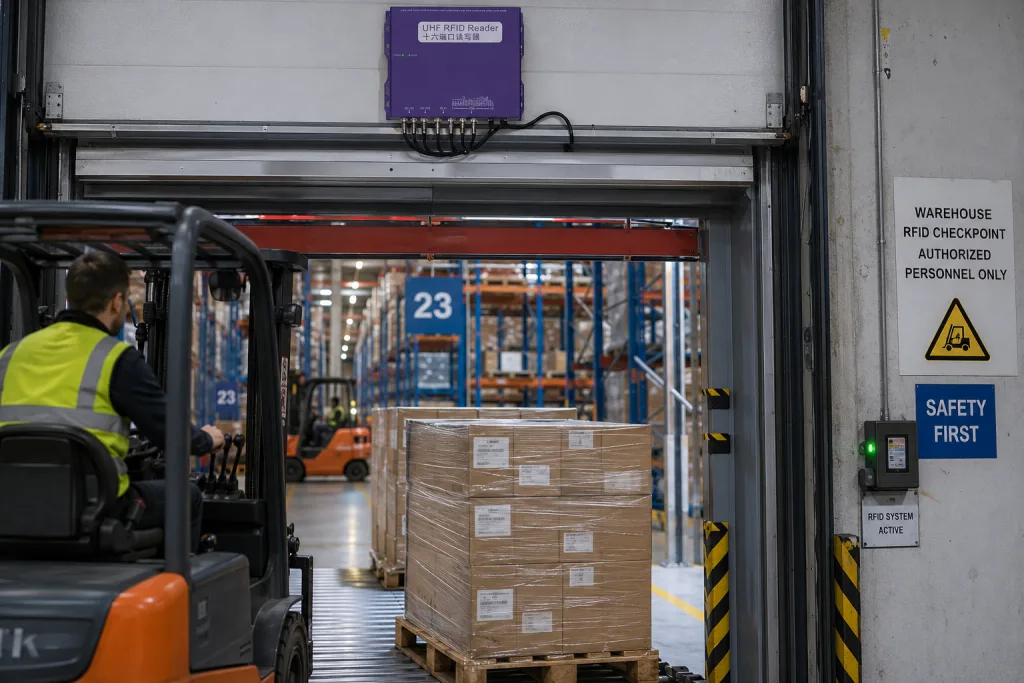
What is RFID tag location tracking and how does it work?
RFID tag location tracking uses RFID tags, readers, antennas, and management software to automatically identify and monitor the location of tagged assets without manual scanning. It enables real-time visibility, faster inventory, and more reliable asset management across warehouses, factories, healthcare, and enterprise facilities.
After more than ten years participating in RFID deployment projects for manufacturing plants, logistics centers, equipment management, and government facilities, one observation continues to repeat itself: organizations rarely lose assets because they disappear overnight. Most losses happen because nobody knows where the asset was last seen. RFID changes that by creating an automatic digital record every time a tagged item enters or leaves a monitored area.
Why RFID Tag Location Tracking Is Replacing Manual Asset Searches
Barcode systems work well for individual scans, but they depend on someone actively presenting every label to a scanner. RFID removes that limitation.
When an RFID-tagged asset passes within the reading zone of a fixed reader, identification happens automatically—even if dozens or hundreds of tagged items move simultaneously.
A typical RFID tag location tracking solution includes:
- UHF RFID tags
- Fixed RFID readers
- Circular or linear polarized antennas
- RFID middleware
- Enterprise management software
- Cloud-based reporting dashboard
- Real-time alerts
In practical deployments, the biggest improvement is not only speed. It is continuous visibility without interrupting daily operations.
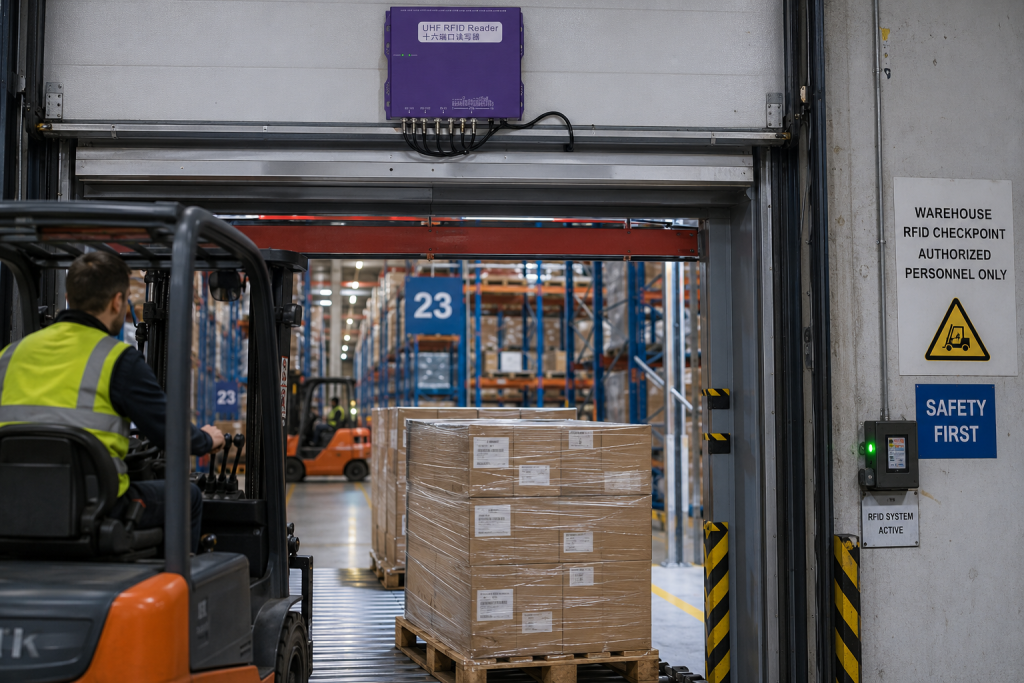
Fixed RFID readers automatically record asset movement without manual scanning.
RFID Asset Tracking System
How Location Tracking Actually Works
Each RFID tag contains a unique Electronic Product Code (EPC). As tagged assets move through reader coverage zones, the reader captures the EPC and sends the data to management software.
The software can immediately display:
- Current location
- Last detected checkpoint
- Movement history
- User interaction records
- Asset status
- Alarm events
- Inventory count
Unlike GPS, passive UHF RFID does not calculate an exact coordinate. Instead, it determines the asset’s location by identifying which reader or antenna detected the tag. For indoor environments, this approach is often more practical, lower in cost, and easier to maintain.
Real Time RFID Tracking
Performance in Daily Operations
Based on our deployment experience, RFID provides the greatest value in environments where assets move repeatedly through defined checkpoints.
Examples include:
- Manufacturing workstations
- Warehouse aisles
- Distribution centers
- Tool rooms
- Vehicle depots
- Hospitals
- Government facilities
- Rental equipment storage
Instead of assigning employees to perform routine searches, the system continuously updates movement records in the background.
One customer operating a regional warehouse previously spent nearly two hours each shift locating reusable transport containers. After RFID checkpoint deployment, supervisors simply reviewed the software dashboard to identify the last recorded location before dispatching staff. The change required very little user training because the tracking process happened automatically.
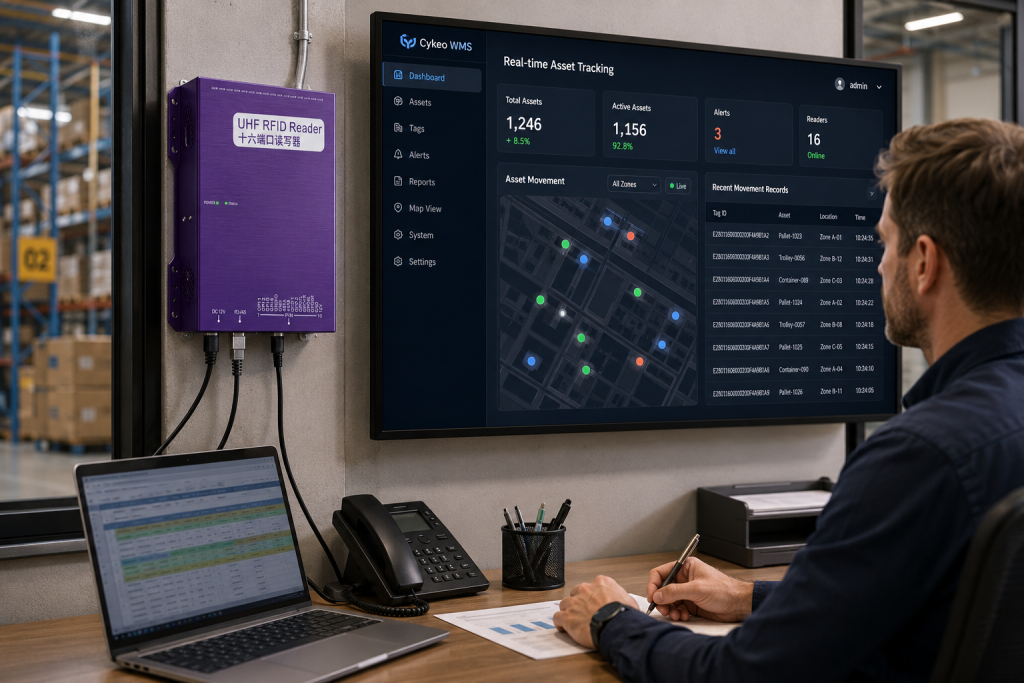
Management software visualizes real-time RFID tag movement throughout the warehouse.
Industry Statistics Supporting RFID Adoption
Independent industry data confirms the accelerating adoption of RFID technology.
According to the RAIN Alliance, global shipments exceeded 45 billion RAIN RFID tags in 2024, reflecting continued growth across logistics, retail, manufacturing, and healthcare.
Meanwhile, GS1 highlights RFID as a core technology for improving supply chain visibility and inventory accuracy through automatic identification and traceability.
Research published by Auburn University’s RFID Lab has also demonstrated measurable improvements in inventory visibility and operational efficiency through large-scale RFID implementations in distribution and retail environments.
These findings closely match what our engineering team observes during enterprise deployments: once asset movement is captured automatically, organizations spend less time searching and more time using the information to improve operations.
Comparison: Barcode vs RFID Tag Location Tracking
FeatureBarcodeRFID Tag Location TrackingLine-of-sight requiredYesNoMultiple items read simultaneouslyNoYesAutomatic identificationNoYesReal-time monitoringLimitedYesManual laborHighLowIndoor checkpoint trackingLimitedExcellentFrequently Asked Questions
Can RFID provide exact GPS coordinates?
No. Passive RFID identifies the reader zone where the tag is detected rather than calculating geographic coordinates. For indoor facilities, this zone-based approach is typically more accurate and practical than GPS.
How far can passive RFID tags be detected?
Depending on the reader, antenna gain, tag design, installation environment,and local regulations, passive UHF RFID systems commonly achieve read distances of several meters to more than 10 meters.
Can RFID track thousands of assets?
Yes. Enterprise RFID systems are designed to identify and manage thousands or even millions of uniquely tagged assets using centralized management software.
Which industries benefit most?
Warehousing, manufacturing, healthcare, transportation, utilities, government, construction, aviation, and equipment rental all benefit from RFID tag location tracking because they rely on fast, reliable asset visibility.
Final Thoughts
rfid tag location tracking is no longer limited to large automation projects. Modern UHF RFID technology enables organizations of every size to identify asset locations automatically, reduce manual searches, improve inventory accuracy, and create a complete movement history without disrupting existing workflows. At Cykeo, our field experience consistently shows that the real value of rfid tag location tracking is not simply finding assets faster—it is giving managers continuous, trustworthy visibility that supports better operational decisions every day.