
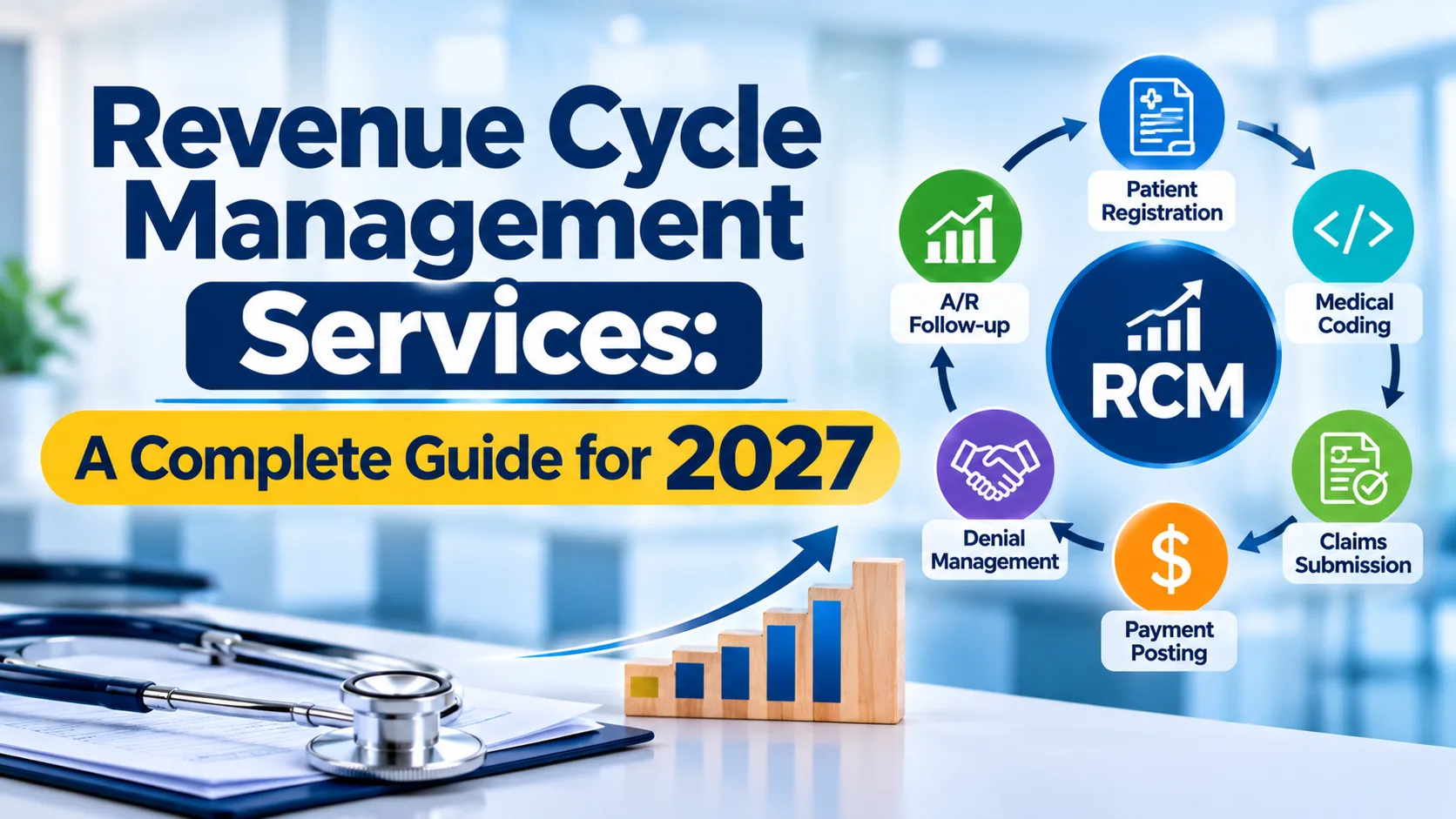
Revenue Cycle Management Services: A Complete Guide for 2027
Healthcare providers work hard to deliver quality patient care, but maintaining a financially healthy practice requires more than treating patients and submitting insurance claims. Every patient encounter involves administrative and financial activities, including appointment scheduling, insurance verification, medical documentation, coding, claim submission, payment posting, and follow-up.
When these activities are not properly coordinated, healthcare organizations may experience delayed reimbursements, claim denials, increasing accounts receivable, and unnecessary administrative expenses. Even a small mistake during patient registration or insurance verification can create problems that continue throughout the billing process.
This is where revenue cycle management services become important. They help healthcare providers organize the financial journey of a patient encounter, from the first appointment to the final payment. Instead of focusing only on claim submission, a complete revenue cycle approach connects front-office operations, clinical documentation, coding, billing, and collections.
For independent physicians, specialty practices, clinics, and hospitals, understanding how RCM works can help identify operational gaps and determine whether internal management or outsourcing is the better option.
This guide explains the revenue cycle process, the services included, pricing considerations, outsourcing benefits, important performance metrics, and how to select the right RCM partner in 2027.
What Is Revenue Cycle Management in Healthcare?
Revenue cycle management (RCM) is the process of managing the administrative and financial activities involved in receiving payment for healthcare services.
The process begins when a patient schedules an appointment or contacts a healthcare provider. It continues through registration, insurance verification, care delivery, documentation, coding, claim submission, payment processing, and collection of outstanding balances.
The goal is to ensure that every stage is handled accurately and that the provider receives appropriate reimbursement for the services delivered.
According to the Healthcare Financial Management Association (HFMA), the revenue cycle includes activities ranging from patient registration and verification of benefits to care delivery, claim submission, reimbursement, and final payment. It also involves communication with patients, insurance companies, and government payers.
In practical terms, RCM connects several departments that might otherwise operate separately.
For example, a registration error can lead to an eligibility issue. An eligibility issue can result in a claim denial. A denial creates additional follow-up work and delays payment. A connected revenue cycle process helps identify these problems earlier and assigns responsibility for resolving them.
What Services Are Included in Revenue Cycle Management?
The exact scope varies between providers. Some vendors handle selected billing responsibilities, while others offer support across most stages of the revenue cycle.
A complete service arrangement may include the following activities.
1. Patient Registration and Scheduling
The revenue cycle begins before a patient receives medical care.
During scheduling and registration, the practice collects information needed to identify the patient, confirm coverage, and prepare for the appointment.
Typical activities include:
- Appointment scheduling
- Patient demographic collection
- Contact information verification
- Insurance details collection
- Subscriber information review
- Referral information collection
- Registration record updates
Accurate patient information is essential because errors can affect eligibility checks and claim processing later.
For example, an incorrect member ID or date of birth may prevent a payer from matching a claim with the correct insurance policy.
2. Insurance Eligibility and Benefits Verification
Eligibility verification determines whether a patient's insurance coverage is active and helps the practice understand relevant benefit information.
The process may involve checking:
- Active insurance coverage
- Policy and member details
- Copayments
- Deductibles
- Coinsurance
- Specialist visit requirements
- Referral requirements
- Service-specific coverage limitations
- Prior authorization requirements
Verifying benefits before an appointment can help practices identify potential issues earlier.
It also gives staff an opportunity to communicate expected patient financial responsibilities before services are provided.
3. Prior Authorization and Referral Coordination
Some healthcare services require payer approval before treatment, testing, or procedures can take place.
If authorization requirements are not identified or completed correctly, the claim may face delays or denial.
Authorization support may involve:
- Identifying services that require approval
- Collecting supporting documentation
- Submitting authorization requests
- Monitoring request status
- Communicating payer decisions
- Recording authorization details
- Tracking approval periods and limitations
The practice should establish clear responsibilities for authorization requests, particularly when clinical documentation or provider input is required.
4. Charge Capture and Medical Documentation
Charge capture is the process of recording the services and procedures performed during a patient encounter.
Clinical documentation provides the information needed to support the services billed.
An effective workflow helps ensure that:
- Services performed are documented
- Required information is available
- Charges are captured accurately
- Missing documentation is identified
- Charges are reviewed before submission
Incomplete documentation or missed charges can affect reimbursement and create additional administrative work.
5. Medical Coding
Medical coding converts documented diagnoses, procedures, and services into standardized codes.
Common code sets include:
- ICD-10-CM for diagnosis coding
- CPT for procedures and professional services
- HCPCS Level II for certain supplies, equipment, and services
Coding must be supported by the medical record and follow applicable coding guidelines.
A revenue cycle workflow should connect coding with documentation review and charge capture. This helps identify discrepancies before claims are submitted.
Learn more about medical coding services.
6. Claim Preparation and Submission
Once the required information is available, the billing team prepares the claim for submission.
Claim preparation may involve reviewing:
- Patient demographics
- Insurance details
- Provider information
- Diagnosis and procedure codes
- Modifiers
- Place-of-service information
- Authorization details
- Payer-specific requirements
Claims may be reviewed through claim-scrubbing processes to identify common errors before submission.
After preparation, claims are transmitted electronically to the appropriate payer, often through a clearinghouse.
Timely and accurate submission helps reduce avoidable processing delays.
Explore medical claim submission services to learn more about this stage.
7. Payment Posting and Reconciliation
After a payer processes a claim, it provides payment and adjustment information.
The billing team records these transactions in the practice management system.
Payment posting may include:
- Insurance payments
- Contractual adjustments
- Patient responsibility
- Denied service lines
- Partial payments
- Refunds or credit balances
- Payment discrepancies
Electronic remittance advice (ERA) can provide information about how a payer processed a claim.
Accurate payment posting helps providers compare expected reimbursement with actual payments and identify balances that require further attention.
8. Denial Management and Appeals
A claim denial means the payer has not approved payment for all or part of the submitted service.
Denials may occur because of:
- Incorrect patient information
- Inactive insurance coverage
- Missing authorization
- Coding errors
- Incomplete documentation
- Duplicate claims
- Filing deadline issues
- Payer-specific billing requirements
Denial management involves reviewing the reason for nonpayment and determining the appropriate response.
A typical process includes identifying the denial, investigating the cause, correcting information when appropriate, submitting supporting documentation or an appeal when justified, and monitoring the outcome.
An effective process also reviews denial patterns. If the same problem keeps occurring, the practice should investigate the workflow that caused it.
For additional support, explore Stream RCM's denial management services.
9. Accounts Receivable Follow-Up
Accounts receivable (A/R) represents payments that remain outstanding.
A/R follow-up focuses on unpaid claims and balances that require additional action.
Billing teams may organize outstanding balances into aging categories:
A/R aging categoryMeaning0–30 daysRecently submitted or outstanding claims31–60 daysClaims requiring continued monitoring61–90 daysOlder balances that may need active follow-up91–120 daysHigher-priority outstanding accountsMore than 120 daysAged balances requiring careful reviewRegular follow-up helps practices identify older claims, investigate delays, and take appropriate action before applicable filing or appeal deadlines become an obstacle.
10. Patient Billing and Collections
After insurance processing, some balances may become the patient's responsibility.
Patient billing activities may include preparing statements, reviewing account balances, communicating payment responsibilities, and supporting payment follow-up.
A patient-friendly approach should provide clear information about balances and available payment options according to the practice's policies.
11. Financial Reporting and Performance Analysis
Reporting helps providers understand how effectively their revenue cycle is operating.
Useful reports may include:
- Claims submitted
- Claims accepted and rejected
- Payments posted
- Denial reasons
- Outstanding accounts receivable
- A/R aging
- Collection performance
- Payment delays
- Follow-up activity
These reports help management identify recurring problems and determine which areas need improvement.
The Three Main Stages of the Revenue Cycle
Healthcare revenue cycle operations are commonly divided into three connected stages: front-end, middle, and back-end activities.
Understanding these stages helps practices identify where problems begin and how they affect reimbursement.
Front-End Revenue Cycle
The front end covers activities that take place before or around the beginning of patient care.
It commonly includes:
- Appointment scheduling
- Patient registration
- Insurance verification
- Benefits review
- Referral coordination
- Prior authorization
- Financial clearance
- Patient financial communication
The purpose is to establish accurate patient and coverage information before services are provided.
For example, if the insurance policy is inactive, the practice can investigate the issue before submitting a claim that may later be denied.
Middle Revenue Cycle
The middle stage connects clinical services with the information needed for reimbursement.
It includes:
- Patient care documentation
- Charge capture
- Clinical documentation review
- Medical coding
- Charge reconciliation
- Documentation clarification when appropriate
This stage is important because claims must accurately represent the services documented in the medical record.
Back-End Revenue Cycle
The back end focuses on claim processing, reimbursement, and outstanding balances.
It includes:
- Claim submission
- Claim status monitoring
- Payment posting
- Denial management
- Appeals and corrected claims
- A/R follow-up
- Patient statements
- Collections
- Financial reporting
A problem in an earlier stage may appear as a denial or payment delay during the back end. That is why the three stages should be managed as one connected process.
Why Are Revenue Cycle Management Services Important?
A healthcare practice can provide excellent clinical care and still experience financial difficulties if its administrative workflows are not properly coordinated.
A structured revenue cycle helps providers monitor the activities that turn patient care into collected revenue.
1. More Accurate Financial Information
Accurate registration, coding, charge capture, and payment posting help maintain reliable financial records.
When information is incomplete or inconsistent, the practice may spend additional time correcting claims and reconciling balances.
2. Better Claim Management
A structured claim workflow helps ensure that claims are reviewed, submitted, and monitored consistently.
It also makes it easier to identify rejections and take corrective action.
3. Improved Denial Visibility
Denial reporting helps practices understand why claims are not being paid.
Rather than correcting each claim separately without reviewing trends, management can identify recurring issues and address their underlying causes.
4. More Consistent A/R Follow-Up
Outstanding claims require regular attention.
A defined follow-up process helps practices prioritize older balances, monitor payer responses, and reduce the risk of claims being overlooked.
5. Better Coordination Between Departments
The revenue cycle involves front-office employees, providers, coders, billers, and financial managers.
Clear workflows and responsibilities help these teams share information and resolve issues more efficiently.
6. Greater Visibility Into Practice Performance
Financial reports help management understand claim activity, collection trends, denial patterns, and outstanding balances.
This information can support operational planning and more informed decisions.
7. Reduced Administrative Pressure
Managing every revenue cycle activity internally can place pressure on a small team.
External support may help practices distribute responsibilities and maintain more consistent administrative coverage.
Benefits of Outsourcing Revenue Cycle Management
Healthcare providers can manage their revenue cycle internally, outsource selected functions, or work with an external partner for broader support.
Outsourcing may be useful when internal staffing, expertise, or administrative capacity is limited.
Access to Specialized Administrative Support
An external provider may offer access to staff familiar with coding coordination, claim processing, denial follow-up, and payer workflows.
The value depends on the vendor's actual experience and the services included in the agreement.
Flexible Service Arrangements
A practice does not necessarily need to outsource every activity.
It may keep scheduling and patient registration in-house while outsourcing coding, claim submission, payment posting, and A/R follow-up.
Other practices may prefer a broader arrangement.
More Consistent Follow-Up
A dedicated external team can establish routines for monitoring claims, reviewing denials, and following up on unpaid balances.
This can help practices address outstanding items more systematically.
Potentially Lower Internal Staffing Requirements
Maintaining an in-house revenue cycle team involves salaries, benefits, recruitment, training, supervision, and software expenses.
Outsourcing changes the cost structure by transferring agreed responsibilities to a vendor. However, the practice still needs oversight, communication, and internal coordination.
Support as the Practice Grows
As patient volume increases, administrative requirements may also grow.
An external arrangement may provide additional capacity, depending on the vendor's staffing model and contract.
How Much Do RCM Services Cost?
The cost of RCM support varies based on the size of the practice, specialty, claim volume, service scope, and complexity of the workflow.
There is no single price that applies to every healthcare provider.
Common pricing structures include the following.
1. Percentage of Collections
Under this model, the vendor charges an agreed percentage of the revenue collected by the practice.
For example, if a practice collects $60,000 in a month and the agreed fee is 5%, the service fee would be $3,000.
This is an illustrative calculation, not a standard industry rate.
The agreement should explain which collections are included, how refunds and adjustments are treated, and whether patient payments are included.
2. Per-Claim Pricing
Some vendors charge a fixed amount for each claim processed.
This model may be suitable for practices with predictable claim volumes.
However, providers should confirm whether denial follow-up, payment posting, and A/R management are included or billed separately.
3. Flat Monthly Fee
A fixed monthly fee provides a predictable service expense.
The agreement should define the number of providers, locations, claims, or activities included. Additional charges may apply when the practice exceeds the agreed scope.
4. Hybrid Pricing
A hybrid model combines two or more pricing structures, such as a monthly base fee plus a percentage of collections or additional charges for specialized services.
This may be useful for practices that need a customized service arrangement.
What Affects the Cost?
Pricing factorPotential impactPractice sizeMore providers may increase workloadClaim volumeHigher volumes may require additional resourcesSpecialtyComplex billing workflows may require specialized knowledgeService scopeBroader support involves more activitiesDenial volumeExtensive denial work may increase service requirementsA/R conditionOlder outstanding balances may require additional investigationTechnologyIntegration and system requirements may affect onboardingBefore signing a contract, request a detailed breakdown of included services, additional fees, setup costs, reporting, and termination terms.
How to Choose the Right Revenue Cycle Management Company
Selecting an external partner requires careful evaluation. The vendor may handle financial information, interact with payers, and access protected health information.
Use these criteria when comparing providers.
1. Review Specialty Experience
Different specialties have different coding, documentation, and payer requirements.
Ask whether the vendor has experience with practices similar to yours.
For example, primary care, behavioral health, cardiology, orthopedics, and gastroenterology may have different administrative workflows.
2. Confirm the Service Scope
Ask exactly which activities the vendor will perform.
Confirm whether the agreement includes:
- Patient registration support
- Eligibility verification
- Prior authorization
- Charge capture
- Medical coding
- Claim submission
- Payment posting
- Denial management
- A/R follow-up
- Patient billing
- Financial reporting
Do not assume every activity is included simply because a vendor describes its offering as end-to-end RCM.
3. Evaluate Reporting Capabilities
Request sample reports and ask how frequently they are delivered.
Reports should help you understand claim activity, denial trends, payment posting, outstanding balances, and collection performance.
4. Check Technology Compatibility
Discuss how the vendor will work with your existing EHR and practice management systems.
Confirm integration capabilities, user permissions, data transfer, reporting access, and technical support.
5. Review Security and HIPAA Responsibilities
Revenue cycle vendors may access protected health information while performing services for a healthcare provider.
Practices should review the vendor's security safeguards, access controls, incident response procedures, subcontractor arrangements, and business associate agreement where applicable.
The U.S. Department of Health and Human Services provides official information on HIPAA business associates and the HIPAA Security Rule.
6. Understand Communication and Accountability
Ask who will manage your account, how issues will be escalated, and how frequently the vendor will provide updates.
The agreement should clearly define which responsibilities belong to the practice and which belong to the vendor.
7. Compare Pricing and Contract Terms
Review the complete fee structure rather than focusing only on the advertised rate.
Confirm contract duration, additional charges, termination procedures, data access, reporting expectations, and how outstanding claims will be handled if the relationship ends.
What Makes the Best Revenue Cycle Management Companies?
The best partner is not necessarily the largest vendor or the one with the lowest advertised fee.
A suitable provider should match the practice's specialty, workflow, budget, technology, and operational requirements.
When comparing providers, consider these factors:
- Relevant experience: Familiarity with your specialty and payer workflows.
- Clear service scope: Written details of included and excluded activities.
- Transparent pricing: Fees and additional charges explained in advance.
- Consistent communication: Defined account contacts and escalation procedures.
- Useful reporting: Regular, understandable financial and operational reports.
- Technology compatibility: Ability to work with the practice's existing systems.
- Security practices: Appropriate safeguards for sensitive patient information.
- Scalability: Capacity to support changes in practice volume when agreed.
Ask potential vendors for references, sample reports, onboarding details, and a written proposal.
A comparison based on consistent criteria is more useful than relying solely on promotional rankings.
Key Metrics to Measure RCM Performance
After implementing an RCM process or outsourcing services, practices should monitor performance using clearly defined metrics.
The following indicators can help evaluate different stages of the revenue cycle.
MetricWhat it measuresWhy it mattersFirst-pass acceptance rateClaims accepted on initial submissionHelps evaluate initial claim qualityClean claim rateClaims meeting the agreed clean-claim definitionHelps identify submission errorsDenial rateClaims denied by payersHighlights reimbursement problemsDays in A/RAverage time outstanding receivables remain unpaidHelps monitor collection speedA/R agingOutstanding balances grouped by ageIdentifies older claims requiring attentionNet collection rateCollections compared with expected collectible reimbursementHelps assess collection performanceCharge lagTime between service delivery and charge entryHighlights delays in charge capturePayment posting turnaroundTime between receiving payment and recording itHelps assess posting efficiencyAuthorization-related denialsDenials associated with authorization issuesHighlights front-end workflow problemsThese metrics should be interpreted together.
For example, a high first-pass acceptance rate does not automatically mean that every claim is paid promptly. Providers should also review denial trends, payer response times, A/R aging, and collection results.
Agree on metric definitions and reporting schedules with your RCM partner before the engagement begins.
Common Revenue Cycle Management Challenges in 2027
Healthcare organizations continue to face operational challenges that can affect reimbursement and administrative efficiency.
Changing Payer Requirements
Insurance companies may update coverage policies, coding requirements, authorization procedures, and claim submission rules.
Practices need a process for monitoring relevant changes and communicating them to the appropriate staff.
Incomplete Documentation
Claims depend on the information recorded in the medical record.
If documentation does not support the services billed, claims may require correction, additional information, or further review.
Eligibility and Authorization Issues
Incorrect insurance information and missing approvals can create avoidable claim problems.
Practices should establish clear procedures for checking coverage and identifying authorization requirements before services are provided.
Increasing Denial Workloads
When denials are not reviewed consistently, unresolved claims can accumulate.
Tracking denial reasons and investigating recurring problems helps practices address issues at their source.
Aging Accounts Receivable
Outstanding balances may remain unpaid because of payer delays, missing information, or incomplete follow-up.
Regular A/R reviews help identify which claims need attention.
Patient Financial Communication
Patients may have questions about deductibles, copayments, coinsurance, and outstanding balances.
Clear communication and accurate statements help support a better financial experience.
Data Security and Vendor Oversight
External support does not remove the need for appropriate vendor oversight.
Healthcare providers should review system access, security safeguards, contractual responsibilities, and the handling of patient information.
Why Consider Stream RCM for Revenue Cycle Support?
Stream RCM provides medical billing and revenue cycle support designed to help healthcare providers manage important administrative and reimbursement activities.
Its service areas cover several stages of the revenue cycle, allowing practices to explore support based on their operational requirements.
Medical Billing Services
Stream RCM supports billing workflows involving claim preparation, submission, payment posting, and follow-up.
Learn more about medical billing services.
Medical Coding Services
Accurate coding helps connect clinical documentation with the information required for claim processing.
Explore medical coding services.
Denial Management Services
Denied claims need review, correction, and follow-up. Stream RCM provides denial management services to help practices address claim issues.
Medical Claim Submission Services
Claims should be prepared and submitted according to applicable payer requirements and filing deadlines.
Learn more about medical claim submission services.
Insurance Eligibility Verification
Verifying coverage and benefits before services are provided can help practices identify potential insurance issues earlier.
Explore insurance eligibility verification services.
Prior Authorization Services
Some healthcare services require payer approval before they are provided. Stream RCM also offers prior authorization services.
Revenue Cycle Management Services
Practices looking for broader administrative support can explore Stream RCM's revenue cycle management services.
The right service arrangement depends on your specialty, claim volume, existing workflow, and administrative challenges. Providers should discuss their requirements with Stream RCM and confirm the exact scope, pricing, responsibilities, and reporting arrangements before beginning.
How to Transition to an Outsourced RCM Provider
Moving revenue cycle responsibilities to an external partner requires planning. A structured transition can help maintain continuity and reduce confusion.
Step 1: Review Your Current Process
Evaluate scheduling, registration, eligibility verification, authorization, coding, claim submission, payment posting, denial management, and A/R follow-up.
Identify where delays, errors, or backlogs occur.
Step 2: Identify Your Main Operational Needs
Determine whether your practice needs help with selected billing activities or broader revenue cycle support.
Prioritize the services that address your most important challenges.
Step 3: Select the Required Service Scope
Decide which activities should remain in-house and which should be outsourced.
For example, a practice may keep patient registration and clinical documentation internally while outsourcing coding, claim submission, denial management, and A/R follow-up.
Step 4: Review Technology and Data Access
Discuss EHR and practice management system compatibility, user permissions, reporting, data transfer, and security requirements.
Step 5: Define Responsibilities
Document which tasks belong to the practice and which belong to the vendor.
Clarify who handles missing documentation, authorization questions, claim corrections, patient inquiries, and payer escalations.
Step 6: Agree on Performance Reporting
Establish the metrics that will be monitored and how frequently reports will be delivered.
Regular reviews help both parties identify problems and assess progress.
Step 7: Monitor the Initial Period
During onboarding, review claims, payments, denials, A/R, and communication.
Use the results to identify workflow gaps and make necessary adjustments.
Frequently Asked Questions About Revenue Cycle Management
1. What are revenue cycle management services?
They are administrative and financial services that help healthcare providers manage the process of receiving payment for patient care. They may include registration, eligibility verification, authorization, coding, claim submission, payment posting, denial management, A/R follow-up, and patient billing.
2. What is the main goal of RCM?
The main goal is to manage the financial process from the initial patient encounter through final payment. An organized process helps providers monitor claims, address payment issues, and maintain visibility into outstanding balances.
3. What are the three stages of the revenue cycle?
The three commonly used stages are front-end, middle, and back-end. Front-end activities include registration and eligibility verification. Middle-stage activities include documentation, charge capture, and coding. Back-end activities include claim submission, payment posting, denials, and collections.
4. How much do RCM services cost?
Pricing depends on practice size, claim volume, specialty, and service scope. Common models include percentage-of-collections fees, per-claim pricing, flat monthly fees, and hybrid arrangements. Providers should request a customized quote.
5. Is outsourcing revenue cycle management suitable for small practices?
Yes. Small practices may outsource selected tasks or a larger portion of their revenue cycle when internal staffing or expertise is limited. The best arrangement depends on the practice's workload, budget, and operational needs.
6. What is the difference between medical billing and RCM?
Medical billing focuses mainly on claim preparation, submission, payment posting, and follow-up. RCM covers a broader process that also includes scheduling, registration, eligibility verification, authorization, documentation, coding, and patient financial activities.
7. How do I choose a revenue cycle management company?
Evaluate specialty experience, service scope, pricing, technology compatibility, reporting, communication, security practices, references, and contract terms. Confirm exactly which services are included before signing an agreement.
8. What KPIs should healthcare providers monitor?
Common metrics include first-pass acceptance rate, clean claim rate, denial rate, days in A/R, A/R aging, net collection rate, charge lag, and payment posting turnaround. Definitions should remain consistent when comparing performance over time.
9. Can an RCM provider work with an existing EHR?
Many providers can work with existing EHR and practice management systems, but compatibility depends on the software and vendor capabilities. Confirm integration, user permissions, reporting, and data transfer arrangements before onboarding.
10. Does revenue cycle management include denial management?
Denial management is commonly included in broader RCM arrangements, but service scope varies. Practices should confirm whether the vendor handles denial analysis, corrections, appeals, resubmissions, and follow-up.
Final Thoughts
Managing the financial side of healthcare requires coordination across several administrative and clinical activities. Patient registration, insurance verification, documentation, coding, claim submission, payment posting, and denial follow-up all contribute to whether a practice receives appropriate reimbursement.
A connected revenue cycle helps providers identify problems earlier, monitor outstanding claims, and understand how administrative processes affect financial performance.
For practices evaluating outsourcing, the most important step is to identify their actual operational needs. Some may require support with billing and A/R, while others may benefit from a broader arrangement that includes eligibility verification, authorization, coding, and denial management.
Stream RCM offers medical billing, coding, claim submission, denial management, eligibility verification, prior authorization, and revenue cycle management support.
If your practice wants to review its current workflow or explore external support, visit Stream RCM to learn more and discuss your requirements.